One of the most sobering moments during the PCCP c.a.N.I.S. 2026 Post Graduate Scientific Conference in Baguio City did not involve a complicated surgery.
It was not about cancer.
It was not about cardiology.
It was not about the latest advances in veterinary medicine.
It was about a vaccine.
An expired vaccine.
And a veterinarian who lost the right to practice for one year because of it.
The lecture was delivered by Dr. Tomas M. Acorda of the Professional Regulatory Board of Veterinary Medicine. As he discussed actual decided cases before the Board, the room became noticeably quieter.
Because every veterinarian in the audience realized one thing:
This could happen to anyone.
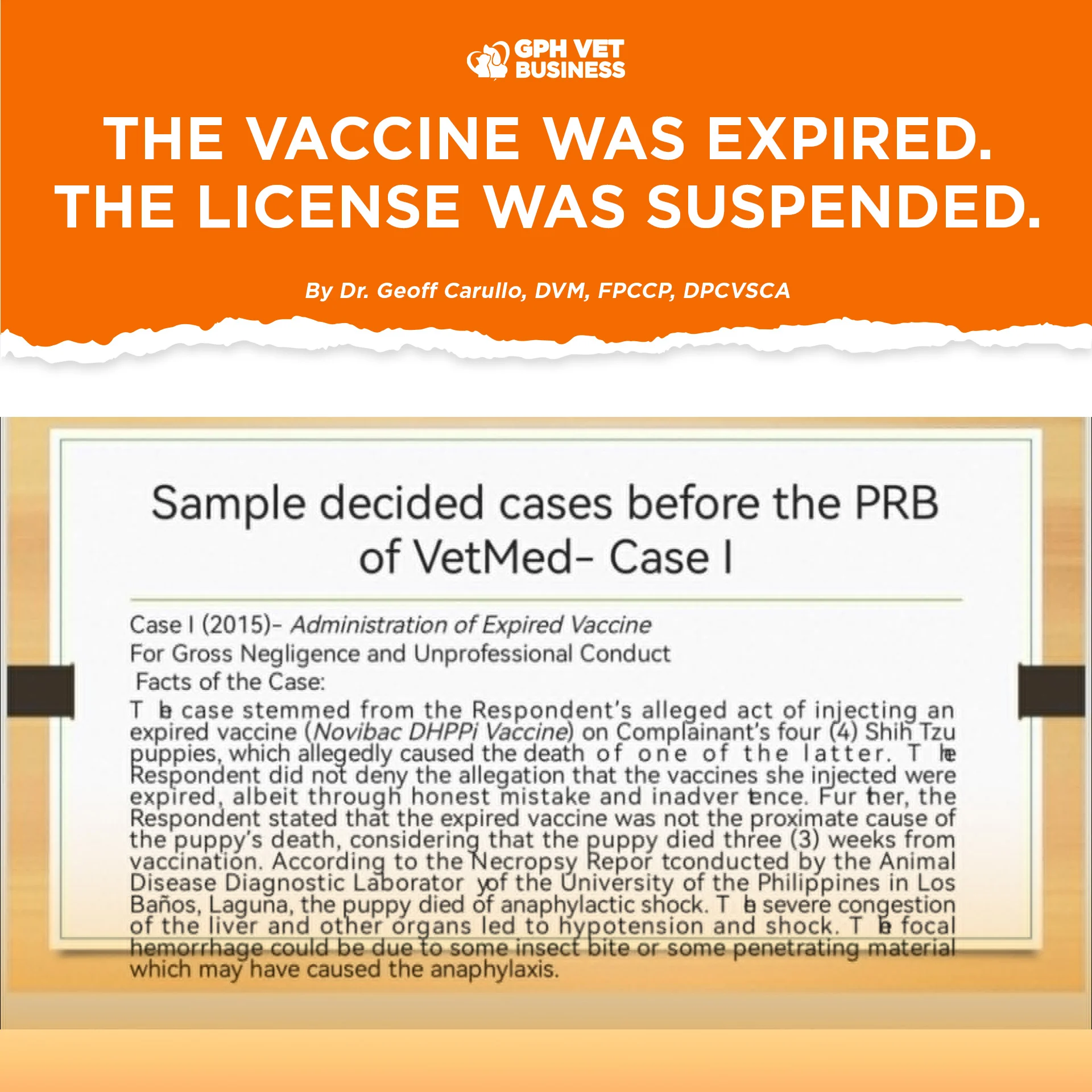
The case involved four Shih Tzu puppies that received an expired vaccine.
The veterinarian admitted that the vaccine administered was expired. However, the veterinarian argued that it was an honest mistake and that the expired vaccine was not proven to be the direct cause of the puppy’s death.
In fact, according to the necropsy findings presented during the lecture, the puppy reportedly died from anaphylactic shock several weeks after vaccination. There were discussions that other factors may have contributed to the death.
From a purely medical standpoint, one might argue that causation was not conclusively established.
But the Board was asking a different question.
A much more important question.
Did the veterinarian exercise the degree of care expected from a professional?
The answer was no.
The Board ruled that administering an expired vaccine constituted gross negligence.
Why?
Because the veterinarian failed to perform one of the most basic responsibilities expected in clinical practice.
Checking the expiration date.
That single omission was enough.
Not because the veterinarian intended harm.
Not because the veterinarian was incompetent.
But because the veterinarian failed to exercise due diligence.
The Board ultimately found the respondent guilty of gross negligence and imposed a one-year suspension from the practice of veterinary medicine.
Think about that.
A one-year suspension.
Not because of a complicated medical error.
Not because of an advanced surgical complication.
Not because of an obscure disease process.
But because somebody failed to look at a date printed on a label.
That lesson should disturb every veterinarian.
Because many of us assume that disciplinary cases happen only to reckless practitioners.
The reality is different.
Most professional disasters begin as ordinary oversights.
- A missed expiration date.
- An unsigned consent form.
- An incomplete medical record.
- A forgotten follow-up.
- A laboratory result that nobody reviewed.
- A drug dosage that nobody double-checked.
Small things.
Routine things.
Things that seem harmless until they become the center of an administrative complaint.


The truth is that veterinary medicine is not judged solely by outcomes.
It is judged by process.
Clients often focus on outcomes.
Regulatory boards focus on professional conduct.
A patient can survive and a veterinarian may still be found negligent.
A patient can die and a veterinarian may still be cleared of wrongdoing.
The difference is often found in documentation, diligence, and adherence to professional standards.
That is why great veterinarians do not rely on memory.
They rely on systems.
- Systems check expiration dates.
- Systems verify drug dosages.
- Systems track inventory.
- Systems ensure that medical records are complete.
- Systems protect patients.
- And when things go wrong, systems protect veterinarians.
The lecture by Dr. Tom Acorda was more than a discussion of a legal case.
It was a reminder that every license hangs on the small things we do every day.
The public trusts veterinarians with lives.
Not only the lives of animals.
But also the trust of families who consider those animals as members of their household.
That trust demands competence.
But more importantly, it demands consistency.
The expired vaccine case teaches a simple but powerful lesson:
Professional excellence is rarely destroyed by one catastrophic mistake.
More often, it is destroyed by small acts of negligence repeated over time.

Before you vaccinate your next patient, pause.
Before you administer your next medication, pause.
Before you sign your next medical record, pause.
Check again.
Because sometimes the difference between an ordinary workday and a one-year suspension is nothing more than a date printed on a label.
Sources
Professional Regulation Commission (PRC). Oathtaking of the Newly Appointed Members of the Professional Regulatory Board of Veterinary Medicine (PRB-VETMED), April 17, 2024.
Professional Regulation Commission (PRC). October 2025 Veterinarians Computer-Based Licensure Examination Results Released.
PCCP c.a.N.I.S. 2026 Post Graduate Scientific Conference, Lecture on Decided Cases Before the Professional Regulatory Board of Veterinary Medicine delivered by Dr. Tomas M. Acorda.
Professional Regulatory Board of Veterinary Medicine administrative case materials presented during PCCP c.a.N.I.S. 2026.
Dr. Geoff Carullo is a Fellow and the current President of the Philippine College of Canine Practitioners.
Sharing this helps others understand what it really means to be a vet. Like and follow if you’re with us.