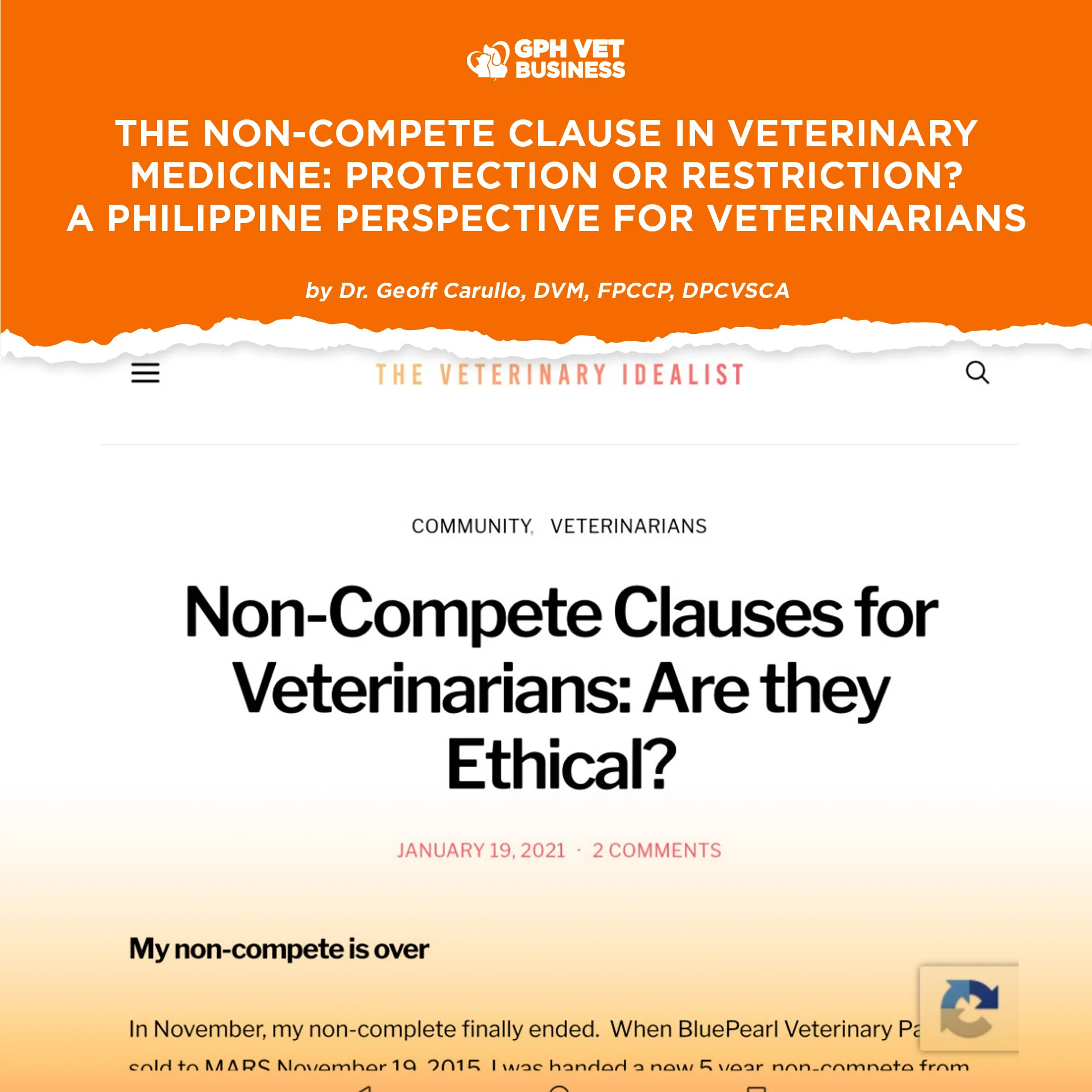
One of the most controversial clauses in veterinary employment contracts is the non-compete agreement. It is often misunderstood, emotionally debated, and sometimes viewed as either a necessary business protection or an unfair restriction on a veterinarian’s career.
So where should Philippine veterinarians stand?


What is a non-compete clause?
A non-compete clause is a contractual provision that prevents an employee from opening, joining, or working for a competing veterinary clinic within a specific geographic area and for a specified period after leaving employment.
For example:
- No practice within a 5-kilometer radius for one year.
- No employment with competing clinics in the same city for two years.
These clauses are increasingly appearing in veterinary employment contracts in the Philippines.
Why do clinic owners include them?
Building a veterinary clinic requires years of investment.
Owners spend money on:
- Training associates
- Marketing
- Building goodwill
- Developing loyal clients
- Purchasing expensive diagnostic equipment
Many fear that after investing heavily in a veterinarian, that employee may resign and establish a competing clinic nearby while serving the very clients introduced during employment.
From a business standpoint, this concern is understandable.


Why do veterinarians oppose them?
Young veterinarians often argue that non-compete clauses limit their ability to earn a living.
Unlike many professions, veterinary jobs may be limited in certain provinces or cities. A broad restriction could force someone to relocate, travel long distances, or temporarily leave clinical practice altogether.
Many also feel that patients should be free to choose their veterinarian rather than have contracts indirectly influence where care is available.
What does Philippine law say?
Philippine law does not automatically prohibit non-compete agreements.
Courts have generally recognized that they may be enforceable provided they are reasonable.
Factors that courts typically consider include:
- Duration of the restriction
- Geographic coverage
- Nature of the work prohibited
- Whether the restriction reasonably protects legitimate business interests
- Whether it unfairly deprives a person of the ability to earn a living
An overly broad clause, such as prohibiting veterinary practice anywhere in the Philippines for five years, would likely face significant legal challenges.
On the other hand, a narrowly tailored restriction that protects legitimate business interests is more likely to be viewed as reasonable.
Ethics versus legality
Something can be legal but still raise ethical questions.
The veterinary profession depends on mentorship, collaboration, and professional growth.
Some believe restrictive contracts discourage young veterinarians.
Others argue that without protection, clinic owners become hesitant to invest in training new graduates.
The challenge is finding a balance.

A practical middle ground
Instead of asking whether non-compete clauses are good or bad, perhaps we should ask:
Is this particular clause fair to both parties?
A reasonable agreement should protect the clinic without preventing a veterinarian from building a career.
Likewise, associates should recognize that client relationships, business systems, and goodwill are valuable assets developed through years of investment.
Final thoughts
Employment contracts should never rely on assumptions or verbal promises.
Read every clause carefully before signing. If a provision seems unclear or unreasonable, discuss it before accepting the position. Open communication at the beginning of employment is far better than legal disputes after resignation.
The goal should not be to create winners and losers, but to build professional relationships founded on fairness, transparency, and mutual respect.
Sources
- Civil Code of the Philippines (principles on contracts)
- Philippine Supreme Court jurisprudence on restraint of trade, including Ferrazzini v. Gsell (G.R. No. L-10712, August 10, 1916) and Rivera v. Solidbank Corporation (G.R. No. 163269, April 19, 2006)
- The Veterinary Idealist. Non-Compete Clauses for Veterinarians: Are They Ethical? (January 19, 2021)
Dr. Geoff Carullo is a Fellow and the current President of the Philippine College of Canine Practitioners.
Sharing this helps others understand what it really means to be a vet. Like and follow if you’re with us.