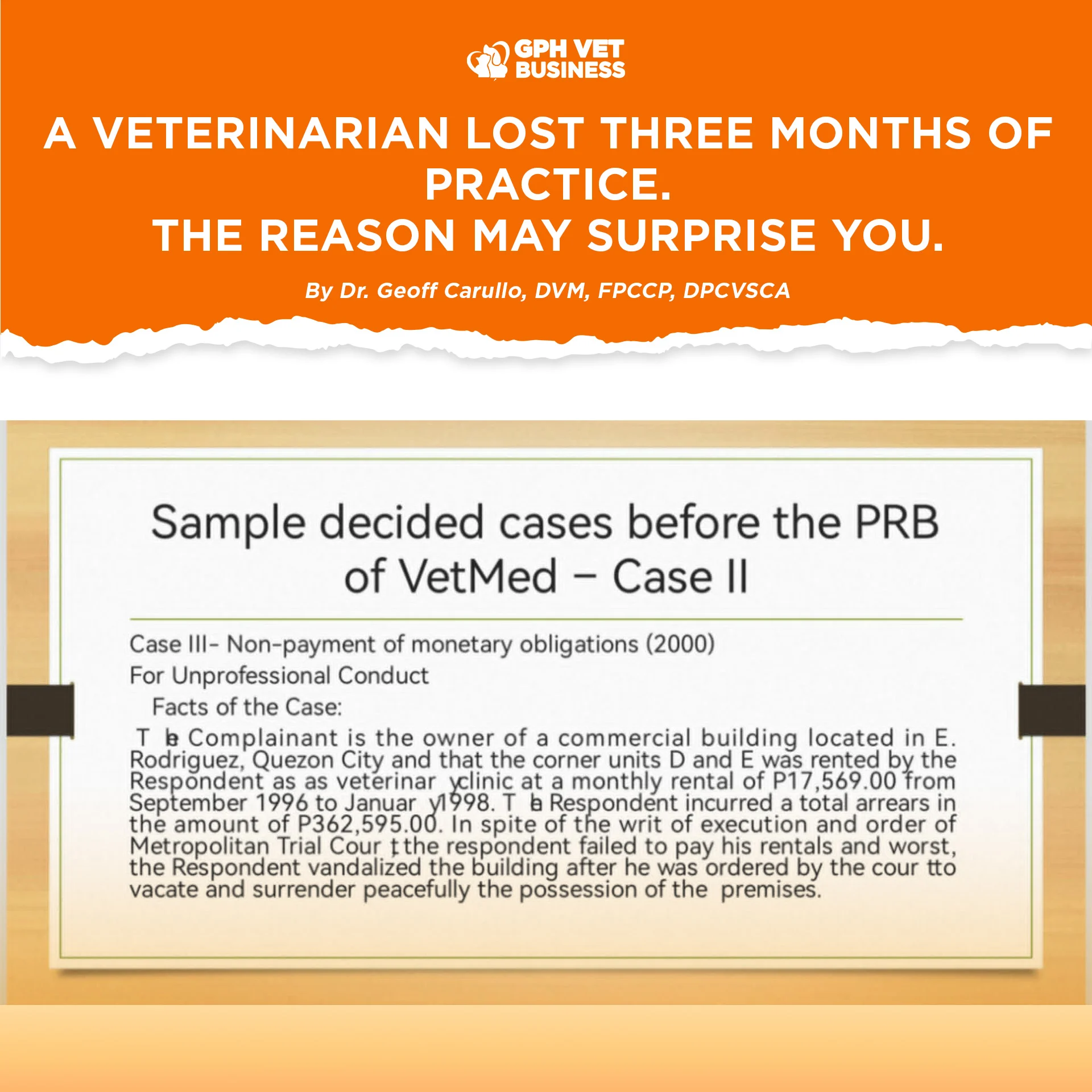
One of the cases discussed by Dr. Tom Acorda during the PCCP c.a.N.I.S. 2026 Post Graduate Scientific Conference involved a veterinarian who was disciplined not because of a medical mistake, but because of actions that occurred outside clinical practice.
The veterinarian leased a commercial space for a veterinary clinic. Over time, rental obligations accumulated to more than ₱362,000. Despite court orders and a writ of execution, the obligations remained unpaid. According to the case records presented, the situation escalated further when the property was allegedly vandalized after the respondent was ordered to vacate the premises.
The matter eventually reached the Professional Regulatory Board of Veterinary Medicine.
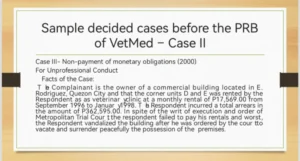
The issue was straightforward:
Was the veterinarian guilty of dishonorable conduct?
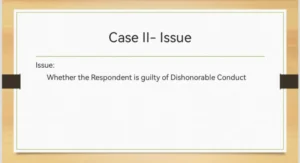
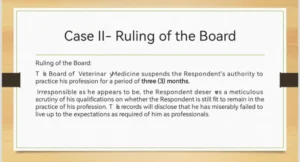
The Board ruled in the affirmative.
The penalty was a three-month suspension from the practice of veterinary medicine.
At first glance, some may wonder what unpaid rent has to do with veterinary medicine.


The answer is simple.
A veterinary license does not merely certify clinical competence.
It also reflects the trust that society places in a professional.
More Than Medical Knowledge
Many veterinarians spend years mastering anatomy, pathology, surgery, pharmacology, and medicine.
Those skills are essential.
But professionalism extends beyond technical expertise.
- How we honor commitments.
- How we manage our obligations.
- How we deal with conflict.
- How we conduct ourselves when things do not go our way.
These are also reflections of professionalism.
The public does not separate the veterinarian from the person.
Neither do regulatory bodies when conduct raises questions about integrity and fitness to practice.
A Profession Built on Trust
Veterinary medicine is unique because trust is at the center of everything we do.
- Clients trust us with their animals.
- Employees trust us as leaders.
- Business partners trust us with agreements.
- Society trusts us with a professional license.
That trust is difficult to earn and easy to lose.
For this reason, regulatory boards often look beyond clinical performance when evaluating whether a professional has lived up to the standards expected of the profession.
The Bigger Lesson
This case was never really about rent.
It was about accountability.
It was about the realization that our actions outside the consultation room can sometimes carry consequences inside it.
Professionalism is not something we switch on when we wear a white coat and switch off when we go home.
It follows us into our businesses.

Our contracts.
Our obligations.
And our daily decisions.
Because in the end, being a veterinarian is not only about what we know.
It is also about how we conduct ourselves when no patient is on the examination table.
That is the standard the profession expects.
And that is the standard worth protecting.
Sources
- Acorda, T. (2026). Decided Cases of the Professional Regulatory Board of Veterinary Medicine. Lecture presented during the PCCP Companion Animal National Integrated Symposium (c.a.N.I.S. 2026), Baguio City, Philippines.
- Professional Regulatory Board of Veterinary Medicine. Administrative disciplinary case involving dishonorable conduct arising from non-payment of rental obligations and related acts, as presented during the c.a.N.I.S. 2026 lecture.
- Republic Act No. 9268, The Veterinary Medicine Act of 2004.
- Code of Ethics for Veterinarians, Professional Regulatory Board of Veterinary Medicine.
Dr. Geoff Carullo is a Fellow and the current President of the Philippine College of Canine Practitioners.
Sharing this helps others understand what it really means to be a vet. Like and follow if you’re with us.