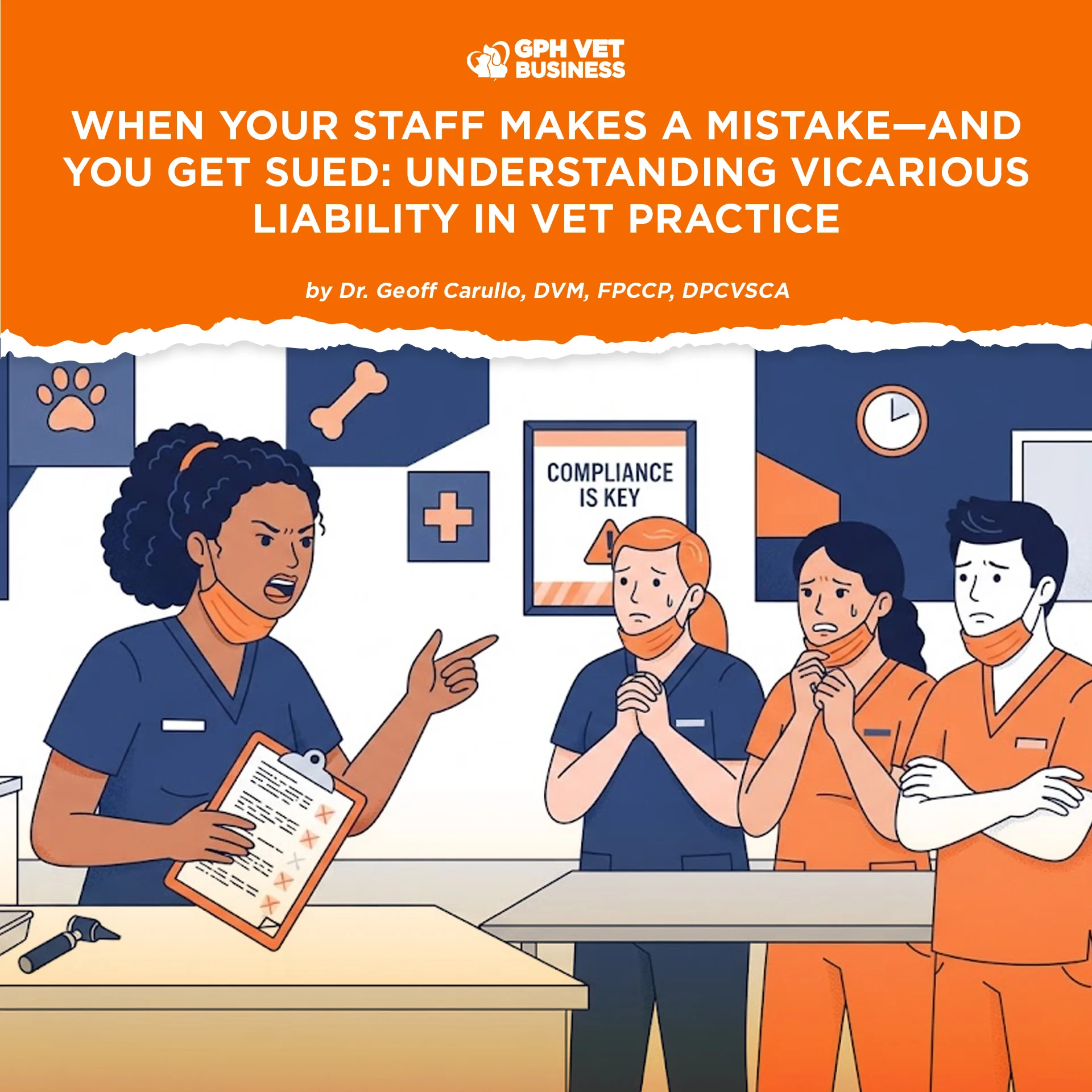
You own the clinic.
You weren’t on duty.
But the vet gave the wrong injection.
Or your associate vet performed surgery without proper consent.
Now the client is threatening to sue you—not just the one who made the mistake.
How is that fair?
Welcome to the world of vicarious liability.
What Is Vicarious Liability?
Vicarious liability is a legal doctrine where a person or entity (usually an employer) is held responsible for the acts or omissions of another person (usually an employee) — even if the employer didn’t directly cause the harm.
In short:
You can be held liable for your team’s actions.
It’s a principle rooted in Article 2180 of the Civil Code of the Philippines, which clearly states:
“The obligation imposed by Article 2176 is demandable not only for one’s own acts or omissions, but also for those of persons for whom one is responsible.”
And yes—this applies to veterinary practice.


How It Affects Vet Clinic Owners
If you’re the owner of a veterinary clinic, you can be held vicariously liable for:
- Misdiagnosis by your associate veterinarian
- Negligence by a vet tech (e.g., wrong drug, wrong patient)
- Unprofessional behavior by front desk staff
- Unauthorized procedures performed under your roof
- Loss or injury of a patient while under clinic care
Even if you weren’t the one holding the syringe, the scalpel, or the phone—you are still accountable because it happened under your business’s authority.
Real-World Scenarios for Vets
- A new hire euthanizes a pet without written consent
- A receptionist releases the wrong dog to the wrong owner
- A vet fails to inform the owner about removing an organ
- A kennel staff forgets to administer critical medication
If the client sues, you as the employer may be liable—civilly, professionally, and financially.


How to Protect Yourself
Being a clinic owner means leading medically and legally. Here’s how you can protect your practice:
- Establish SOPs (Standard Operating Procedures) for all common tasks—especially high-risk ones like consent, euthanasia, surgery, and medication.
- Train your staff well—then document that you did.
- Clearly define job roles and scope of authority.
- Require written consent for all invasive or high-risk procedures.
- Supervise associate vets and interns, especially on difficult cases.
- Get professional liability insurance. It’s your safety net.
- Keep complete and clear medical records—they are your defense if something goes wrong.
Final Thoughts
Being a vet is hard enough.
Being the owner of a vet clinic? That’s another level.
You’re not just responsible for what you do—you’re accountable for what everyone under your roof does.
That’s vicarious liability.
It’s not just legal theory—it’s a real-world risk every vet-entrepreneur must understand.
So be proactive. Train your people. Document your process. Lead with vigilance.
Because when your team fails, the fallout lands on you.

Dr. Geoff Carullo is a Fellow and the current President of the Philippine College of Canine Practitioners.
Sharing this helps others understand what it really means to be a vet. Like and follow if you’re with us.