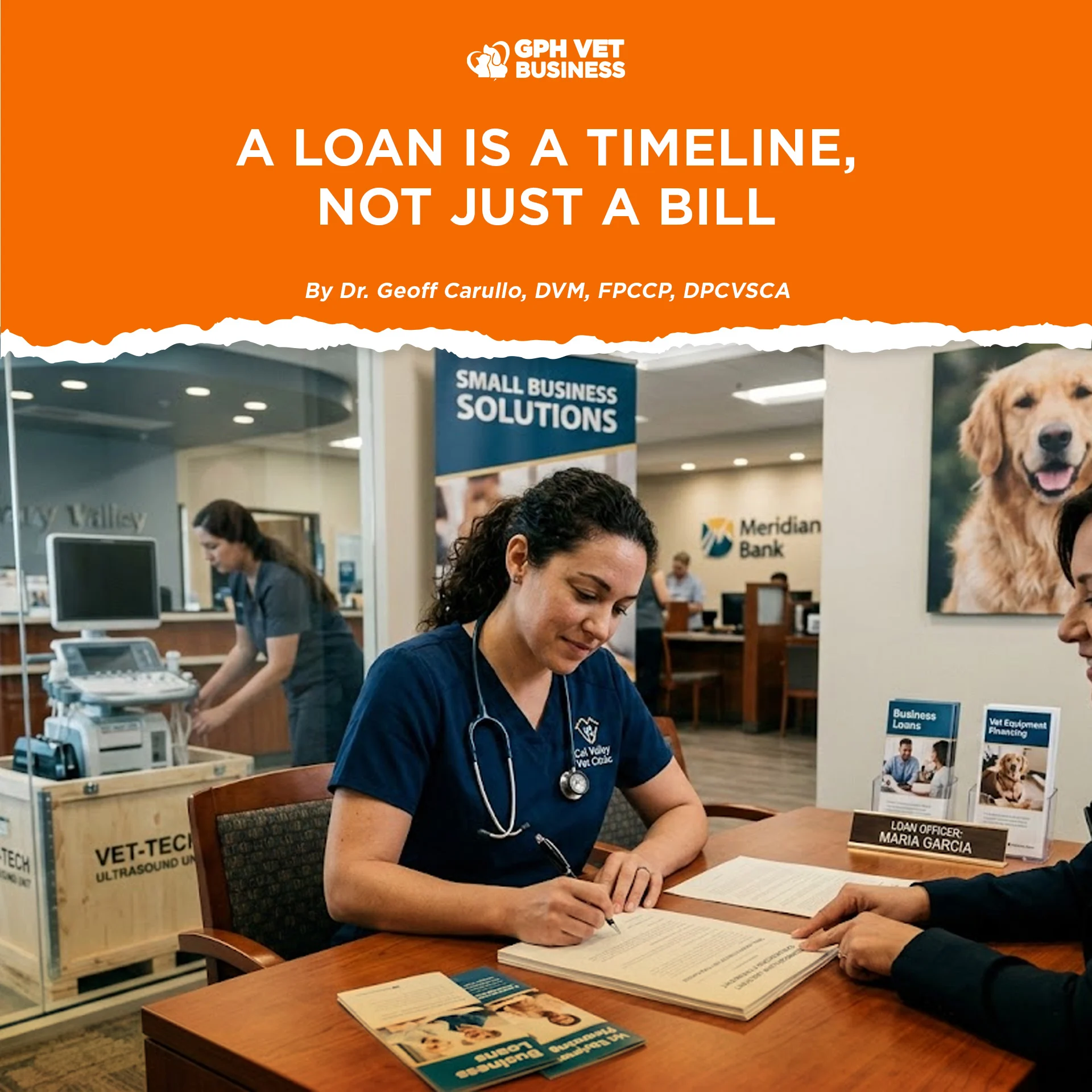
One of the biggest financial turning points in a veterinarian’s career is the moment they decide whether to keep renting a clinic space or take out a loan to own one.
At first glance, a clinic loan looks intimidating. The numbers are large, the commitment is long, and the monthly payment feels heavy. Many veterinarians see a loan as a burden or a risk that should be avoided for as long as possible.
But veterinarians who think long term see something different.
They see a timeline.
A loan allows a veterinarian to control a large and valuable asset with a relatively small amount of capital. Instead of waiting decades to save enough money to buy property outright, ownership begins immediately while the loan is gradually paid down.
In the early years, the loan payment can feel overwhelming. Renting often appears safer and more comfortable. There is less commitment and less perceived risk.
However, time changes the equation.
Loan payments are usually predictable, but veterinary income rarely stays the same. As a practice matures, patient volume increases, services expand, and professional confidence grows. The same loan payment that once felt heavy eventually becomes manageable and later becomes small compared to clinic revenue.
Consider a typical situation in veterinary practice.
A veterinarian takes out a loan to purchase a clinic property worth ₱8 million with a ₱1.5 million down payment. The remaining balance is financed through a long-term loan. During the first few years, the monthly payment requires discipline and careful financial planning.
Ten years later, the picture often looks very different.
The loan payment remains roughly the same, but clinic income may have grown significantly. A large portion of the loan has already been paid, equity has accumulated, and the property itself may have increased in value.
Instead of rent receipts, the veterinarian now holds ownership.
Each monthly payment produces gradual progress. The loan balance declines while equity increases. Financial risk decreases while control increases.
Unlike medical equipment that depreciates or supplies that are consumed, clinic property often appreciates. The increase in value applies to the full property price, not just the initial investment.
Inflation quietly works in favor of the long-term borrower. The money used to pay the loan in later years is often worth less than the money originally borrowed, effectively reducing the real cost of the debt.
What initially feels like a liability slowly becomes leverage.
Many established veterinarians eventually realize that the clinic building they once struggled to pay for becomes one of their strongest financial assets. It can become retirement security, long-term stability, or a source of income when leased to younger practitioners.
A loan is not simply a monthly bill.
It is a structured path toward ownership.
It is a timeline of growing equity.
It is long-term leverage hiding in plain sight.
Dr. Geoff Carullo is a Fellow and the current President of the Philippine College of Canine Practitioners.
Sharing this helps others understand what it really means to be a vet. Like and follow if you’re with us.