Many veterinarians obsess over interiors.
- The tiles
- The logo
- The Instagram wall
- The expensive reception desk
But the brutal truth?
Some clinics are already dead before the first paint dries.
Not because the veterinarian is incompetent.
Not because the medicine is poor.
But because the location was wrong from the very beginning.
In veterinary practice, location is not just geography.
It is psychology.
It is convenience.
It is behavior.
It is traffic flow.
It is visibility.
It is access.
And sometimes,
it quietly determines whether a clinic survives or slowly bleeds to death.
A beautiful clinic hidden in the wrong place can fail faster than a simple clinic placed exactly where pet owners naturally pass every day.
That is the painful reality many clinic owners learn too late.
The Myth of “If You Build It, They Will Come”
Many first-time clinic owners believe good medicine alone will attract clients.
It helps.
But medicine alone does not solve invisibility.
People cannot support a clinic they never notice.
Some veterinarians open clinics in areas with almost no foot traffic because rent is cheaper.
Others hide inside upper floors of buildings with poor signage and difficult parking.
Some choose locations based purely on emotion:
“Malapit sa bahay.”
“Comfortable ako dito.”
“Maganda yung building.”
But clients think differently.
Pet owners value convenience more than most veterinarians realize.
If reaching your clinic feels stressful, difficult, confusing, or inconvenient, many clients simply will not return, regardless of how good you are medically.
Visibility is Free Marketing
One of the most underrated advantages in veterinary business is daily passive exposure.
A clinic located along a busy road gains something powerful:
constant subconscious advertising.
Every car that passes sees your sign.
Every pedestrian remembers your name.
Every nearby resident slowly becomes familiar with your clinic.
This is why some “average” clinics remain consistently busy.
They are seen every single day.
Meanwhile, some excellent clinics remain invisible because nobody naturally encounters them.
Visibility reduces your future marketing costs.
The less visible your clinic is, the more aggressively you need to spend on advertising just to compensate.
Parking Matters More Than Veterinarians Think
Clients do not arrive emotionally neutral.
- They arrive stressed
- They arrive carrying sick pets
- They arrive anxious about costs
- They arrive during emergencies
Now imagine adding impossible parking to that experience.
- Tight roads
- No parking slots
- Flood-prone streets
- Traffic congestion
- Security concerns
These small frustrations accumulate psychologically.
Many veterinarians underestimate how strongly convenience affects repeat visits.
Easy parking quietly increases:
- Compliance
- Follow-up consultations
- Vaccination returns
- Grooming visits
- Overall loyalty
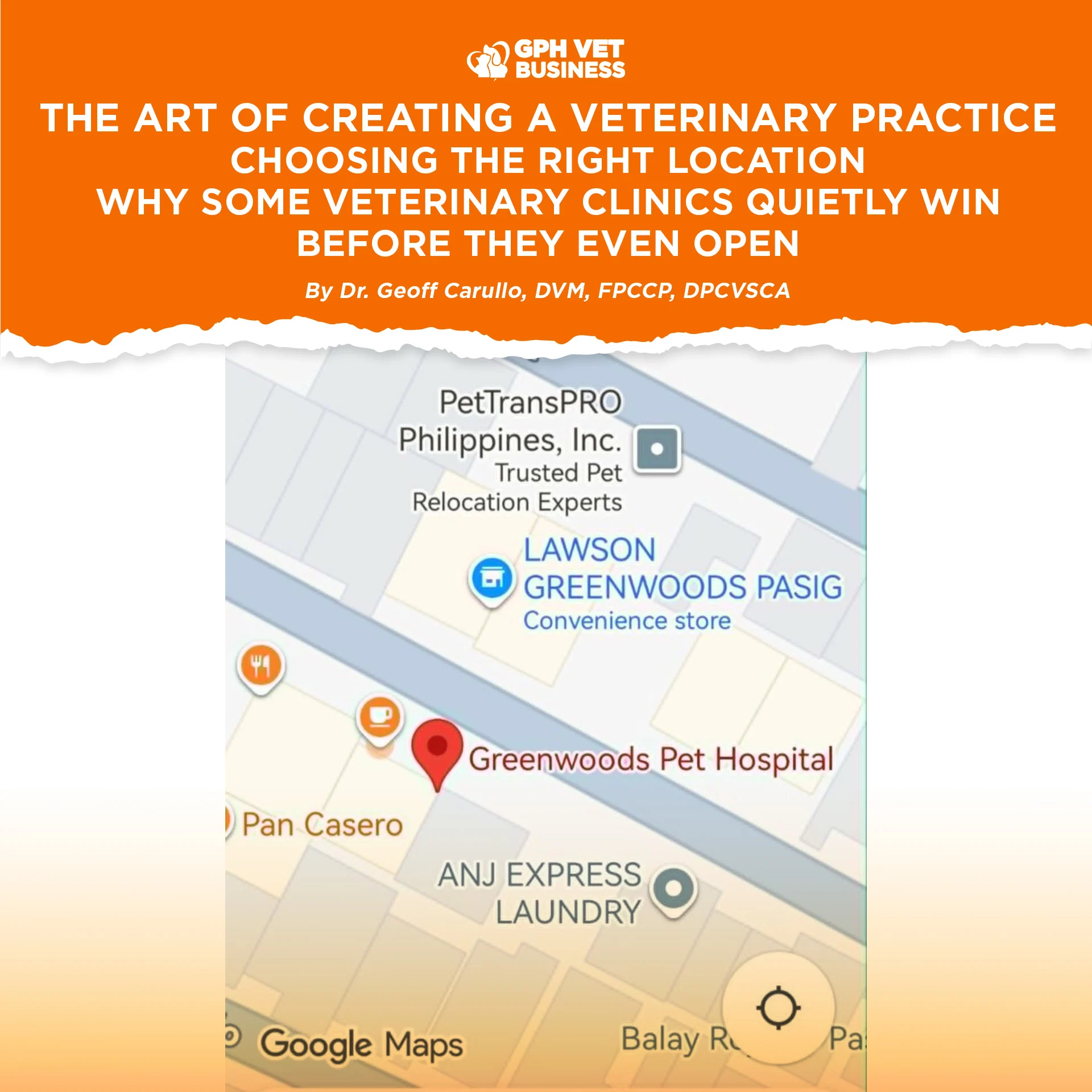
Nearby Establishments Influence Client Flow
Successful clinic placement is often about neighboring businesses.
Some establishments naturally generate useful traffic patterns for veterinary clinics:
- Convenience stores
- Pharmacies
- Grocery stores
- Pet supply stores
- Residential communities
- Schools
- Commercial centers
These create consistent movement of people throughout the day.
Meanwhile, locations surrounded purely by nightlife businesses, isolated warehouses, or low-traffic office zones may struggle despite lower rent.
Veterinary clinics benefit from routine community exposure, not just occasional destination traffic.
Community Psychology Matters
Different communities behave differently.
- Some areas prioritize affordability
- Others prioritize premium service
- Some areas heavily trust referrals
- Others are driven by online visibility
Understanding the psychology of the neighborhood matters as much as demographics.
A luxury clinic placed in the wrong economic environment may struggle.
A budget-friendly clinic placed in a highly affluent district may also fail.
The best clinic owners study not only income levels, but behavior patterns.
- How do people spend?
- How do they travel?
- How do they value pets?
- How often do they seek preventive care?
These questions matter more than beautiful interiors.
The Dangerous Trap of Overspending on Interiors
Some veterinarians exhaust most of their capital building aesthetically impressive clinics while neglecting the fundamentals of location.
But interiors do not create traffic.
Location does.
A modest clinic in the right place can gradually improve over time because revenue grows consistently.
A luxurious clinic in the wrong place often becomes financially suffocating because fixed expenses remain high while client flow stays weak.
This is why some simple clinics quietly dominate their areas for decades.
They mastered positioning first.
Accessibility Creates Trust
Clients unconsciously associate accessibility with reliability.
When your clinic is easy to locate, easy to enter, easy to park in, and easy to revisit, clients perceive stability.
That stability builds confidence.
And confidence builds loyalty.
Veterinary medicine is emotional.
People return to places that reduce stress.
Sometimes the “best” location is not the fanciest road.
It is simply the location that makes pet ownership feel easier.
Final Thoughts
A clinic does not need to start grand.
But it needs to start strategically.
Because in veterinary business, location is not just where your clinic stands.
It determines:
- who notices you
- who remembers you
- who returns
- who recommends you
- and ultimately, whether your business survives long enough to grow
The scary part?
Many veterinarians only realize they chose the wrong location after investing their savings, signing long leases, buying equipment, and building interiors they cannot easily abandon.
By then, relocation becomes expensive.
That is why choosing the right location is not a small decision.
It is one of the first real business decisions that determines the future of the clinic itself.
Sources
- American Veterinary Medical Association (AVMA) – Veterinary Practice Ownership Resources
- VetPartners – Practice Management and Veterinary Business Insights
- Indeed Editorial – Importance of Business Location Strategy
- U.S. Small Business Administration – Choose Your Business Location
Dr. Geoff Carullo is a Fellow and the current President of the Philippine College of Canine Practitioners.
Sharing this helps others understand what it really means to be a vet. If you found this valuable, like and follow for more insights.