One slide from Dr. John Michael T. Figura’s lecture made me stop.
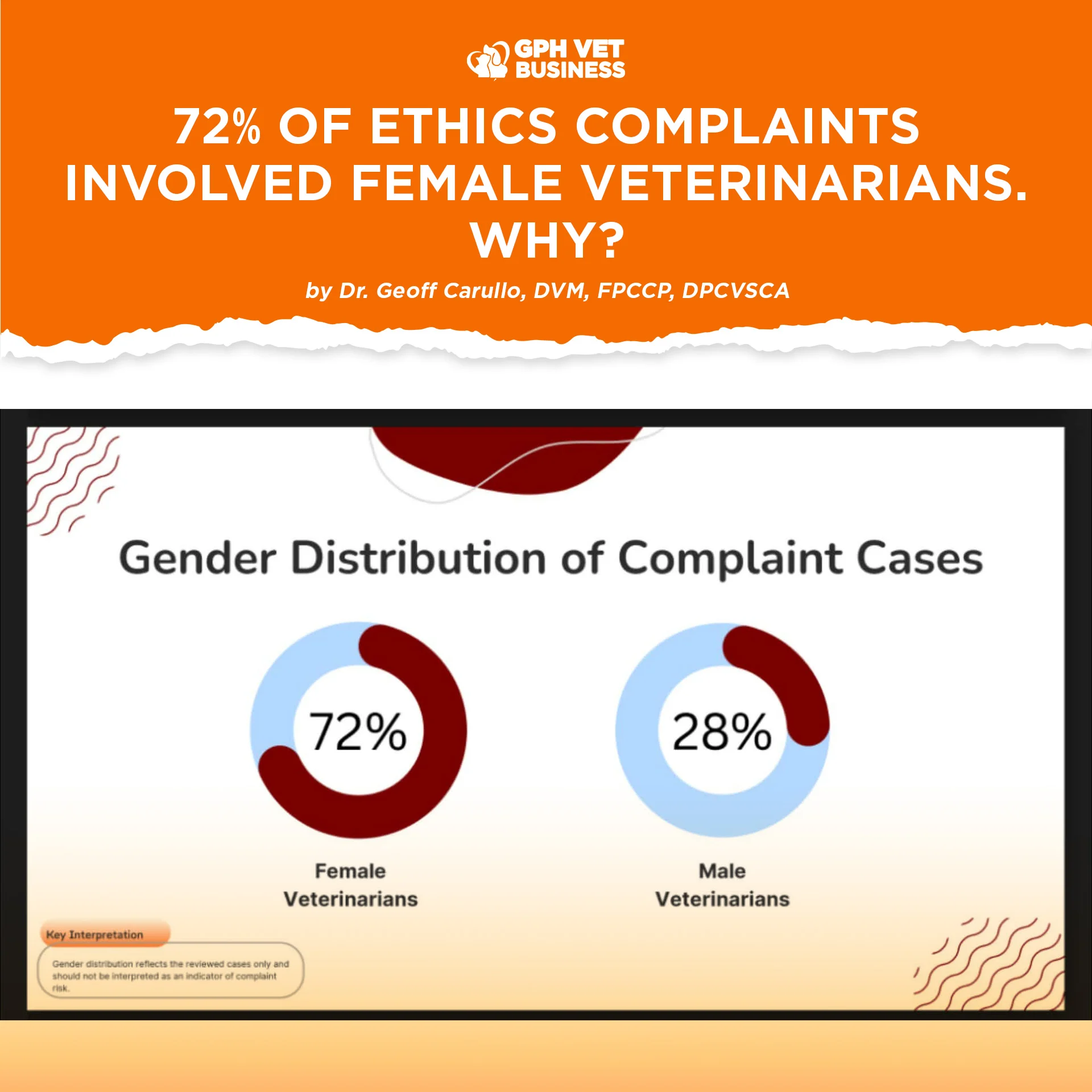
Among the veterinary complaint cases reviewed by the PVMA Ethics Committee, 72% involved female veterinarians. Only 28% involved male veterinarians.
That is a number difficult to ignore.
But before anyone concludes that female veterinarians are more problematic, more careless, or more prone to ethical violations, there is one very important detail written on the same slide:
The gender distribution reflects the reviewed cases only and should not be interpreted as an inherent indicator of risk.
So the more interesting question is not:
“Why are women getting more complaints?”
The better question is:
“What is happening inside modern veterinary practice that is producing these complaints?”


First, 72% Does Not Automatically Mean Female Veterinarians Are More Complaint-Prone

Figure 1. Gender distribution of veterinarians involved in reviewed complaint cases. Female veterinarians accounted for 72% of the cases reviewed, while male veterinarians accounted for 28%. These figures describe the reviewed cases only and should not be interpreted as evidence that gender itself increases the risk of receiving a complaint.

Figure 2. Dr. John Michael T. Figura during his presentation on modern ethical dilemmas in veterinary practice. His discussion focused on recognizing potential complaint generators, understanding how conflicts escalate, and helping veterinarians reduce professional risk through better communication, documentation, and ethical decision-making.
We need the denominator.
If the veterinary workforce, particularly companion animal practice, has a large female population, then naturally more consultations, surgeries, confinements, difficult conversations, and client interactions may also involve female veterinarians.
More exposure can mean more opportunities for complaints.
A veterinarian seeing 30 patients a day has far more chances of encountering conflict than someone handling only a few cases.
So raw numbers alone cannot tell us who is “more ethical” or “less ethical.”
But Who Is Actually Facing the Client?
The veterinarian standing inside the consultation room becomes the face of everything.
- The diagnosis.
- The bill.
- The prognosis.
- The failed treatment.
- The unexpected death.
- The decision to hospitalize.
- The refusal to give antibiotics unnecessarily.
- The recommendation for additional diagnostics.
And when an owner becomes unhappy, the veterinarian whose name appears on the medical record may also become the veterinarian whose name appears on the complaint.
Sometimes the complaint is justified.
Sometimes it comes from genuine miscommunication.
Sometimes expectations were unrealistic.
And sometimes the medical outcome was simply bad despite appropriate treatment.
But by then, the complaint has already been filed.


Veterinary Medicine Has Changed
Years ago, an angry client might complain at the reception desk and eventually go home.
Today, that same disagreement can become screenshots, Facebook posts, group-chat discussions, online reviews, viral accusations, and eventually a formal complaint.
Clients are more informed.
Clients are also more empowered.
That is not necessarily bad.
Accountability is necessary in every profession.
But it means today’s veterinarian must possess something previous generations could sometimes learn much later in their careers:
complaint survival skills.
This Is Where Mentorship Becomes Extremely Important
We teach young veterinarians how to diagnose parvovirus.
We teach them how to calculate fluids.
We teach surgery, pharmacology, radiology, ultrasound, anesthesia, and laboratory interpretation.
But who teaches them how to handle the owner who says:
“Doc, bakit namatay?”
Who teaches them what to document after an aggressive confrontation?
Who teaches them how to explain an uncertain prognosis without creating false expectations?
Who teaches them when to obtain written refusal?
When to document financial limitations?
When to refer?
When to stop arguing?
And sometimes, when to simply recognize that a client is already becoming a professional risk?
These lessons rarely come from textbooks.
They come from experience.
And experience becomes much less painful when someone experienced is willing to guide you through it.

The Most Disturbing Part of Complaint Statistics May Not Actually Be the Gender Difference

Figure 3. The PVMA Council on Ethics team. Shown are Dr. Marie Vevienne Casino, Chairman; Dr. Maysie Batinga, Co-Chairman; Dr. Catherine De Guzman, Member; Dr. John Michael T. Figura, Member; and Dr. James Patrick O. Cariño, Member. The council is tasked with reviewing ethical concerns and complaint cases involving members of the veterinary profession.
It may be what they are quietly telling us about our profession.
Veterinarians are practicing in an environment where clinical skill alone is no longer enough.
You can perform the correct diagnostic workup.
You can prescribe the correct medicine.
You can follow accepted standards.
And still find yourself explaining your actions months later before an ethics committee if your communication and documentation were poor.
That is the reality younger veterinarians need to understand early.
So Instead of Asking Why 72% Were Women
Perhaps we should ask something bigger.
Who is teaching our young veterinarians how not to become the next complaint?
Not by hiding mistakes.
Not by avoiding accountability.
But by teaching them to communicate properly, document everything important, obtain meaningful consent, manage expectations, recognize difficult client behavior early, and practice defensible medicine.
Because the safest veterinarian is not necessarily the veterinarian who never encounters an angry client.
It is the veterinarian who knows how to practice properly when that difficult client eventually walks through the door.
And judging from what we are now seeing in ethics complaints, that kind of mentorship may no longer be optional.
Dr. Geoff Carullo is a Fellow and the current President of the Philippine College of Canine Practitioners.
Sharing this helps others understand what it really means to be a vet. Like and follow if you’re with us.