Confinement is not simply about putting a sick animal inside a cage and checking on it from time to time.
A hospitalized patient may need continuous fluids, oxygen support, temperature control, close observation, repeated examination, and rapid intervention when something changes.
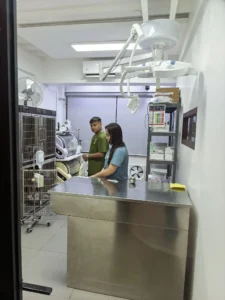
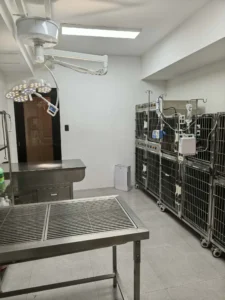
That is why Greenwoods Pet Hospital maintains two separate confinement rooms: one for infectious patients and another for non-infectious patients.
They serve different clinical purposes, but both were built around the same principle: hospitalized animals should have access to appropriate monitoring and supportive care where they are confined.


The Non-Infectious Confinement Room
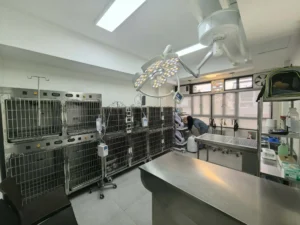
The non-infectious confinement area is intended for patients requiring hospitalization without a suspected contagious disease.
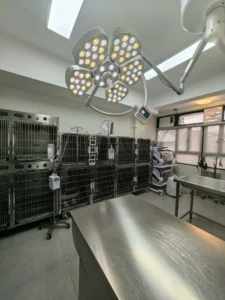
The room is dominated by stainless steel hospital cages, arranged to maximize available space while allowing staff direct access to every patient. Stainless steel was chosen because it is durable, non-porous, resistant to moisture, and practical for repeated cleaning and disinfection.
Many of the cages function as more than simple enclosures.
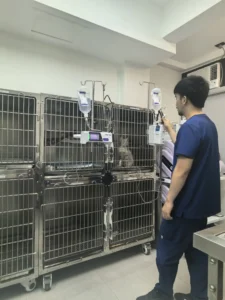
Patients may be connected to infusion pumps, allowing intravenous fluids and medications to be delivered at controlled rates. IV bags are positioned on dedicated holders, keeping the fluid lines organized and accessible to the veterinary team.
Oxygen concentrators are also available when respiratory support is required.
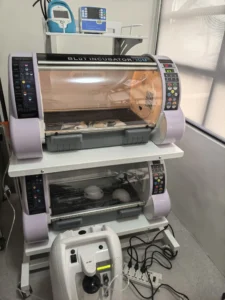
For animals that have difficulty regulating their body temperature, infrared-equipped cages provide additional warming support when clinically indicated. This can be particularly useful for compromised, recovering, geriatric, pediatric, or hypothermic patients.
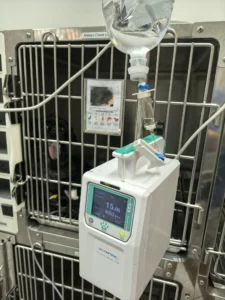
The cages are accompanied by integrated electrical access for the equipment used around each patient. This allows pumps, warming systems, monitors, and other devices to be positioned where they are actually needed rather than relying on equipment positioned across the room.
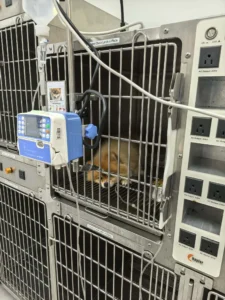
Patient identification and temperament information can also be placed directly at the cage, helping staff immediately recognize the patient and approach it appropriately.
At the center of the room is a stainless steel examination and treatment table. This gives the veterinary team a dedicated surface for physical examinations, dressing changes, catheter placement, medication administration, and other procedures without unnecessarily transferring the patient to another section of the hospital.
Above it is a multi-panel examination light, providing concentrated illumination whenever closer inspection or minor procedures are necessary.
The entire room follows the same practical philosophy: clean surfaces, accessible equipment, uncluttered movement, and the ability to respond quickly.


The Infectious Confinement Room
Our infectious confinement room has a different responsibility.
This area is reserved for patients with known or suspected transmissible disease, allowing them to be managed separately from the general hospitalized population.
Separation matters.
A patient being treated for a contagious illness should not share the same immediate confinement environment as a postoperative patient, a geriatric animal, or another medically vulnerable patient whenever this can be avoided.
But isolation should never mean reduced medical support.
The infectious confinement room is therefore also equipped with stainless steel cages, ICU cages, oxygen concentrators, infusion pumps, infrared support, IV stands, and examination lighting.
The same basic capabilities remain available. Fluids can still be administered accurately. Oxygen can still be provided. Temperature support can still be given. Patients can still be examined properly without compromising the purpose of isolation.
The difference lies in where the patient is managed and how movement between patient populations is controlled.
That separation helps the veterinary team maintain a more organized approach to infection control while continuing to deliver appropriate hospital care.
Why So Much Stainless Steel?
There is a reason stainless steel appears repeatedly throughout both rooms.
In veterinary confinement, surfaces are exposed to urine, saliva, vomitus, blood, disinfectants, moisture, fur, and constant handling.
A hospital cage therefore needs to tolerate far more than everyday furniture.
Stainless steel provides a smooth, durable surface that can withstand repeated cleaning while allowing the team to maintain a more hygienic environment. The treatment tables, cage systems, IV structures, and other fixtures follow the same principle.
The neutral floors and light-colored walls also make the rooms visually clean and bright, while strong overhead lighting helps staff identify changes that might otherwise be missed.

Confinement Is Active Medicine
Perhaps the most important thing about these rooms cannot be seen in a photograph.
A confinement room is not a storage area for sick animals.
It is an extension of the treatment floor.
Every infusion pump running beside a cage represents a calculated fluid rate. Every oxygen line represents respiratory support. Every warming system represents temperature management. Every patient card represents an animal that must be identified, reassessed, and monitored.
And every cage door can hold a patient whose condition may change within minutes.
That is why we separated our infectious and non-infectious confinement areas while equipping both with the tools our veterinary team may need.
Because when an animal is admitted to Greenwoods Pet Hospital, confinement should not mean simply having a place to stay.
It should mean having a place where treatment continues.
Dr. Geoff Carullo is a Fellow and the current President of the Philippine College of Canine Practitioners.
Sharing this helps others understand what it really means to be a vet. Like and follow if you’re with us.