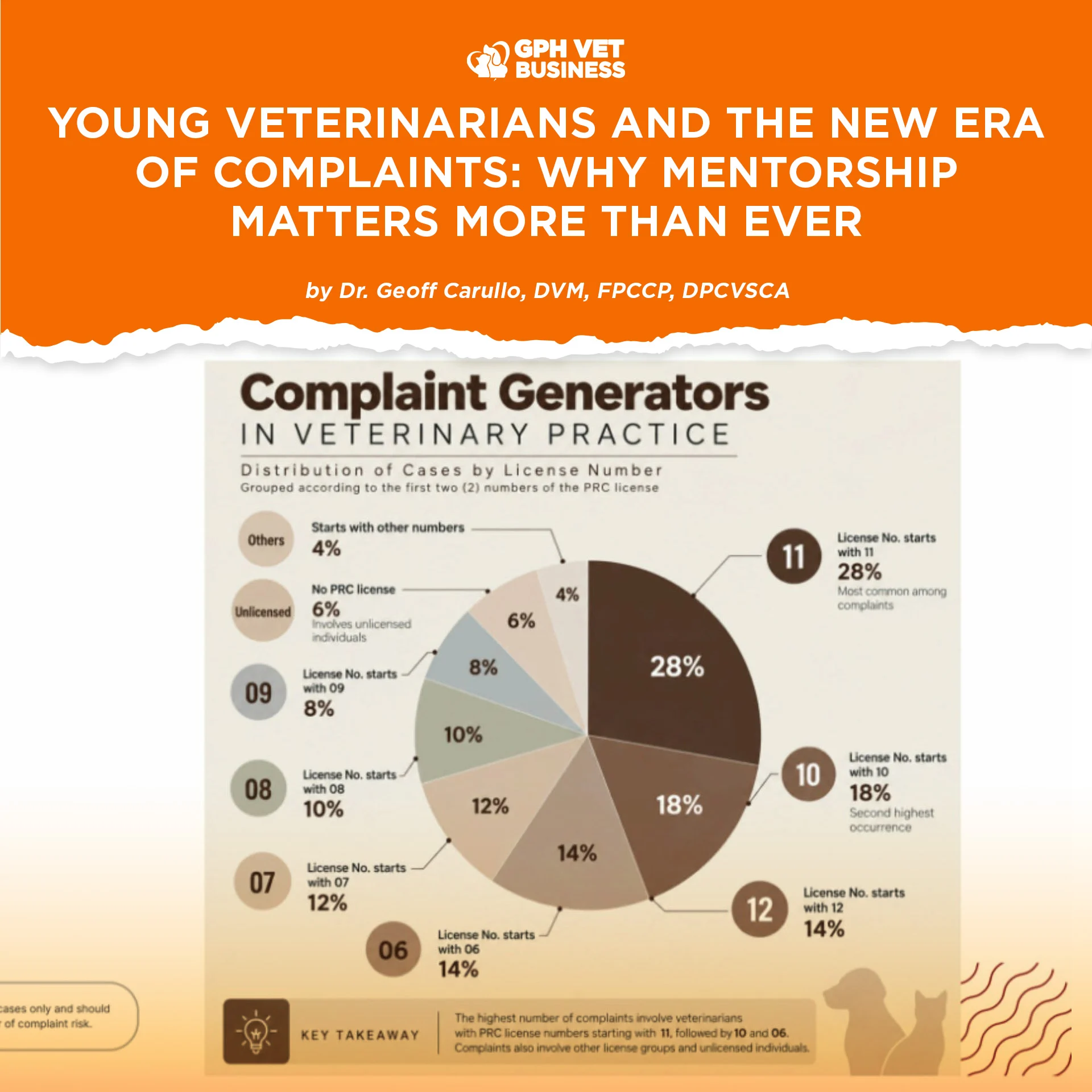
One slide from the recent PVMA seminar at Cavite State University deserves serious attention from every veterinary clinic owner, senior veterinarian, and young practitioner.
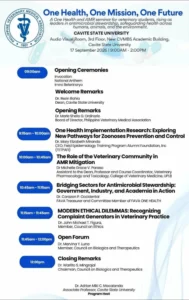
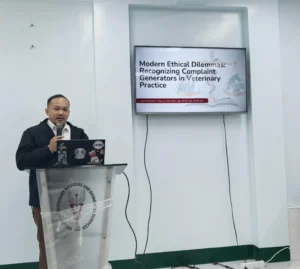
During the lecture “Modern Ethical Dilemmas: Recognizing Complaint Generators in Veterinary Practice,” Dr. John Michael T. Figura of the Council on Ethics presented the distribution of reviewed complaint cases according to the first two numbers of the veterinarian’s PRC license number.
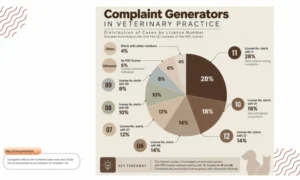
The largest group involved license numbers beginning with 11, accounting for 28% of the reviewed cases, followed by 10 at 18%, then 12 and 06 at 14% each.
At first glance, one may be tempted to say: “Bakit parang maraming relatively newer veterinarians ang nasasangkot sa complaints?”
But there is an important warning written directly on the slide:
The figures represent the cases reviewed and should not be interpreted as an indicator of complaint risk.
In other words, we cannot conclude from this chart alone that younger veterinarians are more unethical, less competent, or naturally more prone to complaints. We do not know the total number of practicing veterinarians in each license-number group, their caseloads, their areas of practice, or how many complaints were never formally filed.
But the pattern still gives our profession something worth discussing.


Veterinary Practice Has Changed
Young veterinarians today are entering a very different profession from the one many of us entered twenty years ago.
Clients have greater access to information. They Google diseases before arriving at the clinic. They join Facebook groups. They compare treatment protocols between hospitals. They take screenshots of conversations. They record invoices. They ask other veterinarians online for second opinions.
And when something goes wrong, filing a complaint is far easier than it used to be.
That does not necessarily mean clients have become unreasonable.
It means the environment has changed.
A veterinarian may perform technically acceptable medicine and still face a complaint because expectations were not properly explained, informed consent was weak, records were incomplete, communication became emotional, or the client misunderstood the prognosis.
Today, clinical competence alone is no longer enough protection.


Why Younger Veterinarians May Be More Vulnerable
There are several possible explanations, and they should be treated as hypotheses rather than conclusions.
A young veterinarian may already know how to diagnose parvovirus, interpret bloodwork, perform surgery, or manage a critical patient. But handling an angry owner is another skill entirely.
Knowing when to say:
“This patient may still deteriorate despite treatment.”
Knowing how to document a refusal.
Knowing how to explain financial limitations without sounding insensitive.
Knowing when a case is beyond your current capability.
Knowing when to refer.
Knowing how much information should be written in the medical record.
Knowing how to respond when a client starts threatening legal action or posting on social media.
These lessons are rarely mastered through textbooks alone.
They are usually learned through experience, and preferably through good mentorship rather than painful mistakes.
Young Vets Need More Than Someone Who Teaches Them Surgery
This is where senior veterinarians and clinic owners have an enormous responsibility.
A mentor should not simply teach a younger veterinarian how to place an IV catheter, perform an ovariohysterectomy, interpret an X-ray, or choose an antibiotic.
A true mentor teaches the things that prevent tomorrow’s ethical complaint.
How to communicate uncertainty.
How to obtain meaningful informed consent.
How to document conversations.
How to discuss prognosis.
How to handle treatment refusal.
How to establish professional boundaries.
How to recognize when emotions are escalating.
How to refer without ego.
And perhaps most importantly, how to admit:
“I need help with this case.”
A young veterinarian should never be made to believe that asking for assistance is a sign of weakness.
Sometimes it is exactly what protects the patient, the veterinarian, and the clinic.

Clinic Owners Should Pay Attention Too
We cannot hire a newly licensed veterinarian, give them a consultation room, hand them complicated cases, and assume that because they passed the board examination they are already prepared for every professional situation.
Passing the boards establishes the right to practice.
It does not magically provide ten years of judgment.
Young associates need supervision. They need accessible senior veterinarians. They need protocols. They need proper medical-record systems. They need consent forms. They need guidance when cases become complicated.
And when a complaint happens, the first question should not immediately be:
“Sino ang may kasalanan?”
Perhaps we should also ask:
“Was this veterinarian adequately prepared and supported?”
Because Complaints Are Now Part of Modern Practice
Veterinarians should also recognize the reality of practicing today.
A dissatisfied client may no longer simply leave the clinic.
They may post online.
They may message professional organizations.
They may write regulatory agencies.
They may seek another veterinarian’s opinion.
They may formally complain.
That is why documentation, communication, consent, professionalism, and appropriate referral have become just as important as diagnostics and treatment.
You cannot prevent every complaint.
But you can reduce the situations that generate them.
And when complaints do arise, good records and good communication can make an enormous difference.
Our Younger Colleagues Need Us

The lesson I took from this presentation is not that young veterinarians are the problem.
It is that young veterinarians may be practicing during one of the most unforgiving periods our profession has ever experienced.
Medicine is becoming more sophisticated.
Clients are becoming more informed.
Expectations are higher.
Social media amplifies disputes.
And professional accountability is becoming increasingly visible.
So instead of simply warning young veterinarians to “be careful,” perhaps senior veterinarians should ask a better question:
Who is teaching them how to be careful?
Every young veterinarian deserves a senior colleague who will answer the phone when a case becomes difficult.
Someone who teaches without humiliating.
Someone who corrects before condemning.
Someone who teaches not only medicine, but judgment.
Because sometimes the difference between a young veterinarian becoming an excellent practitioner and becoming the subject of a complaint is not intelligence or clinical ability.
Sometimes, it is having the right mentor at the right moment.
Dr. Geoff Carullo is a Fellow and the current President of the Philippine College of Canine Practitioners.
Sharing this helps others understand what it really means to be a vet. Like and follow if you’re with us.