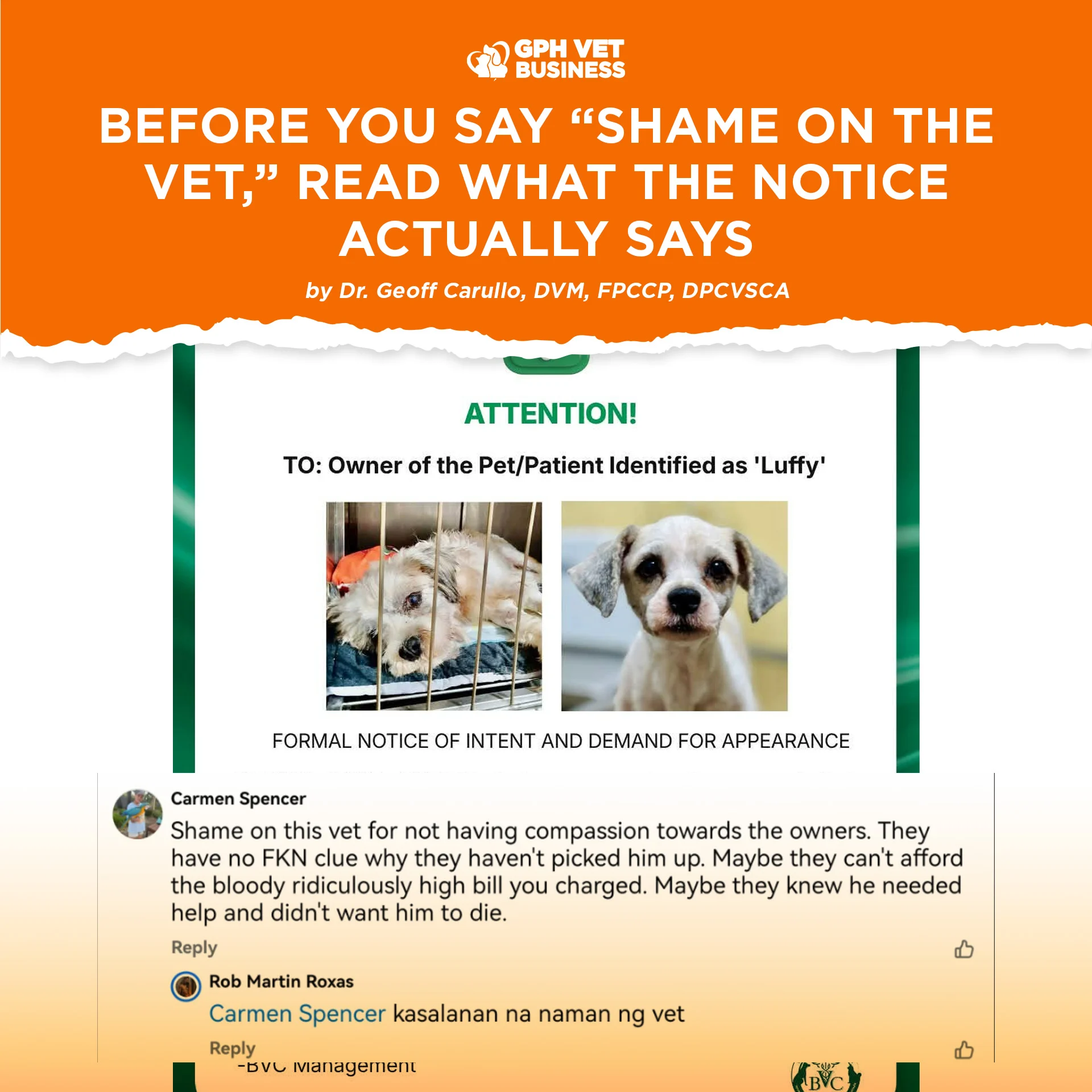
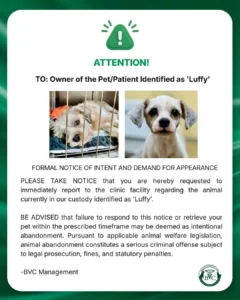
A veterinary clinic posted a formal notice addressed to the owner of a patient named Luffy.
The clinic was asking the owner to immediately communicate with the facility regarding the animal still under its custody. It further warned that failure to respond or retrieve the pet within the prescribed period could potentially be treated as abandonment.
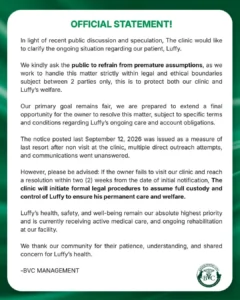
Then came the predictable reaction:
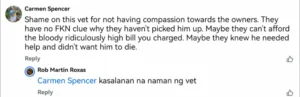
“Shame on this vet for not having compassion towards the owners. Maybe they can’t afford the ridiculously high bill.”
But wait.
Why is the veterinarian being shamed for asking an owner to come back for his or her own animal?
The post does not say, “Pay immediately or we will throw your dog outside.”
It does not say, “Your pet will no longer receive care.”
What it essentially says is:
Please contact us. Your animal is still here. You have a responsibility to respond.
And there is actually a legal basis for taking abandonment seriously.


Pet Ownership Does Not End at the Clinic Door
When you admit your pet to a veterinary hospital, ownership does not suddenly transfer to the veterinarian.
The veterinarian becomes responsible for providing appropriate professional care while the patient is under the clinic’s custody.
But the owner remains the owner.
Food continues to be consumed.
Medicines continue to be administered.
Cages have to be cleaned.
Veterinary nurses and attendants continue caring for the patient.
Electricity, oxygen, monitoring, sanitation and hospitalization continue whether the owner answers the telephone or not.
A veterinary clinic cannot simply switch all of that off because the owner disappears.
So why should asking that owner to communicate suddenly be considered a lack of compassion?


The Law Actually Recognizes Abandonment
RA 8485, as amended by RA 10631, specifically makes it unlawful for a person having custody of an animal to abandon it.
The law defines abandonment as relinquishing one’s right, title, claim or possession of the animal with the intention of not reclaiming it or resuming ownership or possession. It also recognizes circumstances where there may be reasonable cause or excuse, which is precisely why abandonment should not be declared automatically from a single missed call or delayed pickup. (Lawphil)
But here is the part particularly relevant to veterinary clinics.
The Revised Implementing Rules and Regulations of the Animal Welfare Act specifically contemplate pets or animals abandoned in veterinary clinics or hospitals for fifteen days.
Subject to a legally and ethically sound internal policy, those animals may eventually be placed for adoption, referred to an appropriate registered shelter or pound, or otherwise dealt with ethically by the proper authorities.
And before a final decision is made, the rules require diligent effort to contact the owner. (Bai.gov.ph)
Read that last part again.
Diligent effort to contact the owner.
Isn’t that exactly why a veterinary clinic would issue notices, send messages, make telephone calls or make other reasonable efforts to locate an owner?

“But Maybe They Cannot Afford the Bill.”
Possible.
And financial hardship deserves empathy.
But inability to pay and abandonment are two completely different issues.
If you are struggling financially, communicate.
Talk to the veterinarian.
Explain your circumstances.
Ask what arrangements are possible.
Retrieve your pet if medically appropriate.
Make arrangements for its continuing care.
What cannot reasonably become the solution is:
Disappear and leave the veterinary hospital to figure everything out indefinitely.
The clinic did not purchase that animal.
The veterinarian did not adopt that animal.
And veterinary hospitals are not automatically shelters simply because an owner encounters financial difficulty.
Compassion can exist together with accountability.
And There Is an Even Newer Legal Context
RA 12308, enacted in 2025, also identifies abandoning, displacing, or neglecting to provide adequate care for animals under one’s custody or care among punishable acts, with penalties determined by the court under the law. (Lawphil)
So the concept that abandonment may carry legal consequences is not something a veterinary clinic simply invented for a Facebook poster.
Philippine law takes abandonment seriously.
One Important Qualification
I would still be careful with the wording of any clinic notice.
Failure to retrieve an animal on a particular date does not automatically prove criminal abandonment.
Intent matters.
Circumstances matter.
Whether there was reasonable cause or excuse matters.
And ultimately, criminal liability is not something a veterinary clinic itself gets to conclusively declare.
So wording such as “may constitute abandonment under applicable law” is safer and more accurate than declaring that the owner has already committed a criminal offense.
But that legal nuance does not change the bigger point.
The clinic has every legitimate reason to ask an absent owner to communicate and retrieve or make arrangements for an animal remaining in its custody.
So Why “Shame on the Vet”?
A veterinarian accepts a sick animal.
Treats it.
Confines it.
Feeds it.
Medicates it.
Assigns staff to it.
Keeps caring for it while waiting for the owner.
Then the clinic asks:
“Please come back. Please contact us regarding your pet.”
And somehow the veterinarian becomes the villain?
That is a strange definition of compassion.
Veterinarians have responsibilities under animal welfare laws.
But pet owners have responsibilities too.
Animal welfare cannot mean demanding unlimited responsibility from the veterinary profession while removing responsibility from the person who actually owns the animal.
So before saying:
“Shame on this vet.”
Perhaps ask the more relevant question:
Where is the owner?
Because compassion should never become an excuse for abandonment.
And veterinary care should never become a system where responsibility for an animal is silently transferred to the veterinarian simply because the owner stopped answering.
Sources
Republic Act No. 8485, Animal Welfare Act of 1998. (Lawphil)
Republic Act No. 10631, amending the Animal Welfare Act, particularly Section 7 on abandonment and its definition. (Lawphil)
Bureau of Animal Industry, Revised Implementing Rules and Regulations of RA 8485, as amended by RA 10631, Rule 7.4, Care and Handling of Abandoned Animals, including the provision concerning animals abandoned in veterinary clinics or hospitals for fifteen days and the requirement for diligent efforts to contact the owner. (Bai.gov.ph)
Republic Act No. 12308, Animal Industry Development and Competitiveness Act of 2025, including the provision penalizing abandoning, displacing, or neglecting animals under one’s custody or care. (Lawphil)
Dr. Geoff Carullo is a Fellow and the current President of the Philippine College of Canine Practitioners.
Sharing this helps others understand what it really means to be a vet. Like and follow if you’re with us.