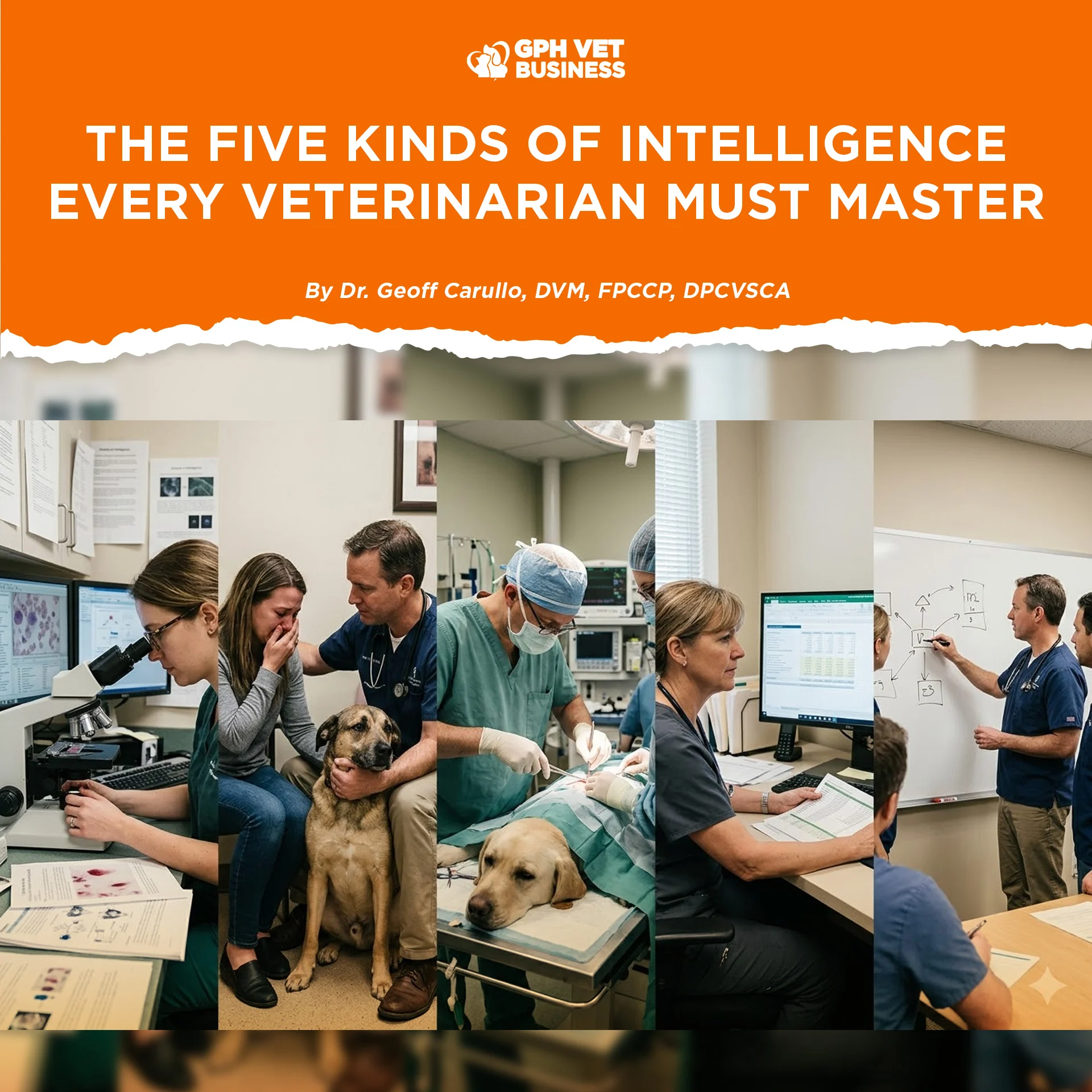
No one tells you this in vet school.
You walk in thinking intelligence is about grades, memory, and diagnostics.
You walk out realizing…
that’s only one piece of the game.
Because in real veterinary practice, intelligence is not singular.
It is layered.
And the veterinarians who rise above the noise, the burnout, the financial pressure, and the chaos…
Are the ones who master all five.
1. Analytical Intelligence — The One That Gets You Licensed
This is the intelligence we all recognize.
The ability to:
- Diagnose a crashing parvo case
- Interpret bloodwork under pressure
- Choose the right drug at the right dose
This is what exams measure.
This is what textbooks reward.
But here’s the uncomfortable truth:
There are thousands of intelligent veterinarians…
…and many of them are struggling.
Because analytical intelligence alone does not prepare you for reality.
2. Emotional Intelligence — The One That Keeps You Alive in Practice
Veterinary medicine is not just science.
It is human emotion, amplified.
- A client crying in front of you.
- A complaint waiting to explode online.
- A staff member on the verge of quitting.
- A pet you could not save.
Emotional intelligence is the ability to:
- Stay composed when everything is collapsing
- Communicate with clarity without sounding cold
- Carry empathy without burning out
A veterinarian can be brilliant…
But without EQ, they will lose trust.
And once trust is gone, everything else follows.
3. Practical Intelligence — The One That Saves Cases in the Real World
In theory, every case has an ideal plan.
In reality:
- The client cannot afford it
- The diagnostics are unavailable
- Time is against you
This is where practical intelligence takes over.
The ability to:
- Adapt without compromising outcomes
- Create alternative treatment pathways
- Make decisions with incomplete information
This is not written in books.
This is earned in the clinic.
Case by case.
Mistake by mistake.
4. Financial Intelligence — The One Nobody Talks About
This is the silent killer of veterinary careers.
You can be:
- Skilled
- Compassionate
- Dedicated
And still end up:
- Underpaid
- Overworked
- Exhausted
Because you were never taught how to:
- Price your services properly
- Manage cash flow
- Build a financially stable clinic
Medicine saves patients.
But money sustains the ability to keep saving them.
Without financial intelligence, even the best veterinarians burn out… or shut down.
5. Strategic Intelligence — The One That Changes Your Entire Trajectory
This is the rarest form.
This is vision.
The ability to see:
- Where the profession is going
- What services will matter in the next 5–10 years
- When to expand, invest, or pivot
Strategic intelligence is why some vets:
- Build empires
- Lead industries
- Shape the future of veterinary medicine
While others remain stuck in survival mode.
The Truth Most Won’t Say
Veterinary medicine is not just about being smart.
It is about being complete.
Because:
- IQ makes you capable
- EQ makes you trusted
- Practical intelligence makes you effective
- Financial intelligence makes you sustainable
- Strategic intelligence makes you powerful
Miss one…
And you will feel it.
Ignore several…
And the profession will humble you.
Final Reality
There will be a phase in your career where none of this is clear.
You will question yourself.
You will feel behind.
You will wonder if you chose the right path.
That phase is not failure.
That is where these intelligences are being built.
Quietly.
Painfully.
But powerfully.
And if you survive that phase…
You don’t just become a better veterinarian.
You become a different one.
Sources
Robert Sternberg (1985). Beyond IQ: A Triarchic Theory of Human Intelligence. Cambridge University Press.
Daniel Goleman (1995). Emotional Intelligence: Why It Can Matter More Than IQ. Bantam Books.
Howard Gardner (1983). Frames of Mind: The Theory of Multiple Intelligences. Basic Books.
American Animal Hospital Association (2023–2026). Veterinary practice management and client communication guidelines.
Veterinary Management Groups (2020–2024). Financial benchmarking and practice performance reports.
International Renal Interest Society (2024). Clinical decision-making frameworks in veterinary medicine (consensus-based approaches).
Dr. Geoff Carullo is a Fellow and the current President of the Philippine College of Canine Practitioners.
Sharing this helps others understand what it really means to be a vet. Like and follow if you’re with us.