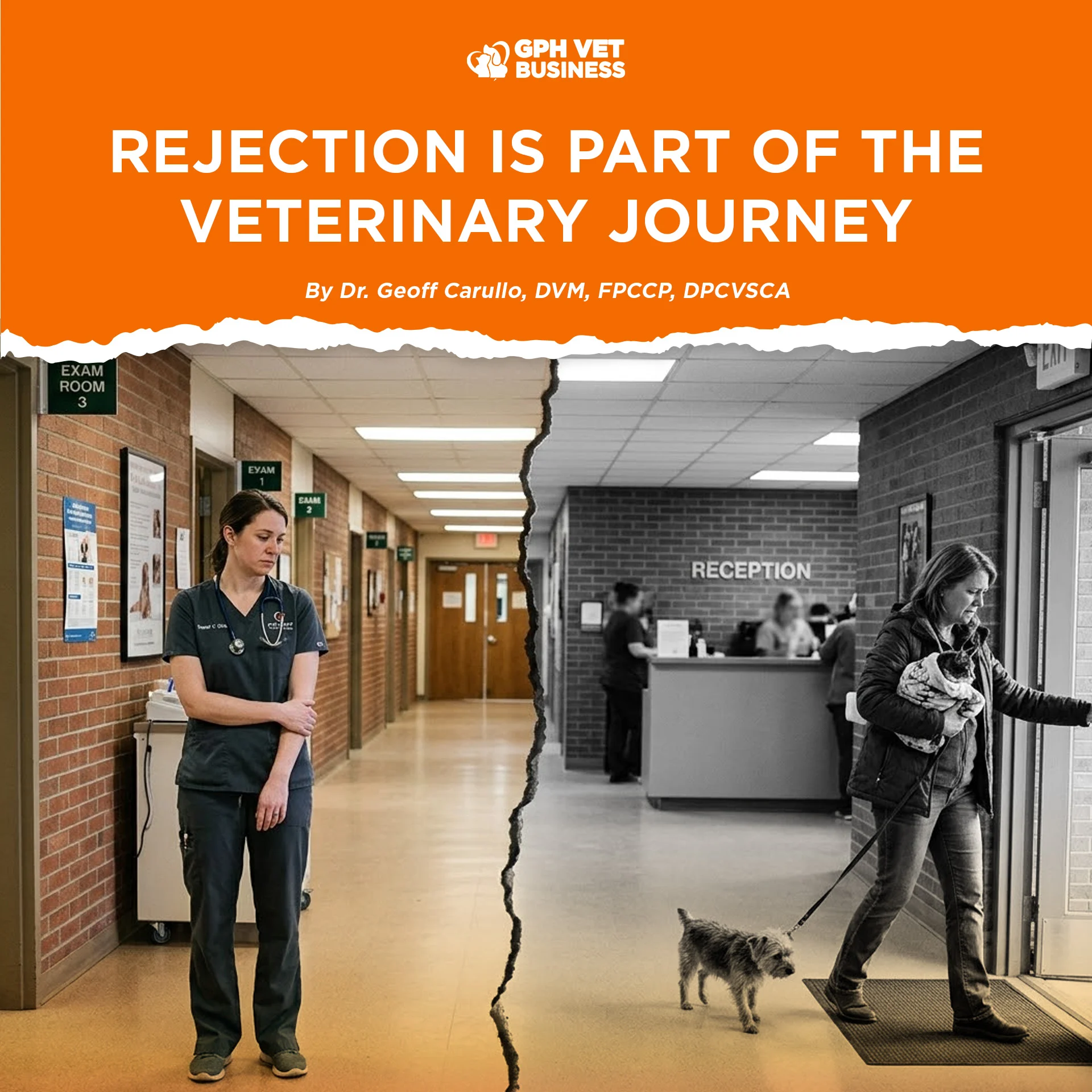
Rejection is Part of the Veterinary Journey
By Dr. Geoff Carullo, DVM, FPCCP, DPCVSCA
In veterinary medicine, rejection comes in many forms.
- A client declines your recommended diagnostics or surgery.
- A case doesn’t respond the way you expected.
- A pet owner questions your decision.
- A colleague disagrees with your approach.
And sometimes, despite doing everything right, things still don’t go your way.
If rejection affects you deeply every time, this profession will drain you.
Because the truth is, rejection is not the exception in veterinary practice.
It is the process.
Every “no” you hear from a client is not a reflection of your worth as a veterinarian.
It is a reflection of many things beyond your control—finances, emotions, timing, understanding.
But if you take every rejection personally, you begin to hesitate.
- You start explaining less.
- You recommend less.
- You avoid difficult conversations.
And slowly, you limit your own growth.
Some veterinarians experience one rejection and pull back.
- They stop pushing for better diagnostics.
- They stop standing firm on their medical decisions.
- They begin to doubt their own clinical judgment.
Not because they are not capable.
But because they allowed rejection to define them.
Others take a different path.
They face rejection, but they don’t stop.
- They reflect.
- They adjust how they communicate.
- They improve how they present options.
- They come back stronger in the next case.
They understand that every declined test, every questioned decision, every difficult interaction is part of becoming better.
Psychology explains this through the concept of resilience and growth mindset.
Veterinarians who view challenges as opportunities to improve are more likely to persist, adapt, and succeed in clinical practice.
Those who see rejection as failure are more likely to withdraw.
Same profession.
Same environment.
Different outcomes.
You will be overlooked.
You will be underestimated.
You will hear “doc, pass muna” more times than you can count.
But none of that defines your ability as a veterinarian.
What defines you is how you respond.
Success in veterinary medicine is not built on constant approval.
It is built on persistence in the face of doubt.
- Showing up again after a difficult case.
- Recommending the right medicine even if it gets declined.
- Continuing to care, even when it’s not appreciated.
The veterinarians who grow are not the ones who avoid rejection.
They are the ones who move through it.
They understand that discomfort is part of mastery.
That every setback carries a lesson.
That every “no” is simply redirecting them toward better communication, better decisions, and better outcomes.
So do not fear rejection in your clinic.
Do not avoid it.
- Face it.
- Learn from it.
- Move through it.
Because the moment rejection stops controlling your emotions…
is the moment you start becoming a stronger, more confident veterinarian.
Sources:
Mindset: The New Psychology of Success (Dweck, 2006) – Growth mindset supports resilience and continuous improvement.
Self-efficacy theory (Bandura, 1977) – Confidence influences persistence and performance.
Grit: The Power of Passion and Perseverance (Duckworth, 2016) – Perseverance is key to long-term success.
Dr. Geoff Carullo is a Fellow and the current President of the Philippine College of Canine Practitioners.
Sharing this helps others understand what it really means to be a vet. Like and follow if you’re with us.