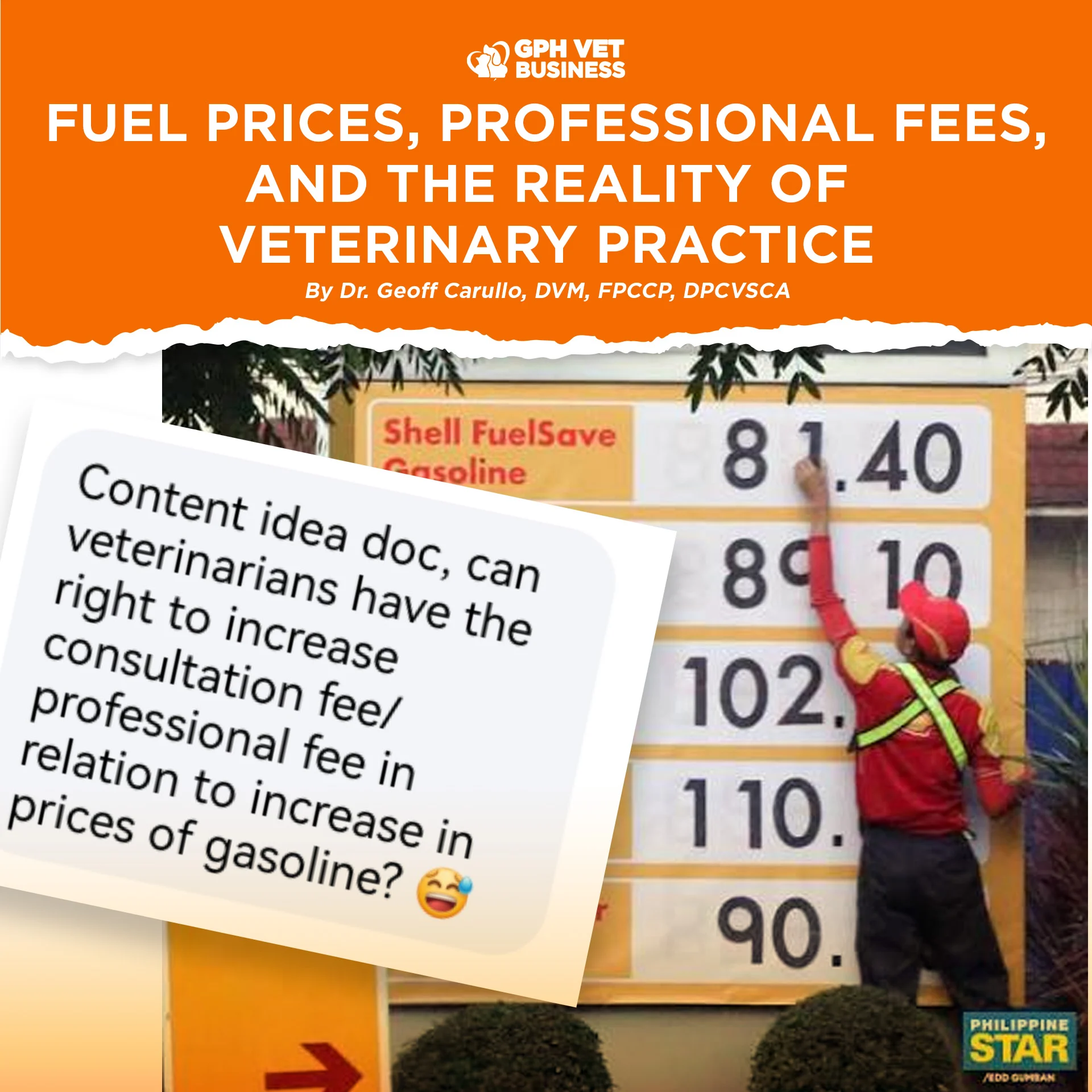
A question that keeps coming up in today’s economic climate is this: Can veterinarians increase their fees because gasoline prices are rising?
The answer is not black and white. It depends on which fee we are talking about.
Let’s begin with consultation fees.
In most veterinary settings, the clinic is stationary. The client comes to you. Your professional fee is based on your expertise, your clinical judgment, your time, and your responsibility as a doctor. These are not directly affected by gasoline prices. Whether fuel goes up or down, your ability to diagnose, treat, and decide remains the same.
That is why, in principle, consultation fees are not directly dictated by fuel costs.
But that’s only one side of the story.
Now let’s talk about house calls.
This is where gasoline becomes very real.
House call services are directly tied to transportation. Every kilometer traveled, every traffic delay, every surge in fuel price—these all translate into actual operational cost. In this case, increasing the house call fee is not only justified, it is practical and fair. You are not just charging for your expertise, you are also covering mobility, time, and logistical expense.
This is one area where fuel prices have a clear and legitimate impact on pricing.
Then comes the products inside your clinic.
Every bag of dog food, every vial of vaccine, every test kit, every IV fluid—none of these magically appear in your clinic. They are transported, stored, and delivered. When gasoline prices rise, logistics costs rise. Suppliers adjust. Distributors adjust. Eventually, clinics feel the effect.
This is why increases in prices of:
- Dog and cat food
- Veterinary drugs and vaccines
- Diagnostic kits and supplies
are expected and understandable. These are logistics-driven costs, and fuel is a major component of that system.
So where does this leave us?
Consultation fees remain a reflection of professional value. They are not automatically tied to gasoline.
House call fees, on the other hand, are directly influenced by fuel and can reasonably be adjusted.
Products and supplies are heavily dependent on logistics, making price increases almost inevitable when fuel costs rise.
At the end of the day, every veterinarian still makes the final call.
Because running a clinic is not just about medicine. It is about sustainability. It is about understanding where your costs truly come from. And it is about making decisions that allow you to continue serving your patients without compromising your practice.
You are not simply reacting to fuel prices.
You are managing a system.
And that is the real role of a veterinarian in today’s world.
Dr. Geoff Carullo is a Fellow and the current President of the Philippine College of Canine Practitioners.
Sharing this helps others understand what it really means to be a vet. Like and follow if you’re with us.