Why Many People Assume This Veterinary Hospital Is Government-Owned
By Dr. Geoff Carullo, DVM, FPCCP, DPCVSCA
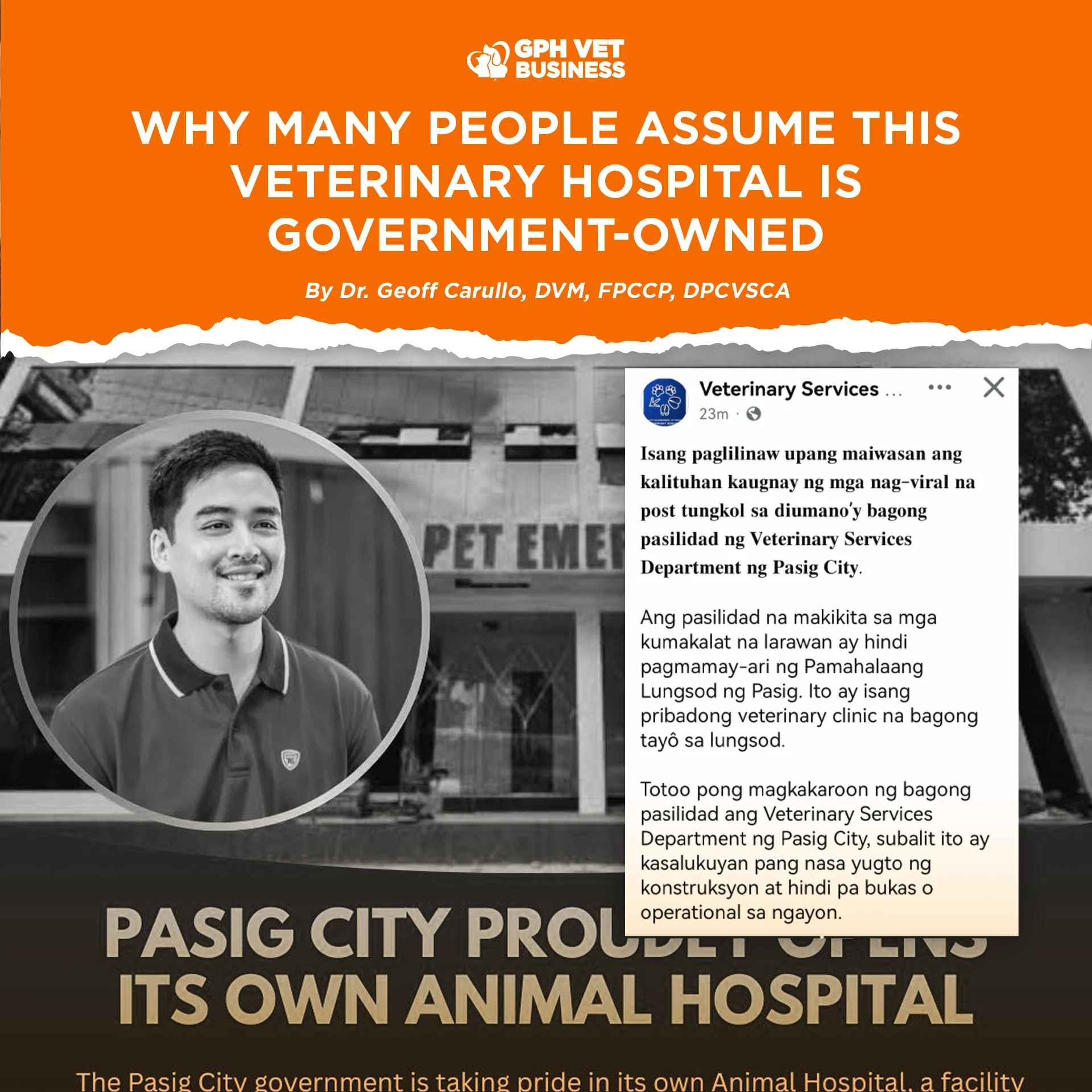
Over the past few days, several viral posts have circulated about a newly opened veterinary facility in Pasig City. A significant number of readers immediately assumed that the hospital is owned and operated by the local government, even though no official statement ever declared it as such.
Read: Veterinary Services Department of Pasig City’s Post
This raises an important question: Why do so many people jump to the conclusion that a veterinary hospital is government-owned?
1. The Term “Veterinary Services” Is Commonly Associated With Government
In the Philippine setting, the phrase “Veterinary Services” has long been associated with:
- City or municipal veterinary offices
- Government-run animal control and rabies programs
- Free or subsidized public services
Because of this historical and cultural exposure, the public has been conditioned to equate the term “Veterinary Services” with an LGU or government department. When this wording appears on a building or in a headline, many readers automatically assume it is publicly owned—even without verification.
This is not immediately malicious. It is a semantic and cultural assumption. However, when left uncorrected, it becomes misinformation.
2. Reading and Understanding Comprehension Remains a Challenge
This is not meant as an insult, but as an observation.
Many people today:
- Read headlines only
- Look at images without reading captions
- Rely on reposted summaries instead of original sources
As a result, context is lost. Details are ignored. Ownership is assumed.
When posts include city names, government-style branding, or public-service language, people rarely pause to ask: Who actually owns and operates this facility?
3. Virality Often Comes Before Accuracy
A major contributor to the confusion is the behavior of some content creators.
Sensational lines such as:
- “City opens its own animal hospital”
- “Government veterinary hospital now operating”
generate far more engagement than a careful, accurate explanation stating that a facility is privately owned.
Whether intentional or not, choosing not to clarify fuels misunderstanding. When virality is prioritized over accuracy, misinformation spreads faster than corrections.
4. Location Does Not Mean Ownership
A critical point that must be emphasized:
Being located within a city does not automatically mean a facility is owned by the city.
Private hospitals, schools, and businesses operate in every city. Veterinary clinics are no different. The presence of a clinic within Pasig City does not make it a government institution unless it is formally declared as such.
5. Why This Clarification Matters
Misunderstandings have real consequences:
- Pet owners may expect free or subsidized services
- Clients may assume government authority or special privileges
- Clinics and veterinarians may receive misplaced criticism when expectations are not met
In the end, the confusion harms both the public and the profession.
Conclusion
This issue is not about attacking a clinic, the government, or content creators.
It is about:
- Responsible communication
- Accurate representation
- Encouraging the public to read beyond headlines
Not every veterinary facility that uses the word “service” is government-owned.
Not every viral post is factual.
And clarity should never be sacrificed for clicks.
Sharing this helps others understand what it really means to be a vet. Like and follow if you’re with us.