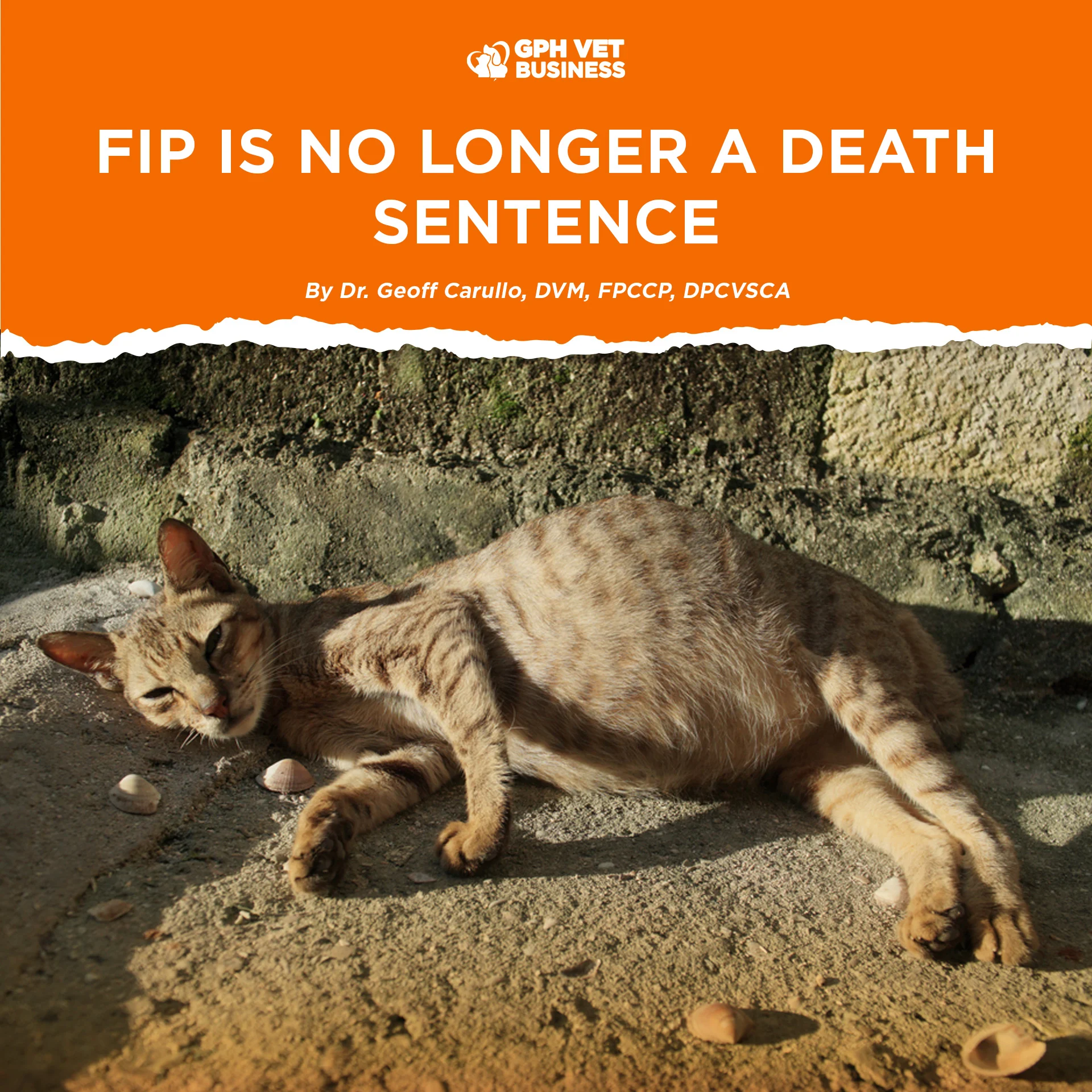
FIP Is No Longer a Death Sentence
By Dr. Geoff Carullo, DVM, FPCCP, DPCVSCA
There was a time when a diagnosis of FIP felt like the end.
No options.
No hope.
Just explanation and euthanasia.
That era is ending.
A recent review by Séverine Tasker and colleagues in Viruses confirms what many progressive clinicians are already seeing in practice:
FIP has entered a new chapter.
And veterinarians need to catch up.
FROM FATAL TO TREATABLE
Feline Infectious Peritonitis is no longer just a tragic outcome of feline coronavirus.
It is now a treatable viral disease in many cases.
This is the shift.
Not theoretical.
Not experimental.
Clinical.
With the introduction of antiviral therapy like GS-441524, we are now seeing:
- Rapid resolution of fever
- Improvement in appetite and activity
- Reduction or disappearance of effusions
- Long-term remission in many patients
We are treating the disease.
UNDERSTANDING THE REAL FIP
The review reinforces something we often oversimplify.
FIP is not just “wet vs dry.”
That classification is convenient.
But incomplete.
FIP exists on a clinical spectrum.
Cats can present with:
- Effusions
- Granulomatous lesions
- Neurologic signs
- Ocular involvement
- Mixed presentations
At its core, FIP is:
- A mutated feline coronavirus
- With macrophage tropism
- Leading to systemic dissemination
- Driven by immune-mediated vasculitis and inflammation
It is a virus-host interaction problem.
THE ANTIVIRAL REVOLUTION
We now target the virus directly.
GS-441524 and similar nucleoside analogs inhibit viral RNA-dependent RNA polymerase, effectively stopping viral replication.
The response is often dramatic.
But not all cases are equal.
CHALLENGING CASES
Neurologic and ocular FIP remain more difficult.
Why?
- Drug penetration barriers
- Higher viral load in protected compartments
- Need for higher dosing and longer treatment duration
These are protocol problems we are still refining.
THE DIAGNOSTIC REALITY
We still do not have a single definitive antemortem test for FIP.
Diagnosis remains:
- Clinical
- Contextual
- Integrative
You are diagnosing FIP by pattern recognition.
What matters:
- Signalment
- Clinical signs
- CBC and biochemistry changes
- Effusion analysis
- PCR or immunostaining when available
Do not wait for perfect confirmation if the clinical picture fits.
Because now, delay has consequences.
THE REAL WORLD PROBLEM
Let’s talk about what the paper also highlights.
Access.
Even if we know what works, we face:
- Variable drug availability
- Inconsistent quality of antivirals
- Regulatory limitations
- Lack of standardization
Science has already moved. Policy has not.
WHAT THIS MEANS FOR YOU AS A VET
This is a mindset shift.
You are no longer explaining inevitability.
You are discussing options.
You are no longer managing decline.
You are aiming for remission.
You are no longer limited by diagnosis alone.
You are guided by clinical judgment and timing.
KEY CLINICAL TAKEAWAYS
- FIP is now treatable in many cases with antivirals
- Early recognition significantly improves outcomes
- Diagnosis is multimodal, not test-dependent
- Neuro and ocular FIP need adjusted protocols
- Drug access and regulation remain major barriers
THE BIGGER PICTURE
FIP used to be one of the most frustrating diseases in feline medicine.
Now it is one of the most exciting.
What happens when medicine catches up to disease.
Your conversations change.
Your confidence changes.
Your outcomes change.
Your patients get a chance they never had before.
Dr. Geoff Carullo is a Fellow and the current President of the Philippine College of Canine Practitioners.
Sharing this helps others understand what it really means to be a vet. If you found this valuable, like and follow for more insights.