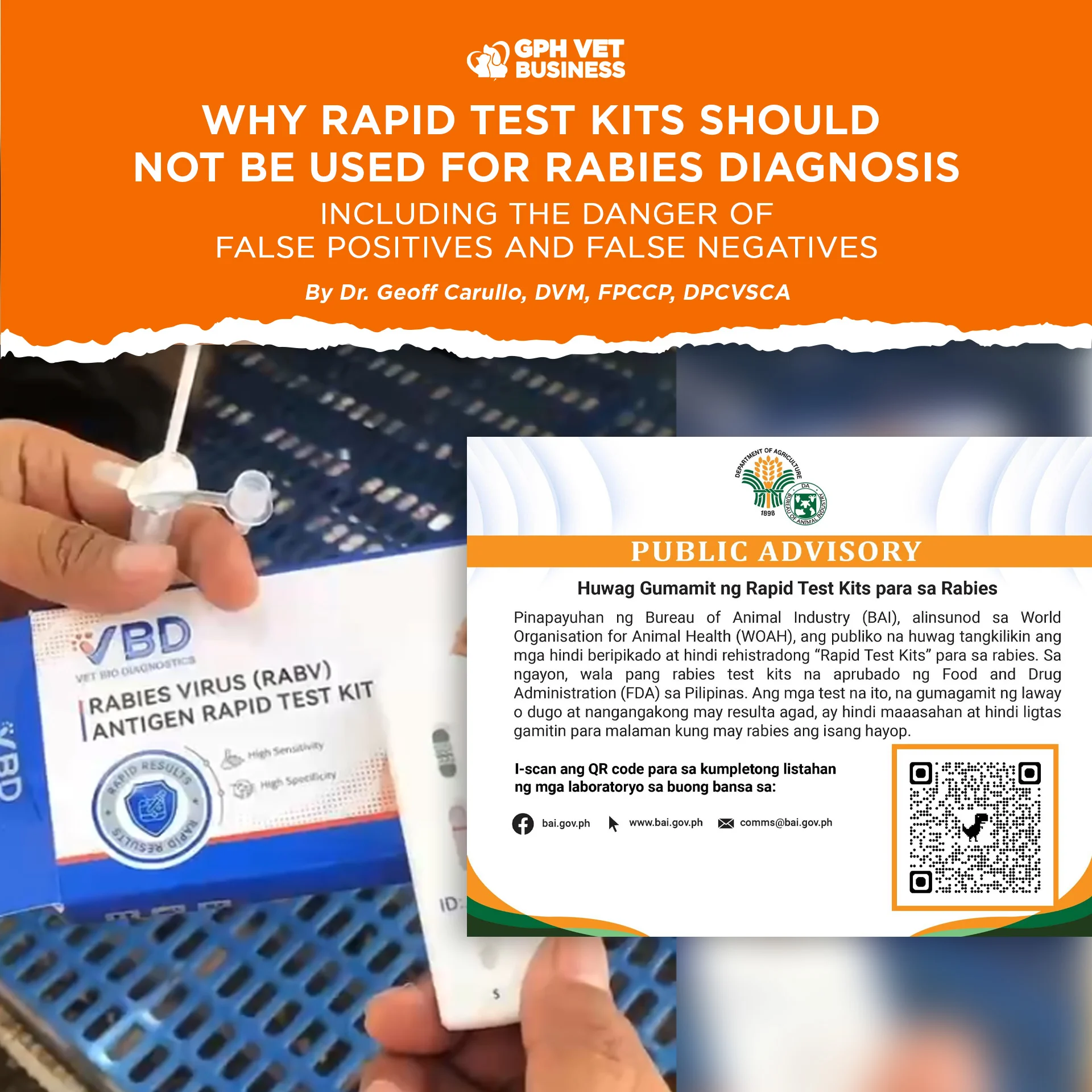
Years ago, a fellow veterinarian once asked me why Vet Diagnostix does not carry a rabies antigen rapid test that was being offered in the market.
My answer then, and up to now, remains simple and honest:
“I honestly cannot explain why some companies sell rabies rapid tests. But I can clearly say this: we do not carry one at Vet Diagnostix.”
— Dr. Geoff Carullo
And there is a reason for that.
Rabies is not a disease that can be reliably diagnosed using blood- or saliva-based rapid test kits. Suggesting otherwise is not just misleading. It is dangerous.
Advisory from the Bureau of Animal Industry (BAI)
The BAI, in alignment with the World Organisation for Animal Health (WOAH), explicitly advises the public not to use unverified and unregistered rapid test kits for rabies.
As of today:
There are no rabies rapid test kits approved by the Food and Drug Administration (Philippines).
Any product claiming to diagnose rabies using blood or saliva with immediate results is unreliable and unsafe.
Commercial kits circulating without regulatory approval place both animal and human lives at risk.
Why Rapid Rabies Tests Are Scientifically Unsound
Rabies does not behave like common viral infections that can be screened through simple samples. Scientifically:
The rabies virus does not consistently shed in saliva
Rabies cannot be reliably detected in blood
The virus primarily localizes in neural tissue, especially the brain
Because of this, rapid test kits—regardless of brand—inherently suffer from poor sensitivity and poor specificity.
This creates two equally life-threatening problems.
False Negative Results: A Silent Killer
A false negative result may falsely assure a bite victim that the animal is rabies-free. This can:
Delay or completely stop post-exposure prophylaxis (PEP)
Provide false reassurance to families
Result in preventable human death
Rabies, once symptomatic, is almost 100% fatal. Missing a diagnosis is unforgivable.
False Positive Results: An Irreversible Tragedy
A false positive result is just as dangerous and often underestimated. It can:
Lead to unnecessary euthanasia of animals
Cause severe emotional trauma to pet owners
Trigger unwarranted PEP in humans, which is invasive, expensive, and not risk-free
Create panic, legal exposure, and erosion of trust in veterinarians
“A false positive can destroy a life just as surely as a false negative. In rabies, accuracy is not optional — it is an ethical responsibility.”
— Dr. Geoff Carullo
The Only Accepted Methods: Gold-Standard Rabies Testing
For these reasons, the BAI uses only internationally accepted confirmatory methods, including:
Direct Fluorescent Antibody Test (DFAT) – the gold standard
Direct Rapid Immunohistochemical Test (dRIT)
Polymerase Chain Reaction (PCR)
These tests:
Examine brain tissue
Provide definitive and confirmatory results
Require that the animal is deceased
While difficult, these remain the only scientifically sound ways to diagnose rabies.
Free Rabies Testing in the Philippines
Rabies testing is conducted free of charge at:
BAI – Animal Disease Diagnosis and Reference Laboratory (ADDRL)
Regional Animal Disease Diagnosis Laboratories (RADDLs)
Important reminders:
Samples must be properly endorsed
Collection must be done only by trained personnel
BAI-ADDRL accepts samples 24/7
Pet owners should coordinate with their City or Municipal Veterinarian (LGU) for proper handling and submission
Legal Reminder: Republic Act No. 9482
The Anti-Rabies Act of 2007 mandates:
Regular rabies vaccination
Responsible pet ownership
Immediate consultation with a licensed veterinarian after any bite incident
Home testing, self-diagnosis, and reliance on unverified rapid test kits place lives at risk and should never be practiced.
Final Word
Rabies is almost always fatal once symptoms appear. There is no room for shortcuts, convenience, or marketing-driven diagnostics.
“I may not be able to explain why some companies sell rabies rapid tests. But I can explain why we don’t. Because when it comes to rabies, being wrong — whether positive or negative — can cost a life.”
— Dr. Geoff Carullo
For the safety of families, communities, and the veterinary profession: do not use rapid test kits for rabies.
Always rely on validated laboratory methods and professional veterinary guidance.
Sharing this helps others understand what it really means to be a vet. Like and follow if you’re with us.