You can be clinically correct.
You can follow protocol.
You can do everything right.
And still lose the patient.
That is the part no one prepares you for.
THE SILENT BURDEN OF BEING A VET
In veterinary medicine, death is not rare.
It is part of the job.
But knowing that does not make it easier.
Because every case is not just a case.
It is someone’s family.
It is someone’s hope.
And sometimes, it becomes your guilt.
You replay everything.
- Did I miss something?
- Did I act too late?
- Could I have done more?
That voice is loud. And it does not stop easily.
WHY WE BLAME OURSELVES
Veterinarians experience high levels of psychological distress, burnout, and self-blame, especially after patient loss.
A study published in the Journal of the American Veterinary Medical Association (JAVMA) found that veterinarians are significantly more prone to mental health struggles compared to the general population.
Research in Veterinary Record highlights that moral stress and compassion fatigue are strongly linked to patient outcomes and perceived failures.
The CDC has also reported elevated suicide risk among veterinarians, partly due to chronic emotional strain and self-imposed pressure.
- We are trained to fix.
- To solve.
- To save.
So when we cannot, we take it personally.
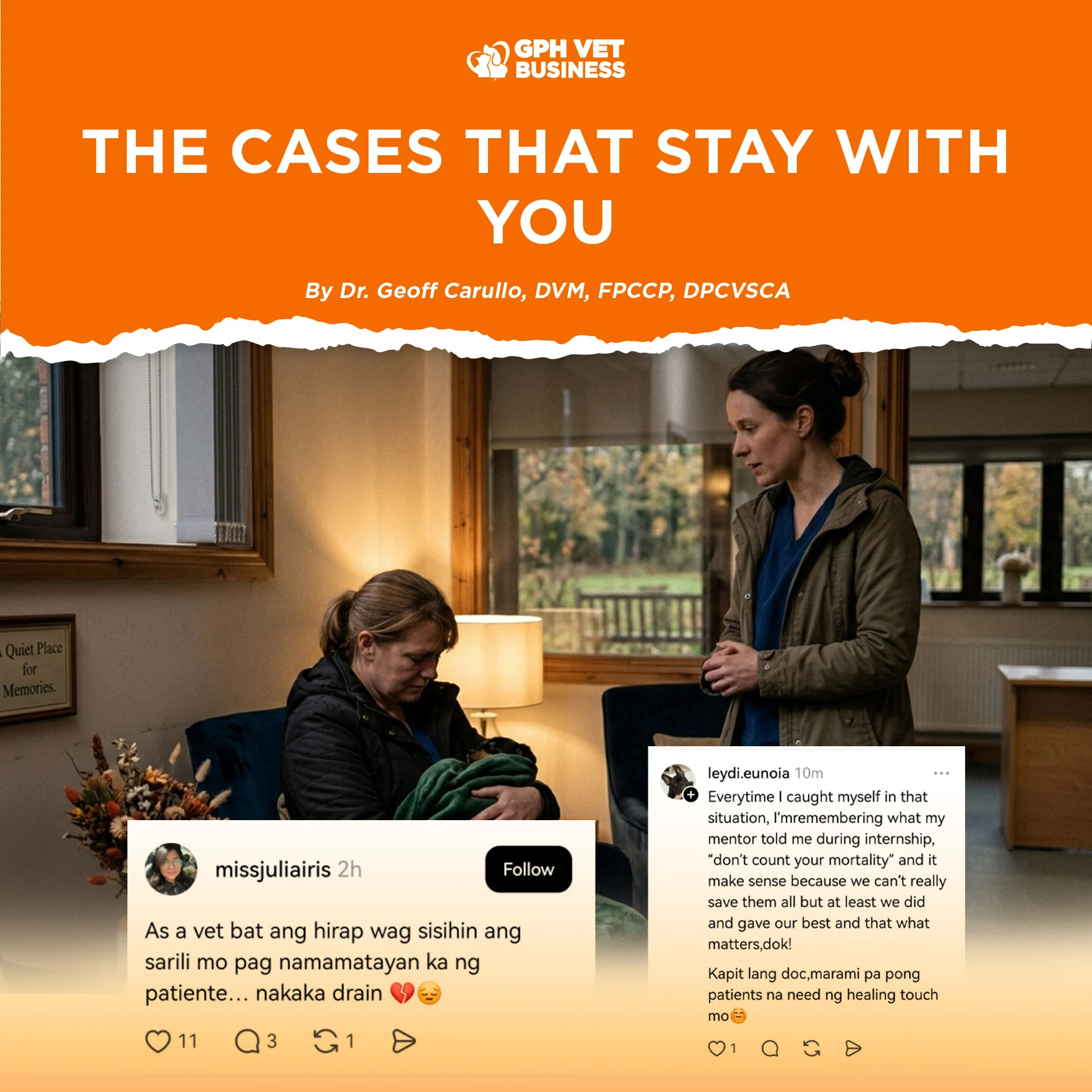
“DON’T COUNT YOUR MORTALITY”
“DON’T COUNT YOUR MORTALITY”
Because if you start measuring yourself by how many patients you lose… you will eventually break.
Medicine is not mathematics.
It is probability.
Even in human medicine, patients still die.
What more in veterinary practice, where limitations are real:
- Financial constraints
- Late presentations
- Limited diagnostics
- Owner decisions beyond your control
You are not practicing in a perfect system. So do not expect perfect outcomes.
THE TRUTH WE NEED TO ACCEPT
You will lose patients.
Not because you are incompetent.
But because biology is unpredictable.
Not because you did not care.
But because sometimes, disease wins.
WHAT ACTUALLY DEFINES A GOOD VETERINARIAN
Not zero mortality. That is impossible.
A good veterinarian is defined by:
- Showing up even after a bad case
- Continuing to learn instead of shutting down
- Being honest with clients even when it hurts
- Giving your best effort, even when the odds are low
What matters is not that you saved all. It is that you tried.
TO THE VETS WHO ARE TIRED
If you have ever gone home questioning yourself…
If you have ever felt drained after losing a patient…
You are not alone.
That feeling does not mean you are weak.
It means you care.
FINAL WORD
You cannot save them all.
But for the ones you do save… you are everything.
And for the ones you lose… you were still their best chance.
SOURCES
- Nett RJ et al. “Prevalence of Risk Factors for Suicide Among Veterinarians” Journal of the American Veterinary Medical Association (JAVMA), 2015.
- Bartram DJ, Baldwin DS. “Veterinary Surgeons and Suicide: Influences, Opportunities and Research Directions” Veterinary Record, 2010.
- Centers for Disease Control and Prevention (CDC). “Suicide Among Veterinarians in the United States,” 2019.
- Figley CR. “Compassion Fatigue: Coping with Secondary Traumatic Stress Disorder,” 1995.
- Moses L et al. “Moral Stress and Burnout in Veterinary Practice” Veterinary Clinics of North America: Small Animal Practice, 2018.
Dr. Geoff Carullo is a Fellow and the current President of the Philippine College of Canine Practitioners.
Sharing this helps others understand what it really means to be a vet. If you found this valuable, like and follow for more insights.