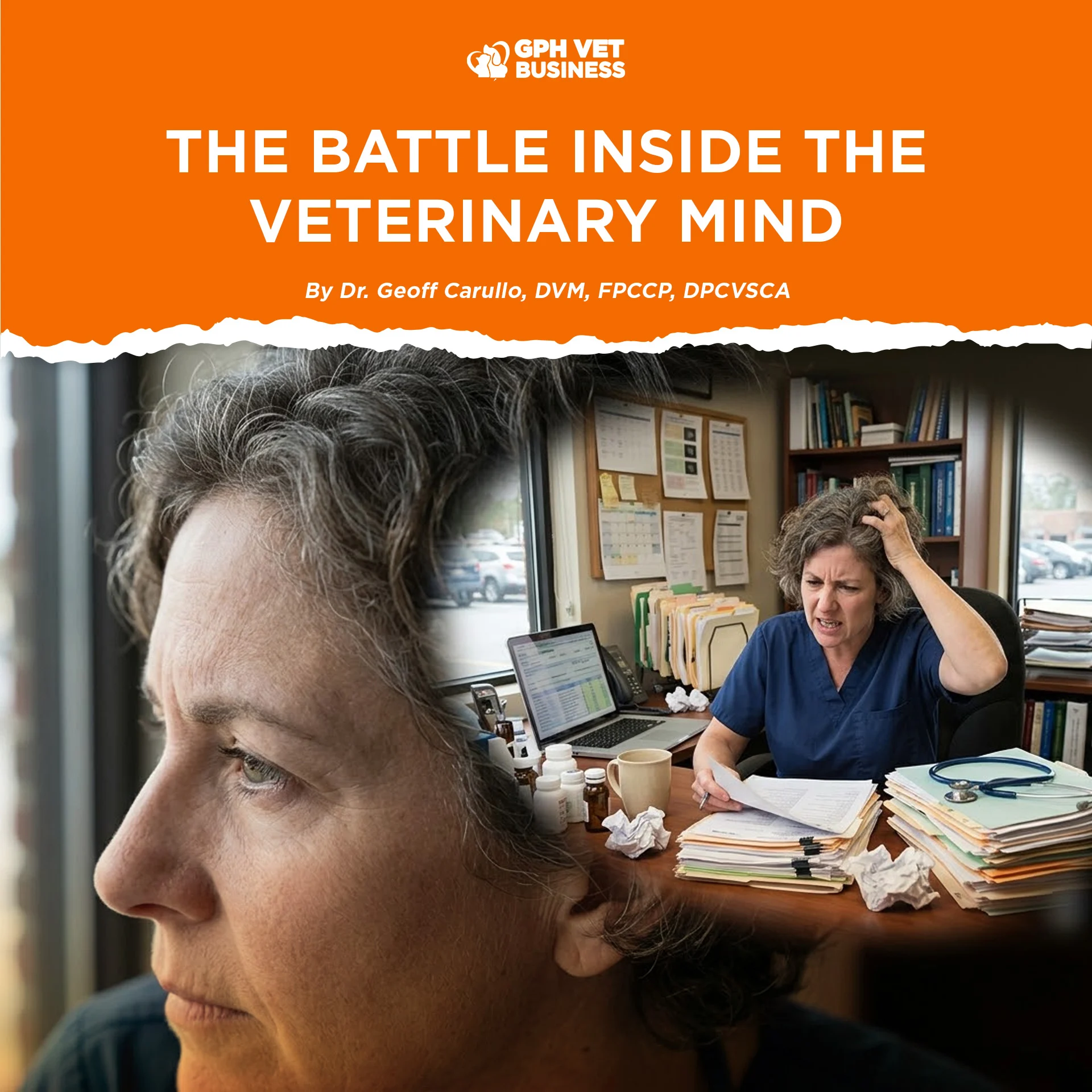
Most veterinarians don’t fail because they lack skill.
They fail because, long before the case begins, long before the clinic opens, long before the decision is made… they’ve already convinced themselves they can’t win.
It doesn’t sound loud.
It doesn’t announce itself.
It whispers.
“Hindi pa ako ready.”
“Baka mali ako.”
“Mas magaling sila kaysa sakin.”
And because it sounds careful, even responsible, we mistake it for logic.
But it isn’t.
It’s fear wearing the uniform of clinical judgment.
In veterinary medicine, we are trained to think critically.
We are taught to analyze, to question, to avoid errors at all costs.
Those are strengths.
But when unchecked, those same strengths can turn against us.
Overthinking becomes hesitation.
Caution becomes avoidance.
And slowly, competence becomes self-doubt.
You see it in practice every day.
- A veterinarian who knows the right diagnostic path but delays acting.
- A clinician who hesitates to explain confidently to clients.
- A capable doctor who stays silent in discussions, afraid of being wrong.
Not because they lack knowledge.
But because they no longer trust themselves.
You don’t need more time.
You don’t need perfect conditions.
You don’t need to feel “ready.”
You need better conversations with yourself.
Because the same mind that questions your every move…
is the same mind that can solve complex cases, lead teams, and save lives.
The difference is not intelligence.
It’s control.
- Control how you respond when a case doesn’t go as planned.
- Control how you think when a client challenges your decision.
- Control the narrative in your head when you feel uncertain.
Because uncertainty is part of this profession.
But self-doubt is optional.
Psychology has long shown that what we believe about our abilities shapes how we perform.
Through the concept of self-efficacy, we understand that confidence is not arrogance.
It is a functional tool. A clinical asset.
Veterinarians who believe they can manage a case are more likely to act decisively, communicate clearly, and persist through difficulty.
Those who don’t… hesitate.
And in medicine, hesitation has consequences.
So the next time doubt shows up in your clinic, don’t treat it as truth.
Treat it like a symptom.
- Observe it.
- Acknowledge it.
- But don’t let it dictate your decisions.
Because at the end of the day, the greatest battle in veterinary medicine is not always the disease in front of you.
It’s the voice inside you.
And if you don’t take control of it, it will take control of your practice, your growth, and your confidence as a doctor.
Sources:
Self-efficacy theory (Bandura, 1977) – Belief in one’s capability directly influences performance and decision-making.
Mindset: The New Psychology of Success (Dweck, 2006) – Growth mindset improves resilience and professional development.
Grit: The Power of Passion and Perseverance (Duckworth, 2016) – Persistence and mindset are key predictors of long-term success.
Dr. Geoff Carullo is a Fellow and the current President of the Philippine College of Canine Practitioners.
Sharing this helps others understand what it really means to be a vet. Like and follow if you’re with us.