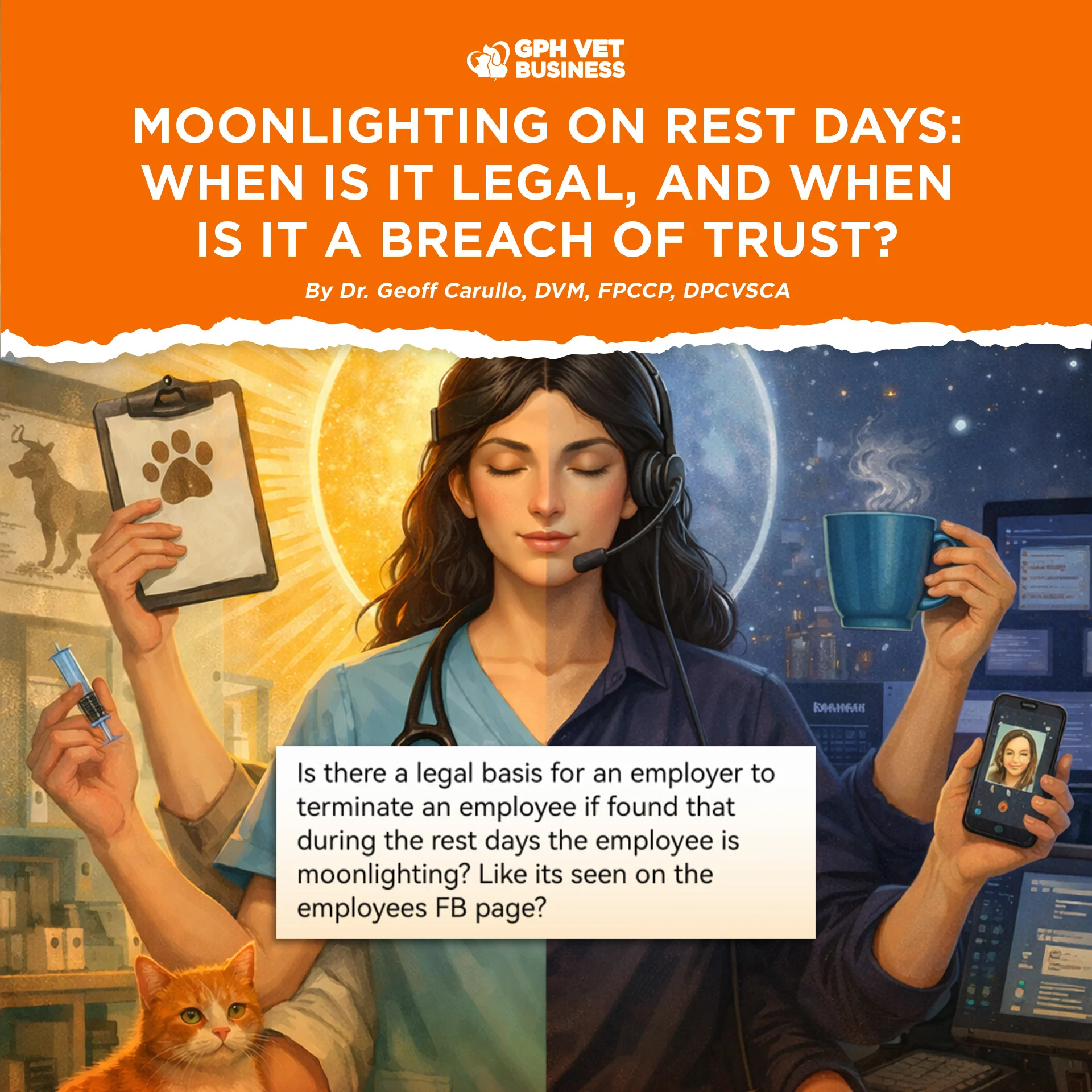
A post recently circulated in a veterinary Facebook group asking an uncomfortable but very real question:
“Is there a legal basis for an employer to terminate an employee if found moonlighting during rest days, especially if it is visible on the employee’s Facebook page?”
This question goes straight to the heart of what is quietly eroding trust in many veterinary clinics today. To answer it properly, we must separate what is legal from what is ethical, and then from what is professional.
Is moonlighting illegal in the Philippines?
By itself, moonlighting is not illegal. An employee is generally free to engage in another source of income during rest days or outside working hours. The right to earn a living is constitutionally protected.
However, this freedom is not absolute. Once you sign an employment contract, you also assume duties of loyalty, good faith, and honesty toward your employer. This is where many young veterinarians get into serious trouble.
When does moonlighting become a legal ground for termination?
Moonlighting becomes a valid ground for disciplinary action or termination when it violates contractual obligations or creates a conflict of interest.
First, non-compete or exclusivity clauses. Many veterinary clinics include provisions prohibiting work for competing clinics, private practice, referral leakage, or use of employer resources for outside work. If you signed such a clause and moonlight anyway, that is a breach of contract. Breach of contract is a lawful ground for termination.
Second, conflict of interest, even without a written non-compete clause. Moonlighting becomes actionable when it involves treating your employer’s clients elsewhere, accepting cases that should have gone to your clinic, advertising your own side practice while employed, or undermining your employer’s pricing and services. In labor law, an employee must act in the best interest of the employer. Competing with your employer while employed is not a right; it is disloyalty.
Third, use of employer time, resources, or reputation. Using clinic equipment, drugs, supplies, records, branding, or performing side work during paid clinic hours constitutes misappropriation and fraud. Publicly posting these activities on social media makes them even easier to prove.
“But it was my rest day”
This is a common misunderstanding. A rest day means you are free from scheduled work; it does not suspend your duty of loyalty. You can sell food, drive Grab, tutor students, or run an online business. But if you are a veterinarian employed by a clinic, you cannot use your license to quietly build a competing veterinary practice behind your employer’s back.
That is not hustle. That is betrayal.
Social media turns conduct into evidence
When moonlighting is posted on Facebook, advertised on Instagram, shared in veterinary groups, shown in clinic photos, or tagged by clients, it becomes documented proof. An employer does not need surveillance when the employee publishes the evidence themselves.
The deeper issue in veterinary practice
Many young vets say, “Mababa ang sahod. Kailangan ko ng sideline.” That concern may be real. But the moment you accept a clinic’s salary, training, cases, clients, reputation, and financial investment, you also accept a professional obligation not to undermine the very business supporting you.
Veterinary clinics are not multinational corporations with massive buffers. Most are owned by veterinarians who use personal savings, loans, and emotional bandwidth to keep the doors open. When a vet secretly builds a competing practice while being paid by someone else, the clinic is effectively funding its own future competitor.
So can an employer terminate a moonlighting employee?
Yes—when there is a non-compete or exclusivity clause, a conflict of interest, client diversion, use of clinic resources, or a breach of trust and confidence. In veterinary practice, trust is foundational. Once broken, no amount of technical skill can repair it.
The real issue is not whether moonlighting is allowed.
The real question is whether you are building yourself honestly—or building yourself on top of someone else’s clinic.
Sharing this helps others understand what it really means to be a vet. Like and follow if you’re with us.