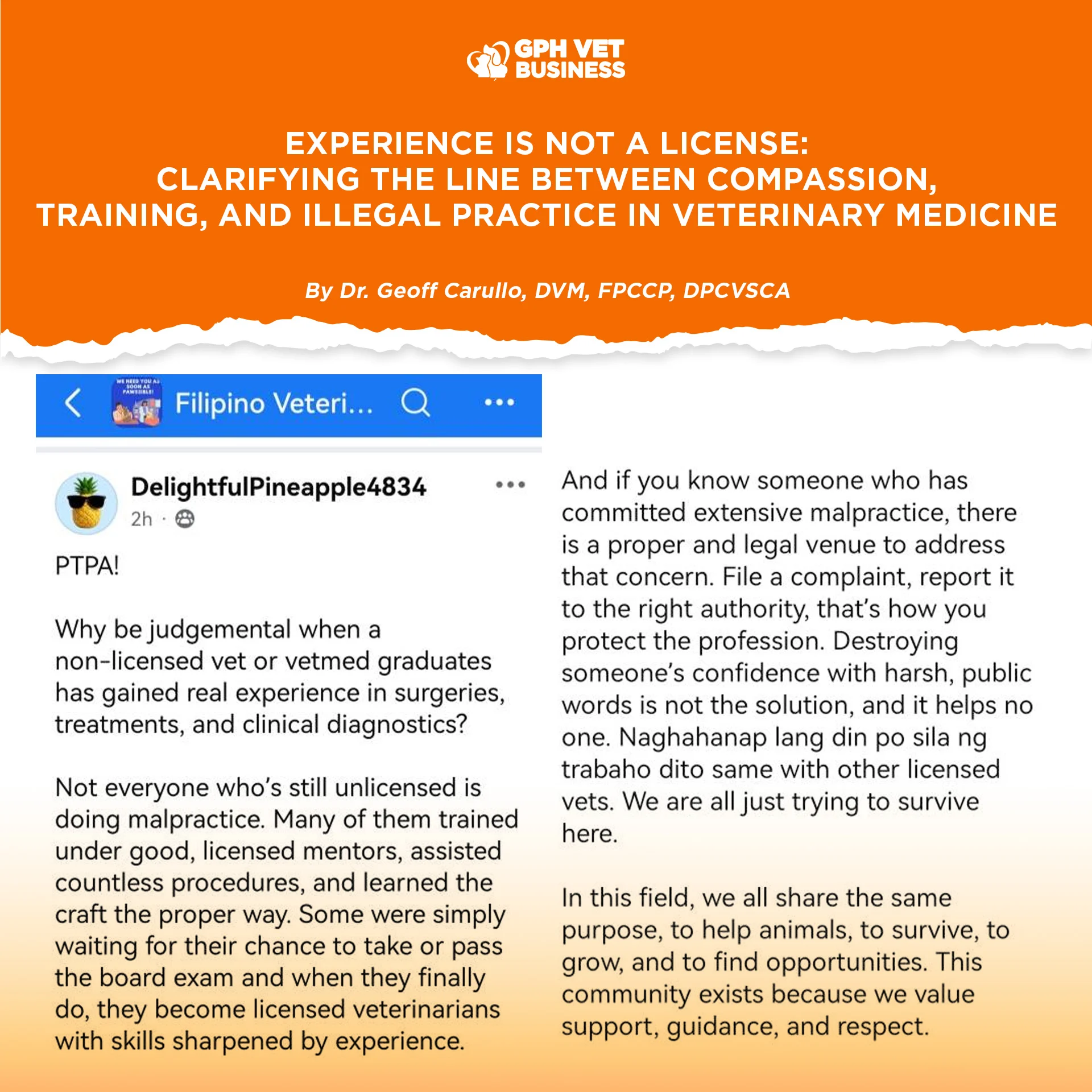
The recent discussion circulating in veterinary groups about non-licensed veterinarians and vetmed graduates practicing clinical work deserves a clear, unemotional, and lawful clarification.
This is not about attacking individuals. This is about protecting animals, the profession, and the public through the rule of law.
This Is Not Veterinary Malpractice
Malpractice is committed by a licensed professional who deviates from the accepted standard of care.
A person without a valid PRC license cannot commit veterinary malpractice, because legally, they are not a veterinarian.
What we are dealing with here is illegal practice of veterinary medicine.
PRC and PVMA disciplinary mechanisms apply only to licensed veterinarians. An unlicensed individual is outside their regulatory jurisdiction. This is why complaints against unlicensed practice are not handled as ethics cases, but as violations of law.
The Law Is Clear and Non-Negotiable
Veterinary medicine in the Philippines is a regulated profession. The law explicitly states that no person may practice veterinary medicine without a valid license issued by the Professional Regulation Commission.
This requirement exists for one reason: standardization.
If experience alone were enough, then the licensure examination would be meaningless. Why require years of education, clinical training, and a national board exam if we will eventually allow practice without passing it?
The license is not a piece of paper. It is the State’s declaration that the individual has met minimum, standardized, and verifiable competence to treat animals and safeguard public health.
Compassion and experience are valuable. But they do not override the law.
Training Under a Licensed Mentor Is Not Authority to Practice
Many unlicensed graduates assist in clinics, observe surgeries, restrain patients, and learn diagnostics. This is normal and necessary as part of professional growth.
However, assisting is not the same as practicing.
Once an unlicensed person independently:
- Diagnoses
- Prescribes
- Performs surgery
- Conducts treatments
- Represents themselves as a veterinarian
they have crossed from training into illegal practice, regardless of skill level or intention.
Good intentions do not legalize an illegal act.
Liability Does Not Stop With the Unlicensed Individual
A licensed veterinarian who knowingly allows an unlicensed person to practice veterinary medicine under their watch may be held liable for condoning illegal practice.
This is not mentorship. This is not compassion. This is exposure to criminal, civil, and administrative consequences.
As licensed professionals, we are expected to uphold the law, not selectively suspend it.
Proper Process Protects Everyone
Calling out illegal practice is not cruelty. It is responsibility.
There are legal venues for addressing these concerns. Filing reports, submitting evidence, and allowing due process to take place ensures that:
- Animals are protected
- The profession maintains credibility
- Individuals are corrected, not destroyed
Correcting someone does not always mean ending their career. In many cases, it redirects them toward legitimate roles such as veterinary nursing, further training, or eventually, proper licensure.
That is accountability with humanity.
Compassion Must Walk With the Law
We can empathize with those struggling to pass the board exam. We can support graduates seeking experience. We can mentor and guide.
But we cannot normalize illegal practice under the banner of kindness.
Because once we blur that line, we endanger animals, discredit our profession, and weaken the very standards that protect us all.
The law is not heartless. It exists to ensure that when an animal’s life is placed in someone’s hands, that person has been formally tested, verified, and authorized to carry that responsibility.
Final Thought
Experience matters. Training matters. Compassion matters.
But licensure is the non-negotiable foundation of professional practice.
Upholding that does not make us judgmental. It makes us responsible custodians of veterinary medicine.
𝐒𝐡𝐚𝐫𝐢𝐧𝐠 𝐭𝐡𝐢𝐬 𝐡𝐞𝐥𝐩𝐬 𝐨𝐭𝐡𝐞𝐫𝐬 𝐮𝐧𝐝𝐞𝐫𝐬𝐭𝐚𝐧𝐝 𝐰𝐡𝐚𝐭 𝐢𝐭 𝐫𝐞𝐚𝐥𝐥𝐲 𝐦𝐞𝐚𝐧𝐬 𝐭𝐨 𝐛𝐞 𝐚 𝐯𝐞𝐭. 𝐋𝐢𝐤𝐞 𝐚𝐧𝐝 𝐟𝐨𝐥𝐥𝐨𝐰 𝐢𝐟 𝐲𝐨𝐮’𝐫𝐞 𝐰𝐢𝐭𝐡 𝐮𝐬.