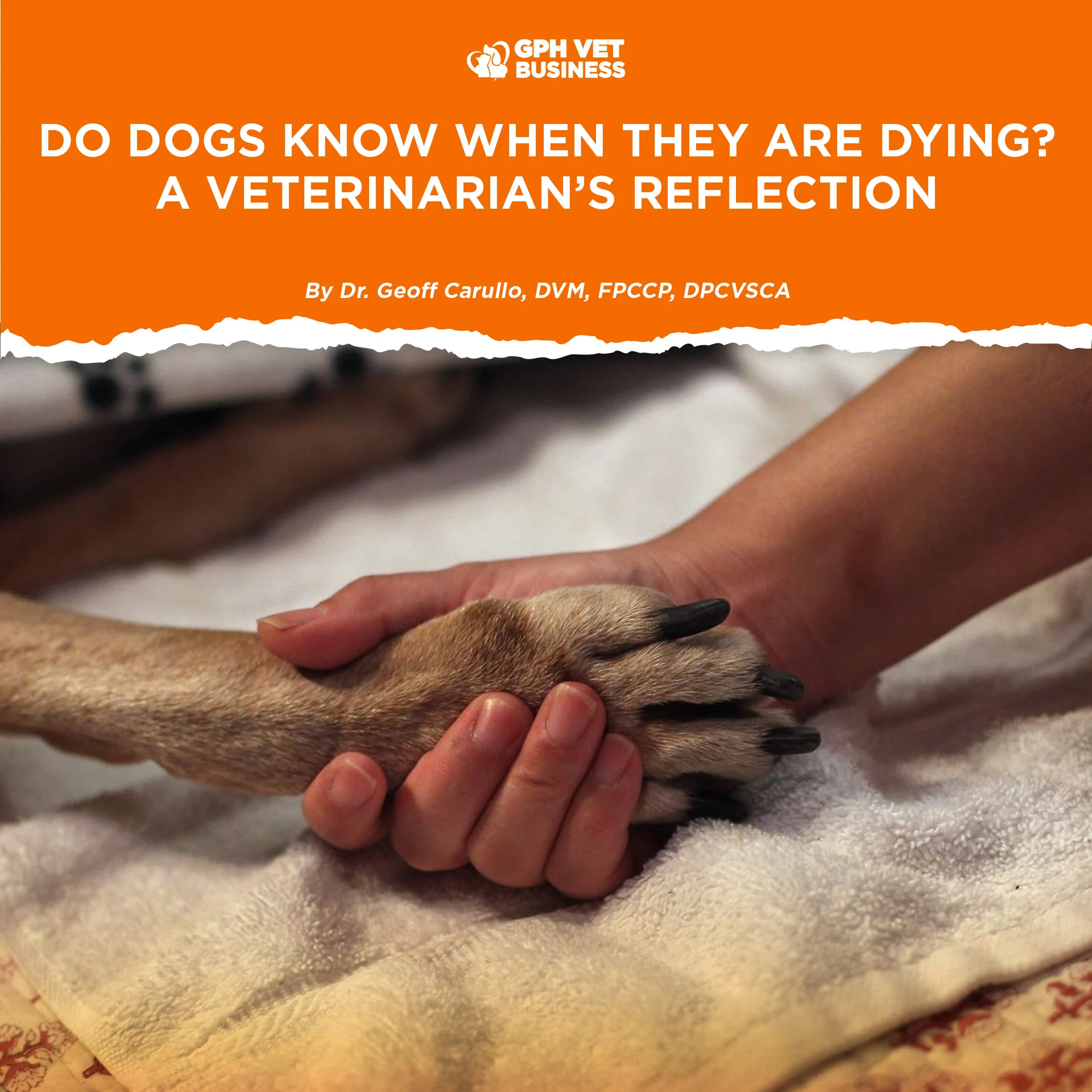
Do Dogs Know When They Are Dying? A Veterinarian’s Reflection
By Dr. Geoff Carullo, DVM, FPCCP, DPCVSCA
One of the most difficult questions we face as veterinarians is this: Does a dog know when it is about to die?
And if it does, should we allow it to pass at home with family, or is it kinder and safer to keep the patient confined in a clinic?
There is no single answer, but there is truth in both science and experience.
Do Dogs Sense the End of Life?
Dogs may not understand death the way humans do, but they can feel their bodies shutting down.
They recognize weakness, severe fatigue, loss of appetite, and the inability to do the things they once enjoyed. Many will withdraw. Some become unusually clingy. Others seek silence and isolation.
More importantly, dogs respond intensely to human emotion. When a family is grieving, anxious, or afraid, dogs sense this shift and often adjust their behavior. They may stay close to loved ones not because they know they are dying, but because they feel that their family needs comfort.
Do Dogs Prefer to Be at Home?
Most dogs find peace in familiar places. The scent of their owners, the rhythm of household sounds, the presence of the people they love. These give comfort during the final days.
Being at home can reduce stress. No strange smells, no unfamiliar voices, no medical machines. For some patients, especially those who are stable but terminal, being in the warmth of family can be deeply meaningful.
When Is the Clinic the Kinder Choice?
There are cases when confinement is the more humane decision:
- When a patient is in uncontrolled pain.
- When active bleeding, seizures, difficulty breathing, or organ failure requires continuous medical support.
- When the family does not have the means or equipment to manage symptoms at home.
In these moments, the clinic becomes a place of relief. Oxygen support, IV fluids, pain control, and close monitoring can prevent unnecessary suffering. As veterinarians, we are responsible for protecting the patient from pain that the family cannot see, recognize, or manage.
The Balance We Must Hold
The best choice is not emotional. It is compassionate.
Our duty is to guide the family toward what minimizes suffering while honoring the bond between pet and owner.
Some dogs are safest and most comfortable in the clinic.
Some dogs are happiest taking their final breaths surrounded by the people who shaped their lives.
There is no wrong choice when love and humane care lead the decision.
What matters most is simple:
- A peaceful passing.
- No pain.
- No fear.
- And a family who knows they did the kindest thing.
𝐒𝐡𝐚𝐫𝐢𝐧𝐠 𝐭𝐡𝐢𝐬 𝐡𝐞𝐥𝐩𝐬 𝐨𝐭𝐡𝐞𝐫𝐬 𝐮𝐧𝐝𝐞𝐫𝐬𝐭𝐚𝐧𝐝 𝐰𝐡𝐚𝐭 𝐢𝐭 𝐫𝐞𝐚𝐥𝐥𝐲 𝐦𝐞𝐚𝐧𝐬 𝐭𝐨 𝐛𝐞 𝐚 𝐯𝐞𝐭. 𝐋𝐢𝐤𝐞 𝐚𝐧𝐝 𝐟𝐨𝐥𝐥𝐨𝐰 𝐢𝐟 𝐲𝐨𝐮’𝐫𝐞 𝐰𝐢𝐭𝐡 𝐮𝐬.