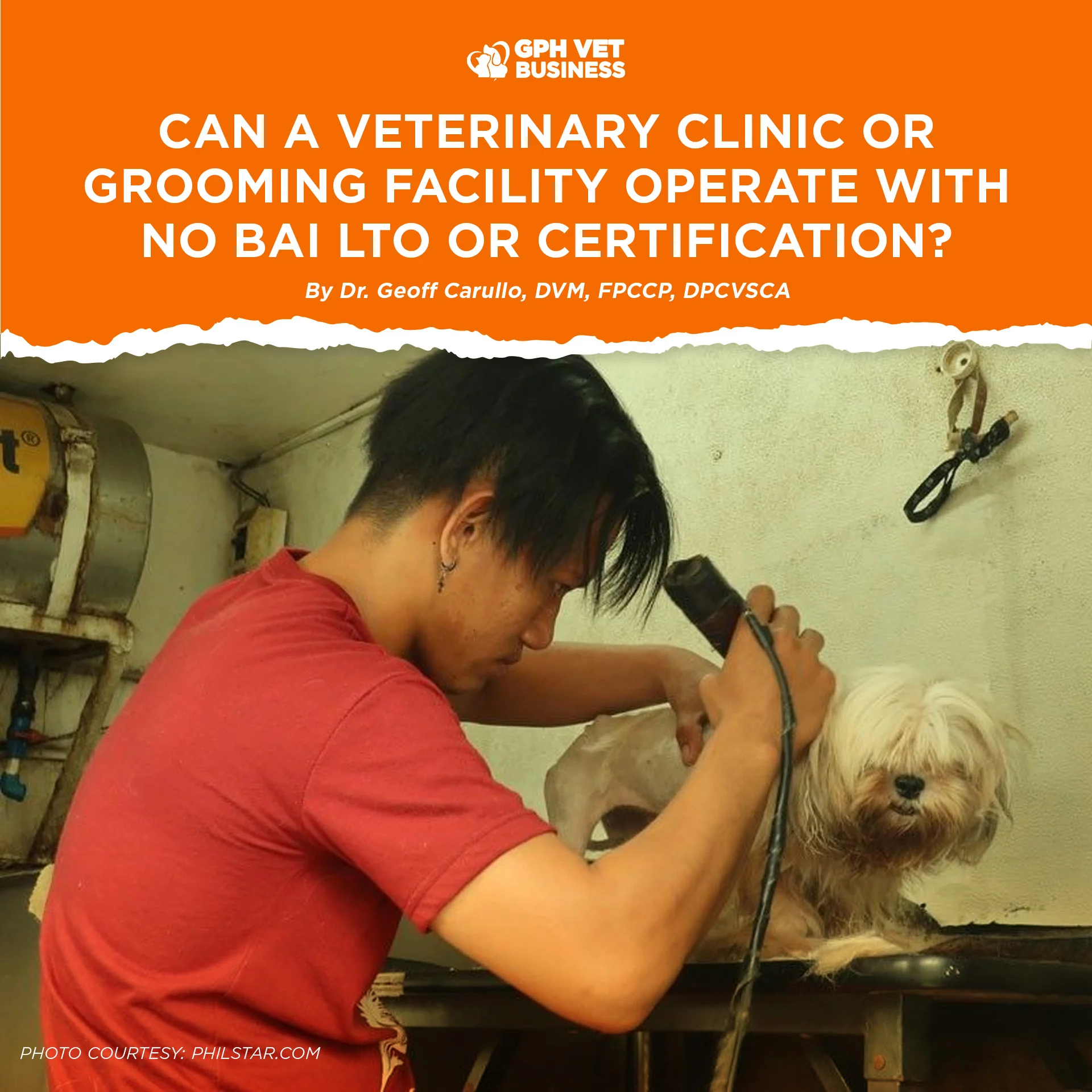
A post recently asked:
“Pwede ba mag operate ang clinic for surgery kahit walang LTO permit?”
Follow-up: “Paano kung wala talagang BAI LTO at kahit anong permit?”
Let us answer this clearly, fairly, and legally.
1. BAI regulates facilities, not just veterinarians
In the Philippines, animal facilities are regulated by the Bureau of Animal Industry (BAI) under the Animal Health and Welfare framework.
This means BAI does not only look at who is practicing (PRC-licensed vets), but also where animals are treated, handled, confined, groomed, or operated on.
That includes:
Veterinary clinics
Veterinary hospitals
Surgical facilities
Grooming facilities
Animal handling facilities
If a facility has no BAI LTO or certification at all, it has no regulatory clearance to operate as an animal facility.
2. Surgery without BAI LTO is a hard NO
Surgery is not a “service.”
It is an invasive medical act involving:
Anesthesia
Open tissues
Blood exposure
Infection risk
Life-threatening complications
BAI requires that any clinic performing surgery must pass inspection for:
Operating room standards
Sterilization areas
Instruments
Recovery cages
Waste disposal
Drug storage
Ventilation and lighting
These are found in BAI’s official Veterinary Clinic & Hospital Inspection Form (RF AHWD-64), which explicitly covers surgical clinic requirements.
If a clinic has no BAI LTO, it is not cleared to perform surgery, even if the veterinarian is PRC-licensed.
3. “Licensed naman ang vet” does not legalize the building
PRC license = authority to practice
BAI LTO = authority of the facility to operate
You need both.
A licensed surgeon working inside an unlicensed facility is still operating in an illegal medical environment.
This is why BAI licenses the place, not just the person.
4. Grooming shops are not exempt
A common misconception:
“Grooming lang naman yan, hindi clinic.”
But grooming facilities:
Restrain animals
Use sharp tools
Expose animals to heat, water, chemicals
Risk injuries, infections, and stress-related death
Because of this, BAI has an official Grooming Facility Inspection Form (RF AHWD-84).
This proves that grooming shops are also expected to meet animal facility standards.
A grooming shop with no BAI certification at all is operating without animal-welfare regulatory clearance.
5. Business permits do NOT replace BAI authority
City Hall permits (Mayor’s Permit, Barangay Clearance, Sanitary, BFP, etc.) only mean:
“You are allowed to do business.”
They do NOT mean:
“You are allowed to operate an animal medical or animal handling facility.”
That power belongs to BAI.
6. What happens when something goes wrong
When:
A pet dies during surgery
A dog is injured during grooming
An infection spreads in confinement
The absence of BAI LTO or certification becomes automatic proof of unsafe operation.
Even before medical skill is questioned, the facility is already legally defective.
7. Official BAI reference forms (publicly downloadable)
These are the same forms used by BAI inspectors nationwide:
Veterinary Clinic & Hospital (including surgery)
RF AHWD-64 – Veterinary Clinic & Hospital Inspection Form
https://ww2.bai.gov.ph/media/ajpng0ve/rf-ahwd-64-veterinary-clinic-hospital-inspection-form.pdf
Grooming Facilities
RF AHWD-84 – Grooming Facility Inspection Form
https://ww2.bai.gov.ph/media/p0hijhku/rf-ahwd-84-grooming-facility-inspection-form.pdf
Master BAI Download Page
https://ww2.bai.gov.ph/ahwd-downloads?BA=Animal+Health+and+Welfare+Forms
These show that BAI officially regulates both clinics and grooming facilities.
Final word
If your clinic or grooming shop has no BAI LTO or certification at all, then:
Surgery is illegal
Anesthesia is illegal
Confinement is unsafe
Grooming is unregulated
This is not about paperwork.
This is about animal lives, public trust, and professional accountability.
A veterinary facility is not legitimate because it exists.
It is legitimate because it is licensed to protect life.
Sharing this helps others understand what it really means to be a vet. Like and follow if you’re with us.