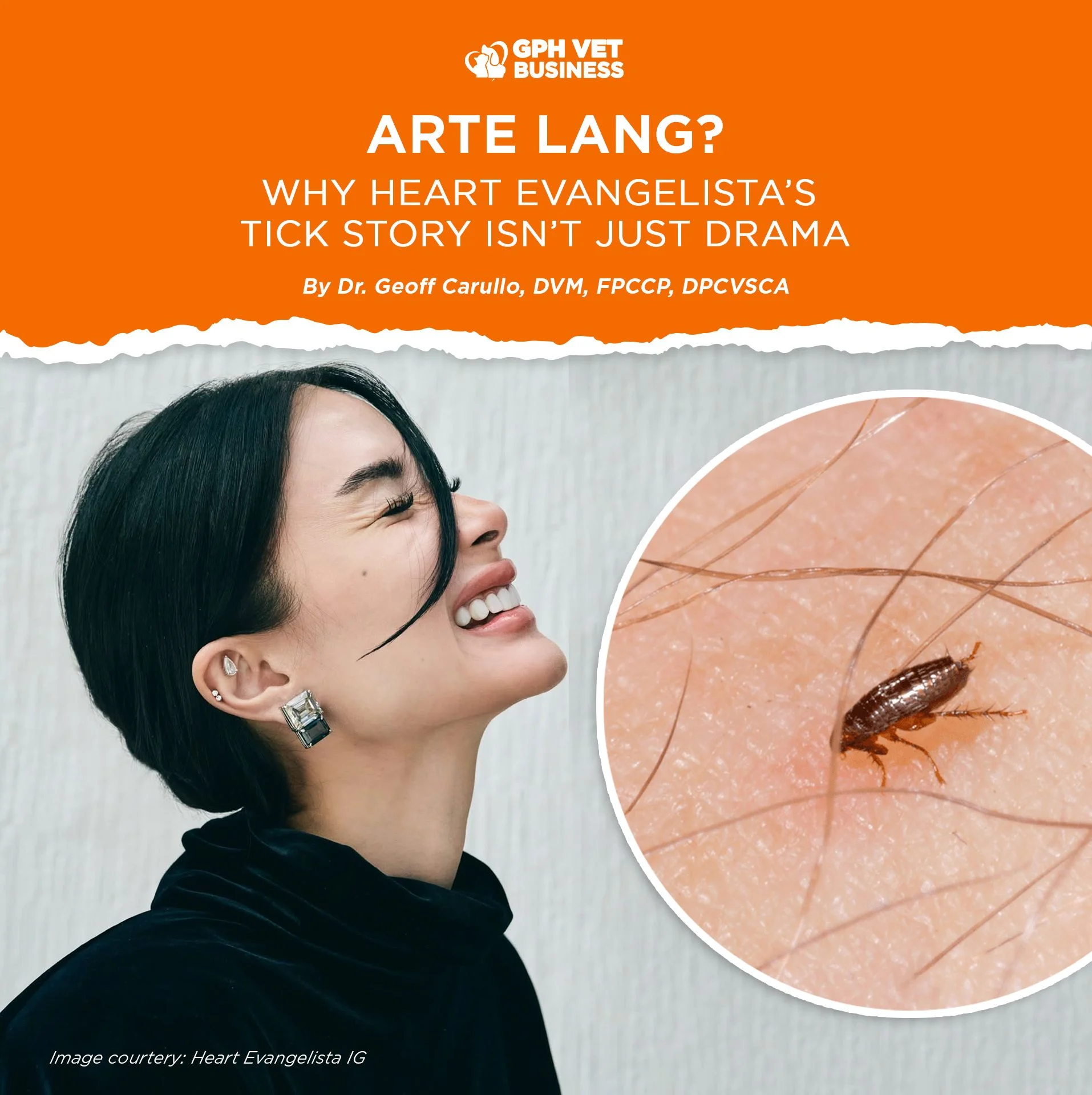
When Heart Evangelista shared that she had a tick bite, parts of the internet reacted predictably:
- “Arte lang yan.”
- “Drama.”
- “Overreacting.”
But here is the truth every veterinarian understands:
- Parasite exposure is not vanity.
- It is medicine.
- It is dermatology.
- It is zoonosis.
And what many netizens dismiss as “kaartehan” is often the exact scenario that walks into our clinics daily.
Parasites don’t only cause “itch.” They trigger inflammatory biology.
Ticks and fleas aren’t simply crawling insects.
They inject:
- saliva
- proteins
- antigens
And in both animals and people, these can trigger hypersensitivity reactions.
That is where Flea Allergy Dermatitis becomes an important teaching point.
Flea Allergy Dermatitis — and what people misunderstand
In dogs and cats, Flea Allergy Dermatitis (FAD) is one of the most common pruritic conditions we manage.
One bite.
One microscopic exposure.
Massive inflammatory cascade.
We see:
- intense pruritus
- papules
- alopecia
- excoriations
- secondary infections
Owners assume parasites must be “plenty” to cause a problem.
We know that sometimes one bite is enough.
And while FAD is primarily an animal dermatologic condition, fleas also cause skin reactions in humans living in the same environments.
Yes — humans can react too
Humans exposed to flea-infested environments often develop:
- pruritic papules (usually ankles, legs, lower body)
- clustered, linear “breakfast, lunch, dinner” bite patterns
- erythema
- localized rashes
- secondary excoriations from scratching
In sensitized or allergic individuals, reactions may be significant — sometimes worrying enough to seek medical evaluation.
It is not psychological.
It is not “celebrity sensitivity.”
It is an inflammatory response to arthropod saliva.
And when netizens call it “kaartehan,” they reveal how poorly parasites are understood outside veterinary medicine.
Tick bites: not always catastrophic — but never trivial
A single tick bite does not automatically mean systemic disease.
But clinically, it is never “nothing”.
Tick saliva alone can trigger localized:
- erythema
- edema
- irritation
- pruritus
In some patients, we also see exaggerated hypersensitivity reactions.
Layered on top of that is the potential for transmission of pathogens, depending on vector species, attachment time, and geography.
So no — we don’t sensationalize.
But neither do we minimize.
Our role as veterinarians: reframe ignorance into awareness
When public figures experience something health-related, the internet usually defaults to mockery.
But veterinarians should see the opportunity.
Moments like this allow us to say:
This isn’t drama.
This isn’t overreaction.
This is why parasite prevention matters.
We educate that:
- fleas are not harmless
- ticks are not cosmetic
- rashes are not automatically “allergy lang”
- hypersensitivity biology is real
- human–pet–environment health is interconnected
The language shifts from ridicule to responsibility.
Final message — for colleagues and clients alike
Heart Evangelista’s experience did not create the problem.
It exposed it.
People live with pets.
Pets live with parasites when unprotected.
Parasites interact with skin, immune systems, and sometimes bloodborne pathogens.
And yes — rashes, papules, itching, and reactions are real.
Not “arte.”
Not exaggeration.
Not drama.
Just science.
And science deserves explanation — not ridicule.
Sharing this helps others understand what it really means to be a vet.
Like and follow if you’re with us.