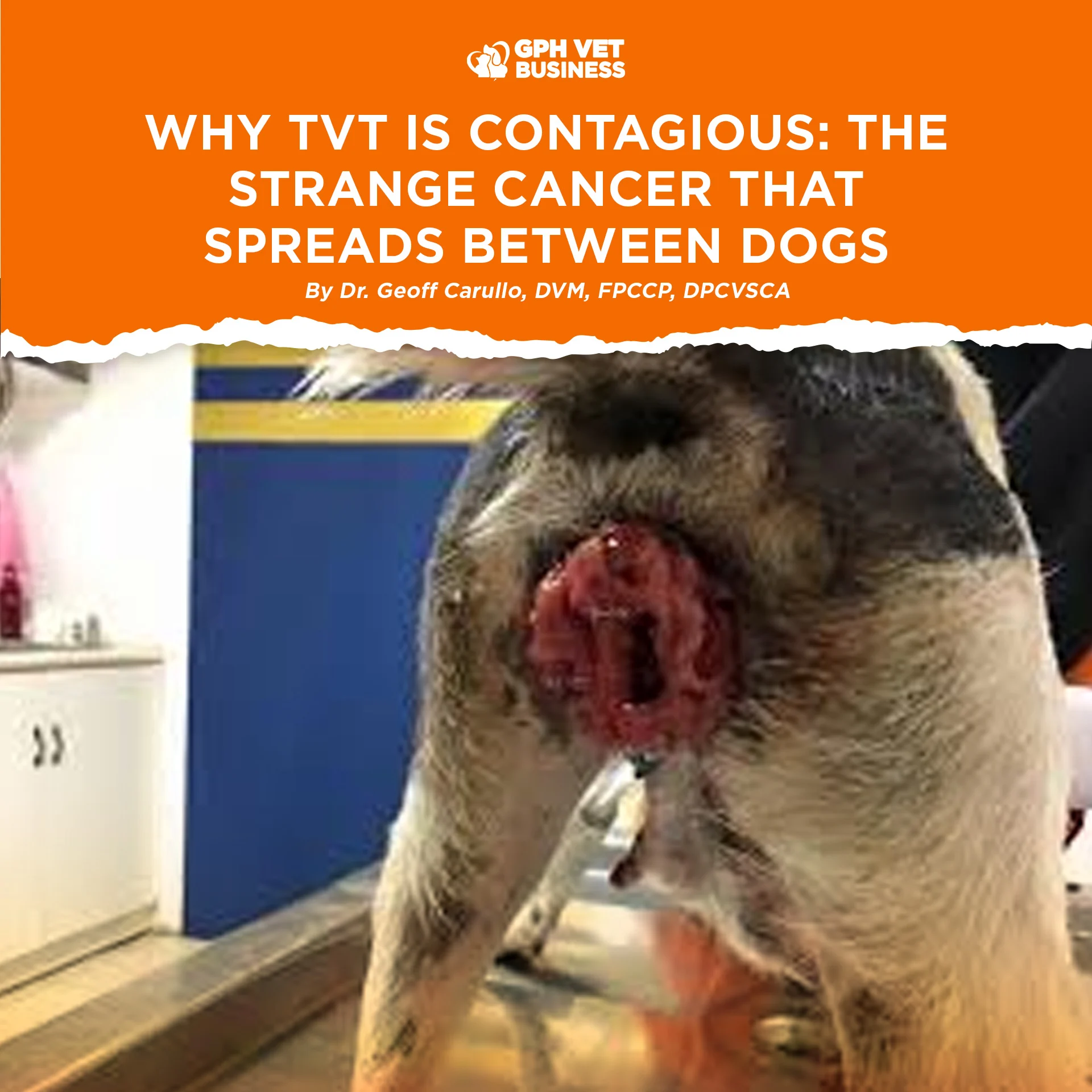
In veterinary medicine, most cancers behave the same way.
They grow inside one patient and stay there.
But canine transmissible venereal tumor (TVT) breaks that rule completely.
TVT is one of the very few cancers in the world that is contagious.
Not because of bacteria.
Not because of viruses.
But because the cancer cells themselves act as the infectious agent.
Yes. The tumor itself spreads.
The Shocking Truth: The Tumor Cell Is the Pathogen
In most diseases, the pathogen is a microorganism.
But in TVT, the living cancer cells themselves are transmitted between dogs.
When a dog with TVT has contact with another dog, tumor cells detach and implant into the tissues of the new host, where they begin growing as a new tumor.
This process is called cellular transplantation.
In simple terms:
Infected dog → tumor cells transfer → new dog → tumor grows.
This makes TVT a clonally transmissible cancer, meaning all tumors worldwide come from the same ancient cancer lineage that originated thousands of years ago from a single dog.
Every TVT tumor we see in clinics today is basically a descendant of that original cancer cell line.
How TVT Spreads Between Dogs
1. Sexual Contact (Most Common)
TVT is usually transmitted during mating.
During copulation, small abrasions occur in the genital mucosa.
Tumor cells from an infected dog enter these microscopic wounds and implant in the tissue of the other dog.
Once implanted, the cells multiply and form the classic cauliflower-like genital tumor.
2. Direct Contact With Tumor Lesions
TVT is called “venereal,” but it is not purely sexually transmitted.
Transmission can also occur through:
- Licking infected lesions
- Sniffing genital tumors
- Biting or grooming
- Contact with bleeding tumor tissue
These actions can transfer viable tumor cells to mucosa or damaged skin, allowing the cancer to establish itself.
This is why TVT is common in stray and free-roaming dogs.
Why the Tumor Survives in Another Dog
Normally, if foreign cells enter the body, the immune system destroys them immediately.
But TVT has evolved ways to escape immune detection.
The tumor behaves almost like a parasitic organism, adapting to survive inside different dogs.
Scientists believe this is why TVT has survived for thousands of years as a living cancer lineage circulating among dogs worldwide.
Can Veterinarians Get Infected?
This is a common fear among veterinarians handling TVT cases.
The answer based on scientific evidence is clear:
No documented cases of humans or veterinarians being infected with TVT.
The reasons are simple.
Species barrier
TVT cells are adapted specifically to dogs and other canids.
Human immune rejection
Human immune systems quickly destroy foreign canine cells.
No zoonotic transmission reported
Studies and veterinary references confirm that TVT does not infect humans.
However, veterinarians should still practice standard precautions such as wearing gloves and maintaining proper hygiene when handling tumor tissue.
The Most Fascinating Part
TVT is not just another tumor.
It is considered the oldest continuously surviving cancer lineage known in nature.
The cancer that we diagnose in a clinic today may have started thousands of years ago in a single ancient dog, and the same cellular lineage continues to circulate in dogs worldwide.
That means every TVT case we treat is part of a cancer lineage that has outlived generations of dogs, civilizations, and even veterinary medicine itself.
Veterinary medicine constantly reminds us that nature still holds mysteries.
And TVT is one of the strangest.
A cancer that behaves like an infectious disease.
A tumor that spreads like a parasite.
A living lineage that refuses to disappear.
Dr. Geoff Carullo is a Fellow and the current President of the Philippine College of Canine Practitioners.
Sharing this helps others understand what it really means to be a vet. If you found this valuable, like and follow for more insights.
Sources
- MSD Veterinary Manual – Canine Transmissible Venereal Tumor.
- Strakova et al., Global distribution of canine transmissible venereal tumour.
- Cambridge Veterinary School – CTVT Overview.
- PetMD – TVT in Dogs FAQ.
- Pimentel et al., Review of CTVT Biology.
- ScienceDirect Veterinary Oncology Literature on CTVT.
- VCA Animal Hospitals – Transmissible Venereal Tumor.
- Strakova & Murchison – Evolution of the transmissible cancer lineage.
- Juniper Publishers Review on CTVT Transmission.
- Los Angeles County Veterinary Public Health – TVT Overview.