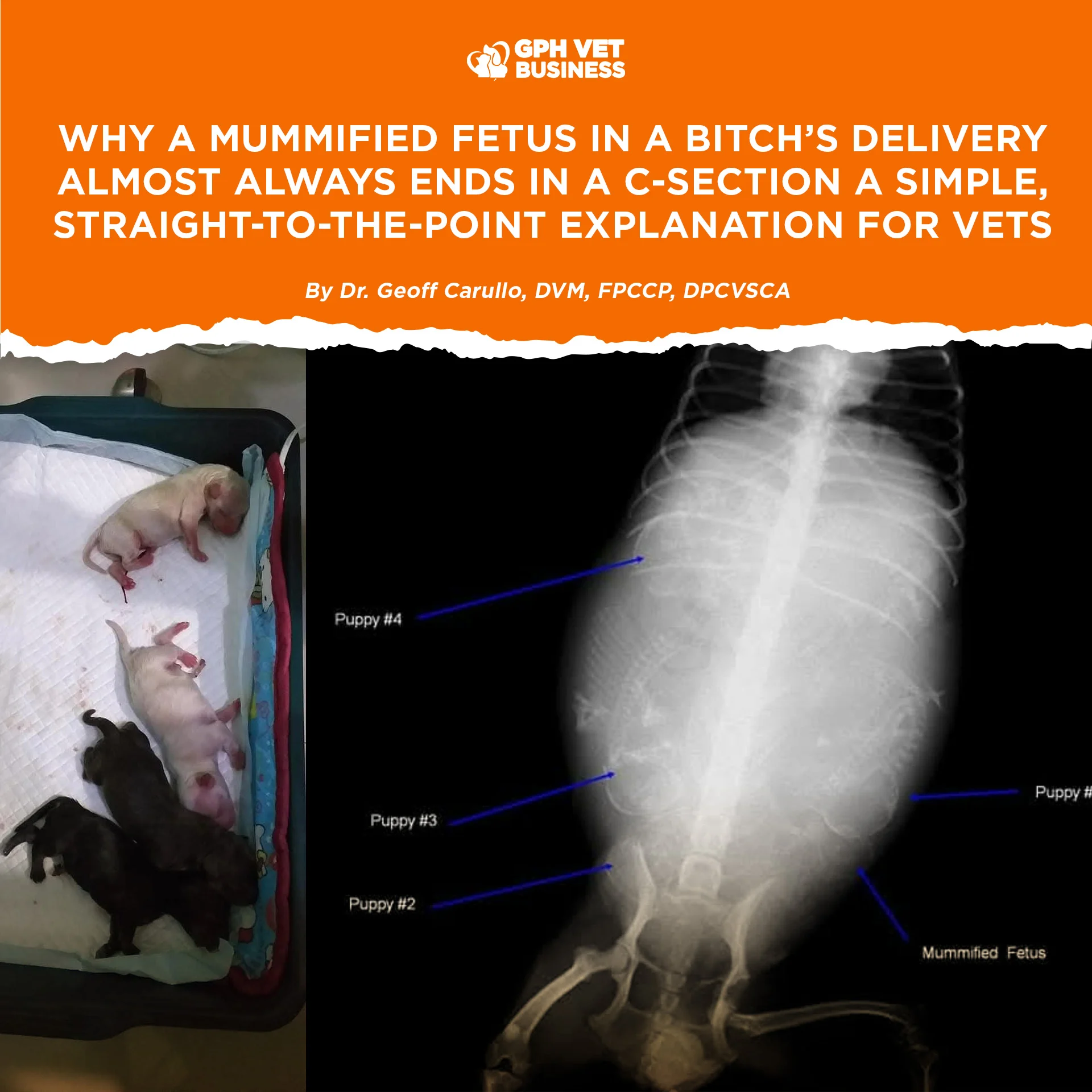
Most of us have seen this scenario:
You take an X-ray or ultrasound.
You count the fetuses.
Then you notice one that doesn’t look right.
Smaller.
Dry-looking.
No heartbeat.
A mummified fetus….
And almost instinctively, your brain already says:
“This is going to be a C-section.”
That instinct is usually right. Here’s why, in plain, practical terms.
First: what actually happens to a mummified fetus?
A mummified fetus is dead but not infected.
The uterus stays sterile, so instead of decomposing, the fluids are slowly absorbed.
What’s left behind is a fetus that is:
- Dry
- Firm
- Stiff
- Non-compressible
In short: it does not behave like a normal fetus anymore.
And that changes everything during labor.
1. It becomes a physical roadblock
Normal puppies are soft.
They compress.
They slide.
A mummified fetus does none of that.
Instead, it can:
- Get stuck at the cervix
- Jam itself in the pelvic canal
- Block the puppies behind it
Think of it as a hard plug inside a soft tube.
Once that happens, normal delivery is no longer realistic.
2. The uterus gets tired — fast
A dead, mummified fetus does not trigger normal labor signals.
So what do we usually see?
- Weak contractions
- Long pauses
- Unproductive pushing
Eventually… uterine inertia.
You can give oxytocin, but if:
- the cervix isn’t fully open, or
- there’s an obstruction, or
- the uterus is already exhausted
Oxytocin won’t magically fix physics.
3. One bad fetus can kill the good ones
Dogs don’t carry one puppy — they carry many.
That’s the real danger.
While everyone waits:
- live puppies behind the obstruction are losing oxygen
- heart rates drop
- stillbirth risk climbs
So even if only one fetus is dead, the entire litter is suddenly in danger.
At that point, waiting is no longer conservative care — it’s risk escalation.
4. Medical management sounds good… on paper
Yes, there are reports where mummified fetuses were expelled medically.
But let’s be honest:
Those cases are carefully selected, highly monitored, and uncommon.
In real clinics, most cases already have:
- questionable cervical dilation
- tired dams
- possible obstruction
- uncertain fetal viability
That’s not the time to experiment.
5. Why C-section wins in real life
Cesarean section is chosen because it is:
- Fast
- Predictable
- Controlled
It allows you to:
- remove the obstruction immediately
- save live puppies before hypoxia kills them
- assess the uterus properly
- end prolonged suffering for the dam
This isn’t about “choosing surgery too quickly.”
It’s about not losing time when time is already lost.
When might C-section be avoided?
Rarely — and only if:
- the dam is stable
- there is no obstruction
- the cervix is open
- no live fetuses are at risk
- you can convert to surgery instantly if needed
Even then, the threshold to operate should be low.
Bottom line for practicing vets
When a mummified fetus is present, C-section is common because:
- the fetus is rigid and obstructive
- the uterus often fails to contract properly
- waiting puts live pups at risk
- surgery gives the best overall outcome
That’s not over-treatment.
That’s good clinical judgment.
Sharing this helps others understand what it really means to be a vet. Like and follow if you’re with us.