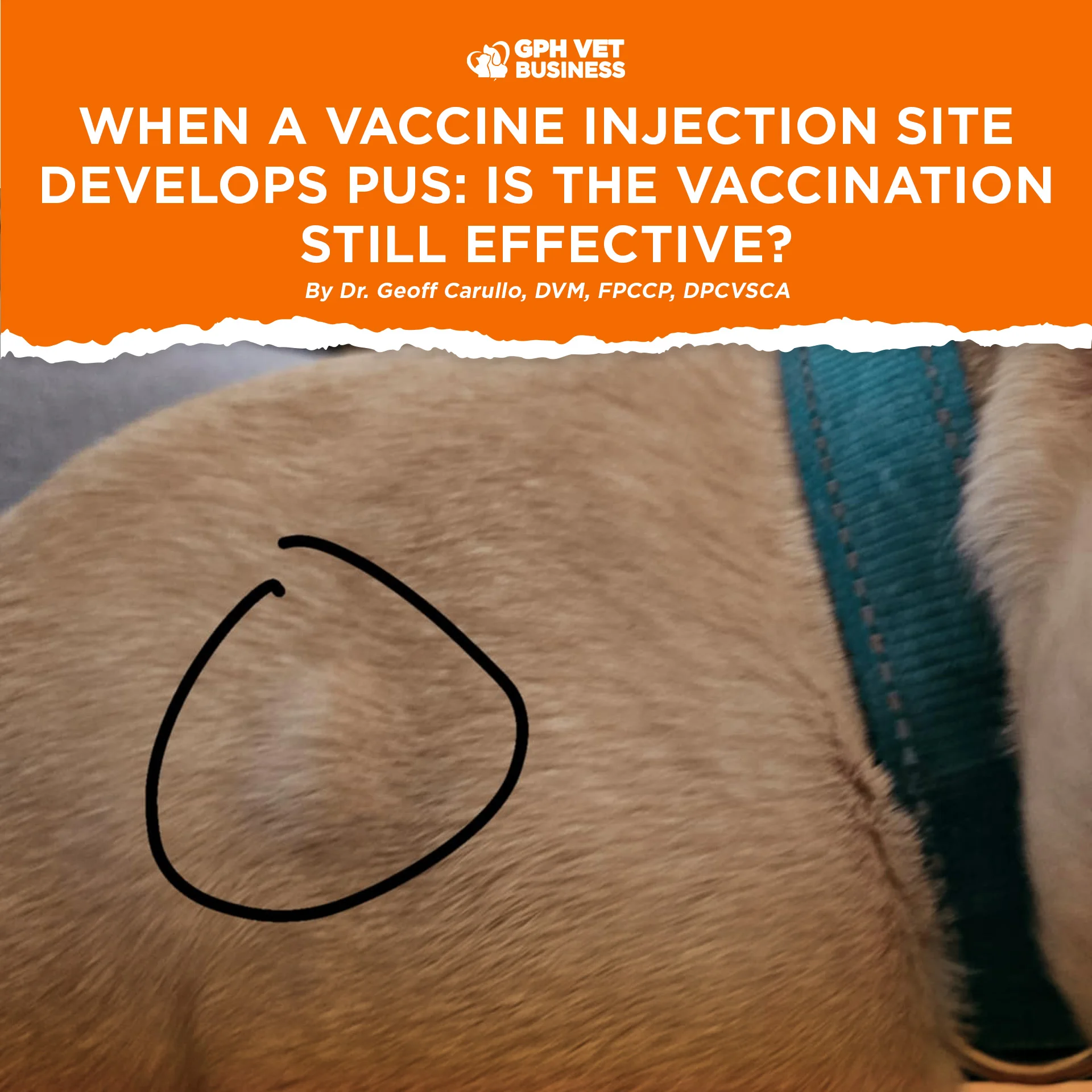
Injection site swelling is a familiar concern after vaccination in dogs and cats. Most post-vaccine lumps are mild inflammatory reactions that resolve on their own. Occasionally, though, the swelling progresses into an abscess, producing pus that may need aspiration or drainage. This raises an important question: does the vaccine remain effective if an abscess develops, or should it be repeated?
What Happens When an Abscess Forms
Vaccines are designed to stimulate the immune system once injected into tissue. Antigens are quickly recognized and carried to local lymph nodes where immune activation begins.
If bacteria contaminate the site or the tissue reaction is severe, an abscess may form. Typical signs include:
- Swelling or a firm lump
- Pain on palpation
- Warmth
- Fluctuation
- Pus on aspiration
The presence of pus indicates a localized infection — not necessarily vaccine failure.
Does an Abscess Mean the Vaccine Failed?
In most cases, no
Immune stimulation usually begins within hours of vaccination, well before an abscess forms. By the time pus accumulates days later, antigen exposure has already occurred. Protective immunity often develops normally, and the vaccine is not automatically invalid.
Revaccination is sometimes done unnecessarily when careful judgment would suffice.
When Revaccination May Be Considered
There are situations where repeating the vaccine is reasonable:
- Early Abscess Formation (within 24–48 hours)
- Large pus volume early
- Possible leakage of vaccine
- Severe tissue necrosis
- Rabies Vaccination Doubts
- If documentation or deposition is uncertain
- If legal compliance requires clarity
- High-Risk Infectious Exposure
- For diseases like parvovirus, distemper, or leptospirosis, repeating may be safer.
When Revaccination Is Usually Not Needed
Revaccination is generally unnecessary if:
- The vaccine was properly administered
- Abscess formed several days later
- Patient is otherwise stable
- Healing occurs after drainage
- No leakage was observed
In these cases, the immune response is expected to be adequate.
Practical Clinical Approach
Step 1: Treat the Abscess
- Aspirate or drain if needed
- Antibiotics when indicated
- Warm compresses and pain control
Step 2: Document the Event
- Vaccine type, site, date, reaction
Step 3: Assess Need for Revaccination
- Was the vaccine properly injected?
- When did swelling start?
- Was antigen likely absorbed?
- Is this a legally required vaccine?
Clinical Pearl
Pus at the injection site does not automatically mean vaccine failure. In most cases, the immune system has already been exposed to the antigen before the abscess forms. Careful judgment is better than automatic revaccination.
Prevention Tips
To minimize abscess formation:
- Always use sterile needles and syringes
- Never reuse needles
- Clean visibly dirty sites
- Inject into healthy tissue
- Store and handle vaccines properly
Injection site abscesses are uncommon but manageable. The key is recognizing that local infection and immune response are separate processes. A calm, rational approach prevents unnecessary revaccination while ensuring proper patient protection.
Dr. Geoff Carullo is a Fellow and the current President of the Philippine College of Canine Practitioners.
Sharing this helps others understand what it really means to be a vet. If you found this valuable, like and follow for more insights.