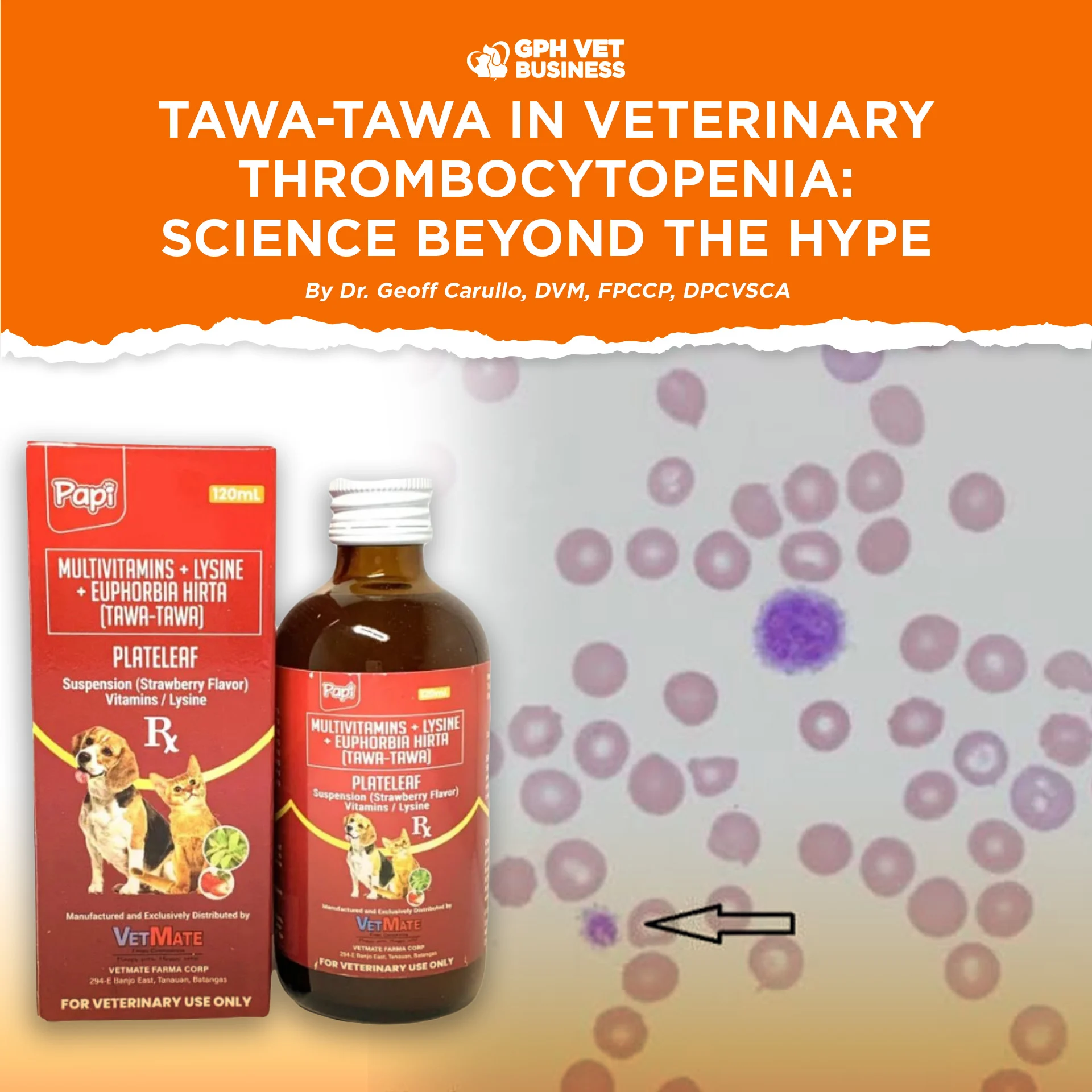
Thrombocytopenia in veterinary practice is one of those conditions that immediately changes the direction of a case. Once platelet counts begin to fall, every move becomes critical. Timing matters. Decisions matter.
And somewhere in that process, a client will ask:
“Doc, pwede po ba tawa-tawa?”
Tawa-tawa, or Euphorbia hirta, has gained a reputation for increasing platelet counts, largely driven by its widespread use during dengue outbreaks. That perception has naturally extended into veterinary medicine, especially in cases like ehrlichiosis and babesiosis where thrombocytopenia is a major concern.
But in clinical practice, we do not rely on reputation. We rely on mechanism.
What makes tawa-tawa interesting is that it is not just folklore. It contains bioactive compounds such as flavonoids and phenolics that have demonstrated measurable effects in experimental models. In induced thrombocytopenia studies, platelet counts increase after administration of Euphorbia hirta extracts. The effect is not dramatic, but it is consistent enough to suggest real biologic activity.
One explanation is its influence on platelet production. Platelets are derived from megakaryocytes in the bone marrow, and certain plant compounds are known to interact with pathways that regulate their development. Tawa-tawa may enhance this process, allowing the body to recover platelet numbers more efficiently.
At the same time, platelet survival appears to be supported. In infectious diseases, oxidative stress contributes to platelet damage and early clearance. The antioxidant properties of tawa-tawa may help stabilize platelet membranes, reducing their destruction and prolonging their circulation.
These combined effects create a situation where platelet recovery becomes more favorable. Not through a single powerful action, but through subtle support at different points of the process.
However, this is where clinical reality must take over.
The available data is largely based on laboratory and animal studies. There are no well-established clinical trials in dogs or cats with naturally occurring thrombocytopenia. There is no standardized dose, no defined protocol, and no clear safety profile across veterinary patients.
In actual cases, platelet recovery is almost always observed alongside proper medical treatment. Antimicrobials, antiparasitics, fluid therapy, and supportive care address the primary disease process. As the underlying condition improves, platelet counts follow.
Because of this, it becomes difficult to attribute recovery to tawa-tawa alone.
From a veterinary standpoint, the position is clear.
Tawa-tawa may have supportive biologic effects. It may contribute to platelet recovery in a limited way. But it does not replace targeted therapy, and it should never delay proper medical management.
Its role, at best, is adjunctive.
In a profession where our patients cannot speak and outcomes depend on timely intervention, we cannot afford to rely on assumptions. We can acknowledge potential, but our decisions must always be anchored in evidence.
Because in the end, what we protect is not just platelet count—
but the life behind it.
Sources
- Perera et al., Potential Use of Euphorbia hirta for Dengue (Systematic Review), PMC
- Apostol et al., Platelet-increasing effects in thrombocytopenic animal models, HERDIN
- Khursheed et al., Pharmacologic and antiviral properties of Euphorbia hirta
- Ethnopharmacological review of Euphorbia hirta, PMC
- Weiss & Wardrop, Schalm’s Veterinary Hematology
Dr. Geoff Carullo is a Fellow and the current President of the Philippine College of Canine Practitioners.
Sharing this helps others understand what it really means to be a vet. If you found this valuable, like and follow for more insights.