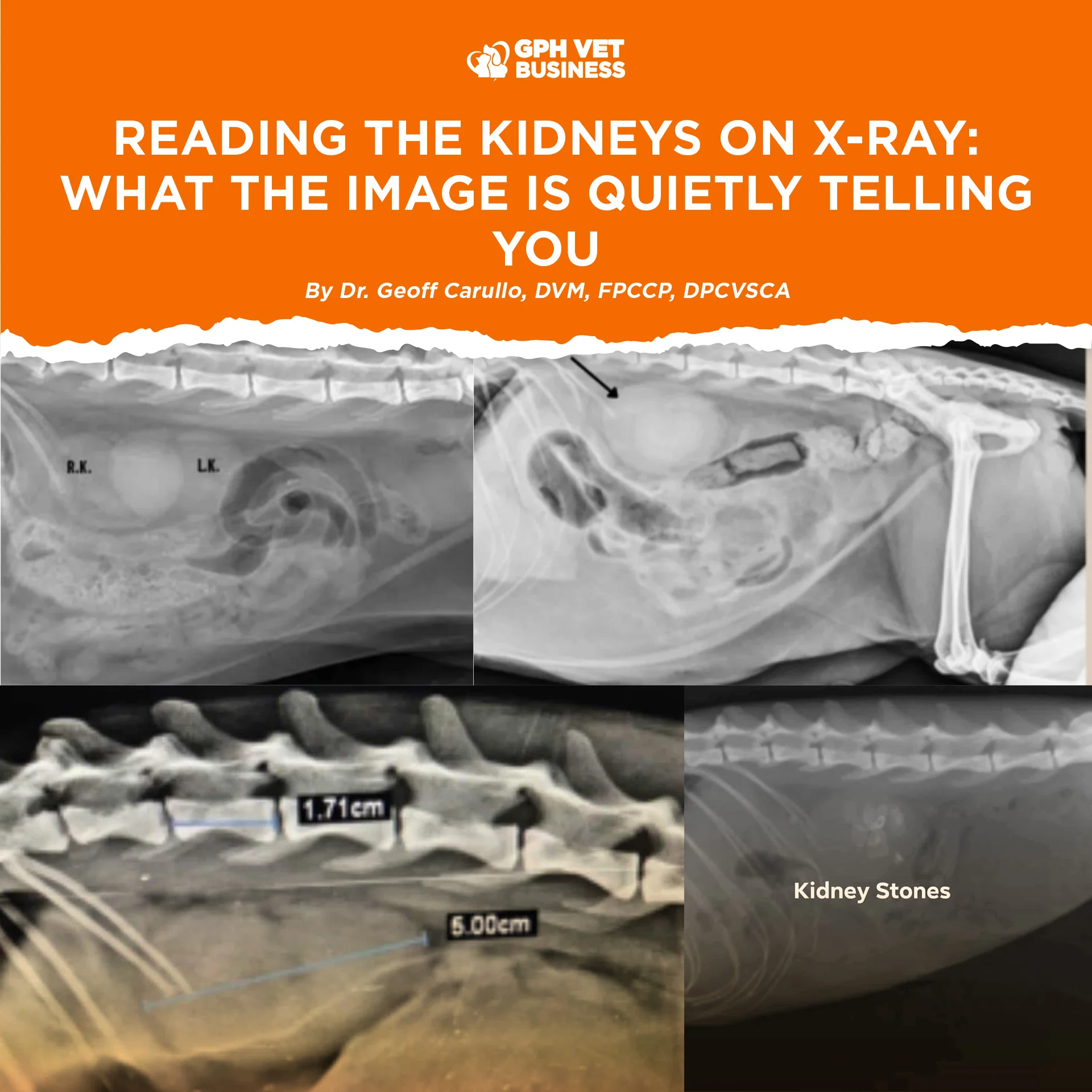
Renal radiographs don’t shout. They whisper.
If you know what to listen for, they tell you more than you think.
Start with kidney size — but never stop there
- Use L2 vertebral body length as your reference
- Cats: kidney length ≈ 2.5–3 × L2
- Dogs: kidney length ≈ 2.5–3.5 × L2
Size alone does not define health or disease
Always assess shape and margins
- Smooth, rounded margins → normal or acute processes
- Irregular, poorly defined margins → suggest chronic disease
A “normal-sized” kidney can still be severely compromised
Compare both kidneys — symmetry matters
- Kidneys should be similar in size
- One large + one small kidney is a red flag
Think:
- Chronic unilateral disease
- Long-standing obstruction (e.g. ureterolith)
- Scarring with contralateral compensatory enlargement
Look for stones, but don’t rely on them
- Nephroliths appear as radiopaque mineral densities
- Usually within the renal silhouette
May be associated with:
- Renomegaly
- Hydronephrosis
Absence of stones on X-ray ≠ absence of disease
Ultrasound often completes what radiographs start
Use X-ray clues to differentiate AKD vs CKD
Acute Kidney Disease (AKD):
- Normal to enlarged kidneys
- Smooth margins
- Preserved contour
Chronic Kidney Disease (CKD):
- Small kidneys
- Irregular margins
- Poorly defined contour
Size + shape together guide urgency and prognosis
Check kidney position and opacity
- Right kidney: more cranial
- Left kidney: more caudal and mobile
Renal opacity clues:
- Soft tissue → normal
- Mineral → stones
- Gas → consider emphysematous changes
The big takeaway
Renal X-rays are about patterns, not single findings
They won’t give you the answer — but they sharpen your judgment
Those quiet clues often speak before bloodwork does
Dr. Geoff Carullo is a Fellow and the current President of the Philippine College of Canine Practitioners.
Sharing this helps others understand what it really means to be a vet. Like and follow if you’re with us.