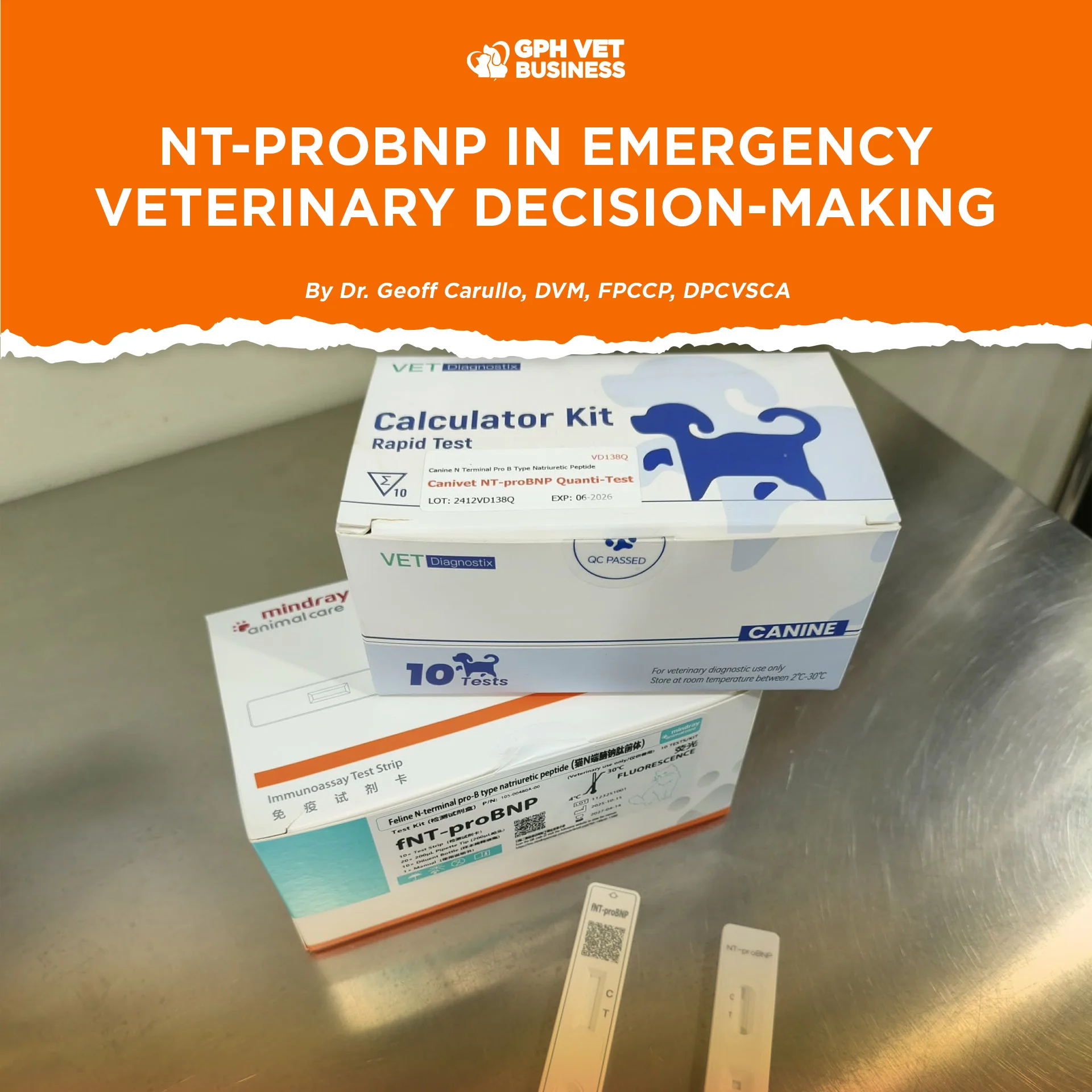
There are tests that confirm what we already suspect.
And there are tests that quietly warn us before a patient reaches the edge.
NT-proBNP belongs to the second kind.
What NT-proBNP Really Measures
NT-proBNP is a cardiac biomarker released when myocardial cells are stretched due to volume or pressure overload. In dogs, elevated levels reflect cardiac stress and reduced cardiac reserve, even when overt clinical signs are subtle or absent.
It does not tell us the exact cardiac lesion.
It tells us how much physiologic buffer the heart still has.
And in anesthesia, that information can change everything.
NT-proBNP Reference Ranges (Quantitative, Canine)
In daily practice, I interpret NT-proBNP using the following ranges:
- < 900 pmol/L — NORMAL
- Significant cardiac stress is unlikely.
- Anesthetic risk from a cardiac standpoint is generally low, though never zero.
- 900–1,800 pmol/L — SUSPICIOUS / BORDERLINE
- Possible early or occult cardiac disease.
- Cardiac reserve may already be compromised.
- Further evaluation is ideal if time permits, and anesthesia should be approached cautiously.
- 1,800 pmol/L — ABNORMAL / HIGH
- Strongly suggestive of significant cardiac stress or disease.
- Poor cardiac reserve is expected.
- Anesthetic and peri-operative risk is high.
Breed considerations matter. In Doberman Pinschers, NT-proBNP values above 735 pmol/L already raise concern for occult dilated cardiomyopathy. While brachycephalic breeds like bulldogs lack strict cutoffs, they should always be managed conservatively.
Why I Use NT-proBNP Before High-Risk Anesthesia
In real-world veterinary practice, we do not always have immediate access to echocardiography. Emergencies do not wait. Some decisions must be made quickly, with incomplete information.
NT-proBNP gives me one essential answer fast:
Can this heart tolerate anesthesia right now?
I routinely request NT-proBNP in:
- Brachycephalic breeds
- Geriatric patients
- Dogs with murmurs, dyspnea, or poor exercise tolerance
- Emergency cases where surgery cannot be delayed
It is not a clearance test.
It is a risk assessment tool.
The Bulldog With Entropion: A Case That Changed How I See Risk
The patient was a bulldog with severe entropion.
This was not cosmetic surgery. The eyelids were painful, corneal damage was progressing, and delaying intervention risked permanent ocular injury.
Pre-anesthetic screening revealed a markedly elevated NT-proBNP, well into the abnormal range.
Clinically, the message was clear:
- The heart was already under significant strain
- Cardiac reserve was limited
- Anesthesia carried a very real risk
However, this was an emergency. The surgery could not be postponed indefinitely.
After thorough client discussion and with maximum precautions, we proceeded.
Post-operatively, the patient collapsed and did not recover. Cardiac failure followed shortly after surgery.
The Difficult Truth About This Case
This is the reality many veterinarians struggle to accept:
The NT-proBNP test did not fail.
It predicted the outcome.
The patient did not die because the surgery was wrong.
The patient died because the heart could no longer compensate.
The biomarker warned us before we crossed that physiologic threshold.
Why NT-proBNP Still Matters Even When the Outcome Is Poor
NT-proBNP is not designed to save every patient.
It exists to make risk visible.
It helps us:
- Identify hidden cardiac compromise
- Adjust anesthetic protocols
- Intensify monitoring
- Support informed consent
- Defend sound clinical judgment
In this case, it confirmed that the outcome was not sudden, random, or negligent. The risk was already present and measurable.
How I Apply NT-proBNP Results in Practice
Normal (< 900 pmol/L)
I proceed with caution but reasonable confidence.
Borderline (900–1,800 pmol/L)
I warn the client clearly, modify anesthesia, and increase monitoring.
High (> 1,800 pmol/L)
I consider the heart a limiting organ.
Elective procedures are postponed.
Emergency surgery becomes a life-threatening decision.
NT-proBNP should never be interpreted alone. It must always be combined with clinical findings, imaging when available, and professional judgment.
Final Word to Fellow Veterinarians
NT-proBNP does not make decisions for us.
It forces us to be honest about risk.
Sometimes, even when surgery is correct and unavoidable, the heart simply cannot carry the patient through.
Knowing that beforehand does not remove the pain of loss.
But it makes our practice safer, clearer, and more defensible.
And in emergency medicine, that clarity matters.
Sharing this helps others understand what it really means to be a vet.
Like and follow if you’re with us.