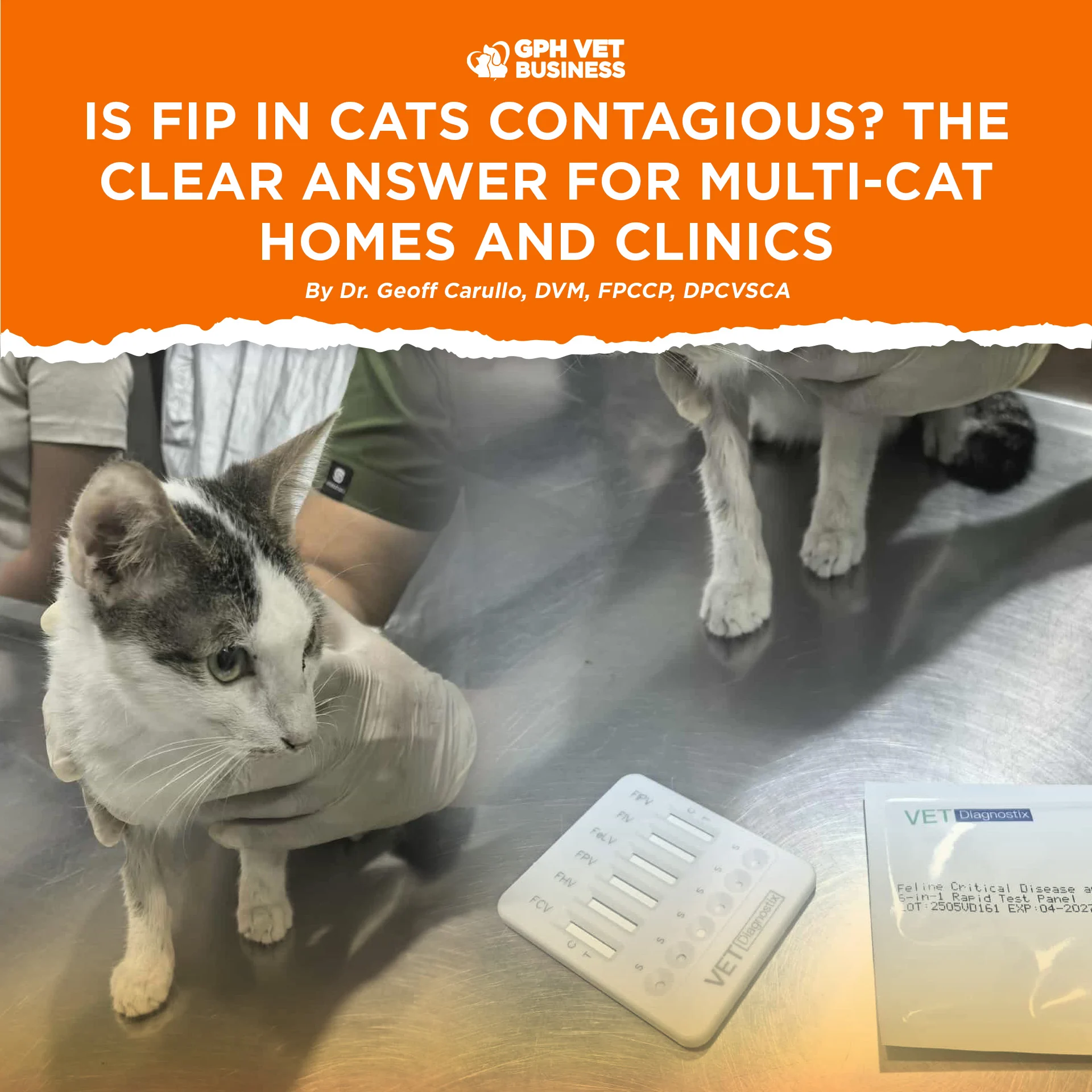
Feline infectious peritonitis (FIP) is one of the most misunderstood diseases in feline practice, mainly because people mix up feline coronavirus (FCoV) with FIP.
Here’s the clear, practical truth:
FCoV is contagious. FIP, in most real-world situations, is not.
The key concept: “FCoV spreads, FIP develops”
1) Feline coronavirus (FCoV) is common and contagious
FCoV primarily infects the intestinal tract and spreads fecal–oral, especially in multi-cat environments (shared litter boxes, contaminated surfaces, group housing).
Many cats infected with FCoV are:
- asymptomatic, or
- have mild, self-limiting GI signs.
Only a small proportion will ever develop FIP.
2) FIP usually happens by mutation inside the cat
FIP is generally thought to occur when an “ordinary” FCoV infection mutates within an individual cat, gains the ability to replicate in macrophages/monocytes, and triggers systemic inflammatory disease (effusive and non-effusive forms).
That is why the cat with FIP is typically not considered the main “source” of FIP for others.
So, is FIP contagious to other cats?
What we tell colleagues and clients (accurately)
Direct transmission of the FIP-causing biotype is considered unlikely under natural conditions.
Cats with FIP usually shed minimal amounts of virus compared with cats carrying enteric FCoV, and “FIP outbreaks” more often reflect shared exposure to circulating FCoV plus shared risk factors, not a single cat “spreading FIP.”
Bottom line: In most homes and clinics, the bigger infection-control issue is FCoV circulation, not “catching FIP” from the FIP cat.
What to do in a multi-cat household when one cat is diagnosed with FIP
Think in risk reduction, not panic isolation.
A) Manage litter box hygiene like it’s your main lever
Because FCoV spreads fecal–oral, litter management matters most:
- 1 litter box per cat plus one extra (ideal rule)
- scoop at least daily
- reduce crowding and shared trays
- routine cleaning and appropriate disinfection of trays and surrounding surfaces
B) Reduce stress and crowding
Stress, high-density housing, frequent introduction of new cats, and unstable social groups are classic “pressure multipliers” for higher viral loads and disease expression.
C) Be careful with introductions
If feasible:
- avoid adding new kittens/cats immediately after an FIP case
- quarantine and stabilize any necessary new introductions
- prevent rapid mixing in catteries or rescue settings
D) Do you need strict isolation of the FIP cat?
In many homes, strict isolation is not required for “FIP contagion” control, because the other cats have often already been exposed to FCoV.
However, temporary separation can still be useful for:
- treatment logistics
- reducing stress/competition
- litter box control and monitoring
This is a “management choice,” not because the FIP cat is assumed to be highly contagious with FIP.
The testing trap: why “coronavirus titers” confuse everyone
Coronavirus antibody titers and many “FCoV positive” results commonly indicate exposure, not FIP, and they do not reliably predict who will develop FIP.
Clinical diagnosis still relies on the whole picture:
- signalment and history
- effusion analysis (if wet)
- imaging and clinicopathologic patterns
- targeted molecular/biopsy approaches when indicated (case-dependent)
Quick clinic script (Taglish-friendly, accurate)
“Yung coronavirus sa cats, yan ang madaling kumalat. Pero yung FIP, usually nangyayari yan kapag nag-mutate yung virus sa loob ng katawan ng isang cat. So hindi siya parang ‘nahahawa’ na FIP mismo. Ang focus natin is litter hygiene, crowding, and stress control.”
Take-home points for veterinarians
- FCoV is contagious. Primary route is fecal–oral.
- FIP is usually not “caught” from an FIP cat. It usually arises from mutation within the cat.
- In multi-cat settings, focus on litter hygiene, density reduction, stress reduction, and stable group management.
- Avoid overpromising with titers. “Coronavirus-positive” is common and not equal to FIP.
Dr. Geoff Carullo is a Fellow and the current President of the Philippine College of Canine Practitioners.
Sharing this helps others understand what it really means to be a vet. Like and follow if you’re with us.