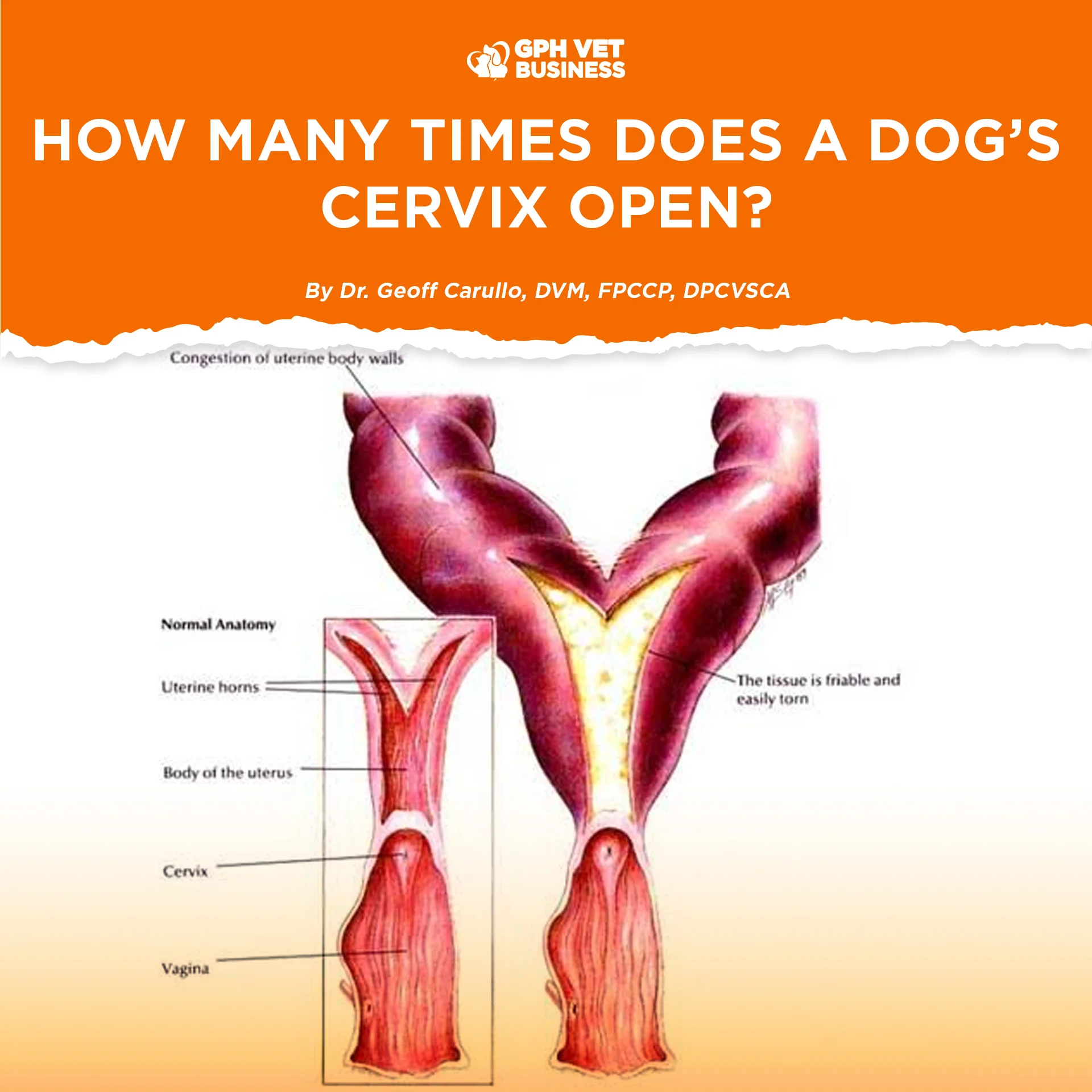
In small animal practice, this is one of those questions that seems simple but actually reveals a deeper understanding of canine reproduction, breeding timing, and diseases like pyometra.
The truth is this:
A dog’s cervix does not repeatedly open and close at random. It opens only during specific, hormonally controlled events.
The cervix in the bitch is a tightly regulated anatomical and functional barrier. Most of the time, it remains firmly closed under the influence of progesterone. This is why uterine infections can become so dangerous when drainage is not possible.
There are only a few key moments in a dog’s life when the cervix opens.
1. During Estrus (Heat Phase)
This is the primary physiologic opening.
Under the influence of estrogen, the cervix:
- Relaxes
- Becomes patent
- Allows sperm passage into the uterus
This is the window when the female is fertile and receptive to mating.
Most dogs go into heat once or twice a year, depending on breed and individual variation.
In practical terms: The cervix opens once per heat cycle.
2. During Parturition (Whelping)
The second major opening occurs during labor.
Driven by:
- Relaxin
- Prostaglandins
- Oxytocin
The cervix undergoes full dilation to allow the passage of puppies.
This is a completely separate physiologic event from estrus.
3. Pathologic Opening (Open Pyometra)
This is where clinical relevance becomes critical.
In open-cervix pyometra, the cervix is partially open, allowing:
- Pus discharge
- Some degree of uterine drainage
However, this is not a normal physiologic opening. It is a consequence of:
- Progesterone dominance
- Cystic endometrial hyperplasia
- Secondary bacterial infection
Closed pyometra occurs when the cervix remains shut, making the condition far more dangerous due to pressure buildup and risk of rupture.
So How Many Times Does It Really Open?
If we simplify it:
- Estrus: about 1–2 times per year
- Parturition: depends on how many times the dog gives birth
- Pathologic conditions: incidental, not part of normal physiology
The cervix opens only during specific biologic events, not repeatedly or continuously.
Clinical Insight
The most important takeaway is not the number, but the principle:
The canine cervix is closed most of the time.
It opens only when hormones permit it.
This explains:
- Why timing is critical in breeding
- Why pyometra often develops during diestrus
- Why closed pyometra is more life-threatening than open forms
Bottomline
This is not a structure that casually opens and closes.
The canine cervix opens with purpose, not frequency.
And in practice, understanding when and why it opens can mean the difference between early diagnosis and missed pathology.
Sources
Johnston, S. D., Root Kustritz, M. V., & Olson, P. N. (2001). Canine and Feline Theriogenology. Saunders.
Concannon, P. W. (2011). Reproductive cycles of the domestic bitch. Animal Reproduction Science, 124(3–4), 200–210.
Verstegen, J., Dhaliwal, G., & Verstegen-Onclin, K. (2008). Pyometra in the bitch. Veterinary Clinics of North America: Small Animal Practice, 38(6), 1269–1280.
England, G. C. W., & Russo, M. (2006). Uterine changes during the estrous cycle. Theriogenology.
Noakes, D. E., Parkinson, T. J., & England, G. C. W. (2019). Arthur’s Veterinary Reproduction and Obstetrics.
Dr. Geoff Carullo is a Fellow and the current President of the Philippine College of Canine Practitioners.
Sharing this helps others understand what it really means to be a vet. If you found this valuable, like and follow for more insights.