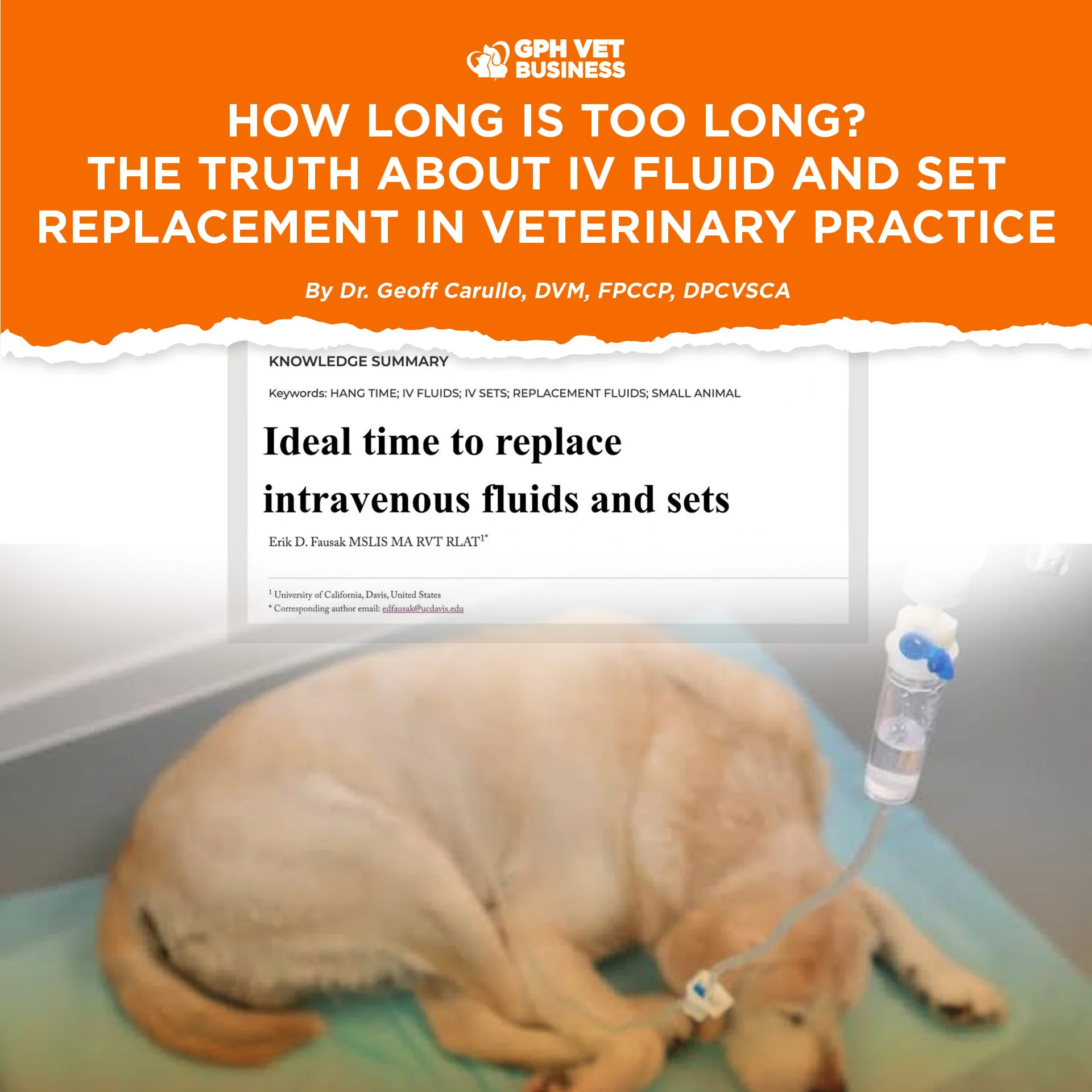
Every clinic has its own “rule.”
24 hours. 48 hours. Some don’t even have one.
But the question remains… when should we really replace IV fluids and IV sets?
Not based on habit. Not based on fear.
But based on evidence.
The Veterinary Evidence We Have Today
A recent review in Veterinary Evidence evaluated available data, including prospective veterinary studies, to answer a very practical question:
How long can we safely use IV fluid bags and administration sets?
The best-supported answer right now:
Replace every 72–96 hours
This recommendation is consistent with guidance from the Centers for Disease Control and Prevention, while acknowledging the unique realities of veterinary practice.
Contamination Risk in Veterinary Settings
A key study by Guillaumin et al. provides an important insight:
IV fluid contamination may occur more frequently in veterinary settings
Possible reasons:
- More frequent handling of lines
- Less controlled environments compared to human hospitals
- Differences in fluid types used
For example, commonly used fluids such as:
- Lactated Ringer’s Solution
- 0.9% Sodium Chloride
…may behave differently depending on storage, handling, and exposure.
This reinforces a critical point:
Risk is not just about time. It’s about environment and technique.
So What Should We Do in Practice?
Based on current veterinary evidence, a practical and safe protocol would be:
- Replace IV fluids and sets every 72–96 hours
- Replace sooner if:
- Fluid becomes cloudy or discolored
- There is any break in sterility
- The system has been frequently manipulated
- Maintain strict aseptic technique at all times
Because at the end of the day…
Poor handling will contaminate a bag in hours.
Good technique can keep it safe much longer.
The Bigger Lesson for Veterinary Clinics
We often think that doing things more frequently automatically means safer care.
But evidence tells us something different.
Changing fluids too early:
- Increases cost
- Adds unnecessary workload
- Does not significantly reduce infection risk when proper technique is followed
What truly matters is:
- Consistency in protocols
- Discipline in asepsis
- Understanding the science behind our decisions
Final Word
72–96 hours is not just a guideline.
It is a balance between safety, efficiency, and real-world veterinary practice.
And as veterinarians, our role is not just to follow routines…
But to practice smarter medicine backed by evidence.
Sources
Fausak, E. (2025). Ideal time to replace isotonic crystalloid intravenous fluids and sets. Veterinary Evidence, 10(3).
Guillaumin, J. et al. (2017). Contamination of IV fluids in veterinary settings.
Centers for Disease Control and Prevention (CDC). (2011). Guidelines for the Prevention of Intravascular Catheter-Related Infections.
Dr. Geoff Carullo is a Fellow and the current President of the Philippine College of Canine Practitioners.
Sharing this helps others understand what it really means to be a vet. Like and follow if you’re with us.