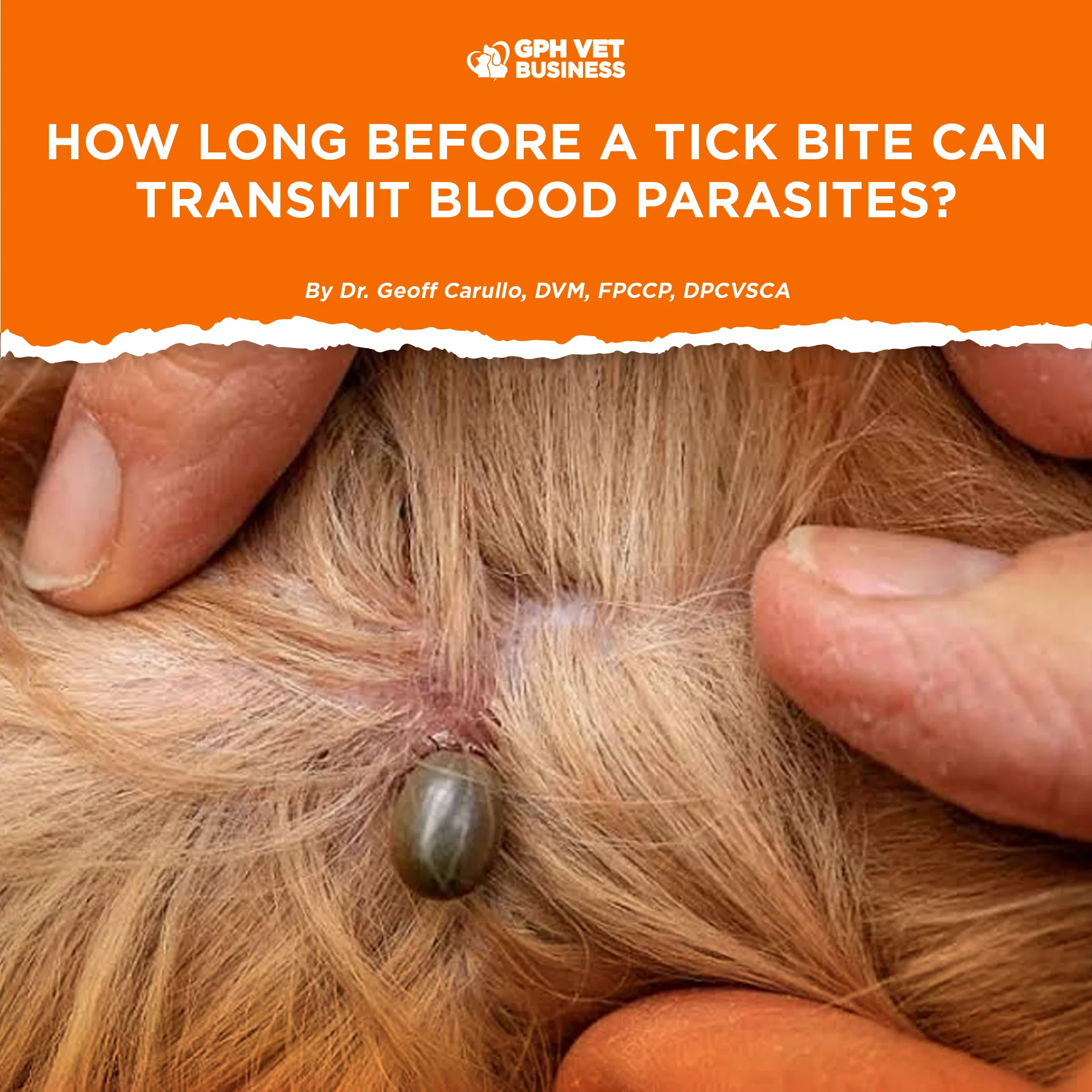
“Doc, it just attached… it should still be safe.”
This is one of the most dangerous assumptions in small animal practice.
Because when it comes to tick-borne blood parasites, time is not your protection.
The Reality: The Clock Starts Immediately
The moment a tick attaches and begins feeding, the risk begins.
It is not about days.
It is about hours.
How Fast Can Transmission Happen?
Ehrlichia (Ehrlichiosis)
Transmission can occur in as early as 3 to 12 hours after tick attachment.
That means a dog exposed during a short walk or brief outdoor stay may already be at risk within the same day.
Babesia (Babesiosis)
Traditionally considered slower:
- 48 to 96 hours is the classic teaching
But newer evidence shows:
- Transmission may occur as early as 8 to 24 hours, especially if the tick has previously fed
Once inside the bloodstream, Babesia invades red blood cells and can rapidly lead to:
- Hemolytic anemia
- Thrombocytopenia
- Severe systemic disease
The Clinical Trap
Here’s the problem:
- You do not know when the tick attached
- You do not know if the tick is infected
- You cannot accurately estimate feeding duration
So when a client says:
“Doc, it just got there.”
That is not reliable clinical information.
What This Means in Practice
In real-world settings, especially in tropical countries like the Philippines:
- Tick exposure is constant
- Ehrlichiosis is very common
- Babesia cases can deteriorate rapidly
Waiting for “enough time” before acting can cost the patient.
Shift Your Approach
If you see a tick:
- ❌ Do not assume it is too early for transmission
- ❌ Do not rely on estimated attachment time
- ✔ Assume infection is possible
- ✔ Monitor, test, or treat when clinically indicated
- ✔ Emphasize strict and consistent tick prevention
The Bottom Line
A tick bite is not just a bite.
It is a potential injection of disease.
And the real question is no longer:
“How long before it can infect?”
But rather:
“Has it already been long enough?”
Because in many cases…
A few hours is all it takes.
Sources
- Beugnet et al., 2025. Assessment of the speed of transmission of tick-borne pathogens
- Fourie et al., 2013. Transmission dynamics of Ehrlichia canis
- Varloud et al., 2018. Early transmission of Babesia canis
- Piesman & Spielman. Tick-borne pathogen transmission timing
- Companion Animal Parasite Council (CAPC). Ehrlichia spp. Guidelines
- Tahir et al., 2020. Ticks and tick-borne pathogens: transmission dynamics (Microorganisms)
Dr. Geoff Carullo is a Fellow and the current President of the Philippine College of Canine Practitioners.
Sharing this helps others understand what it really means to be a vet. If you found this valuable, like and follow for more insights.