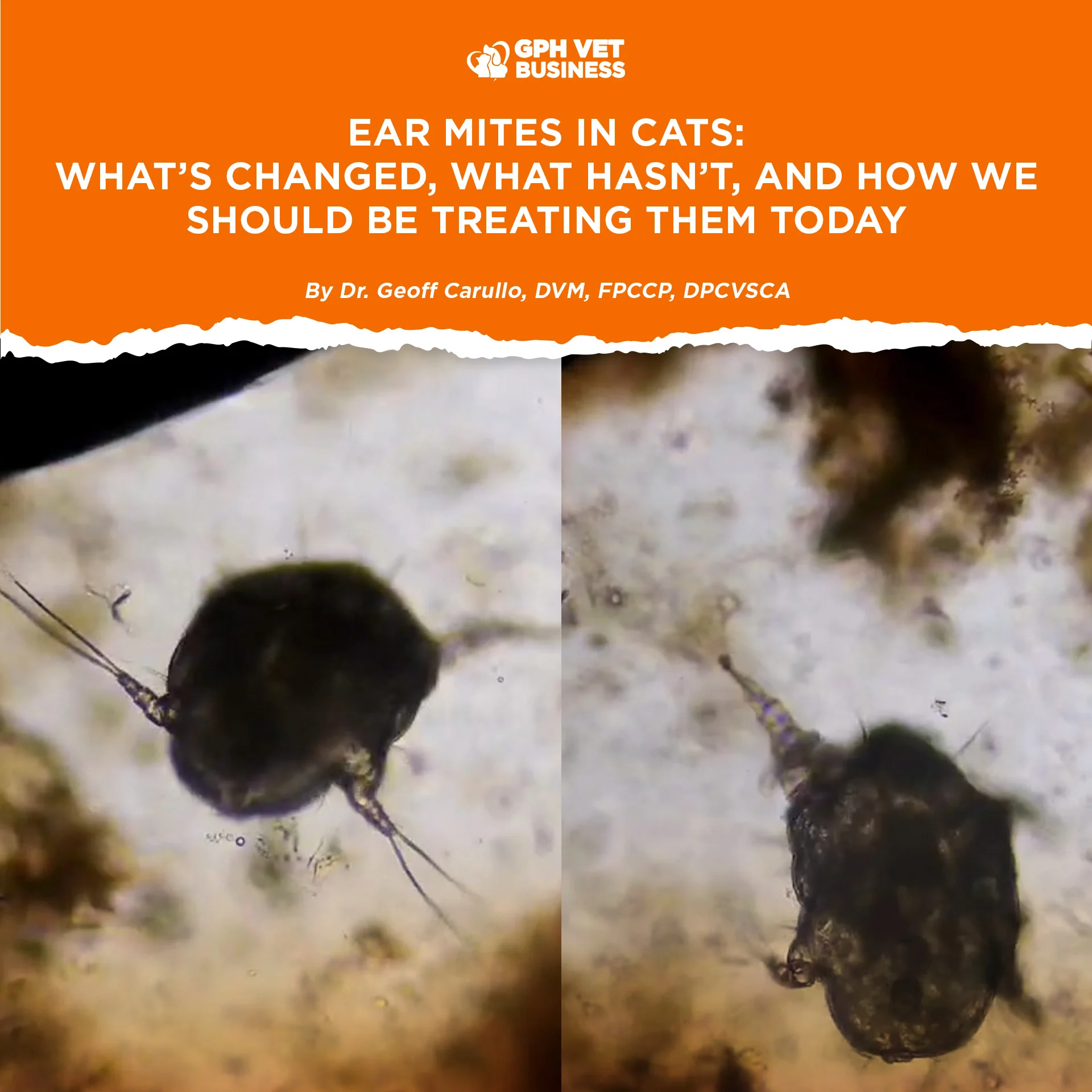
Ear mites are often treated as an entry-level problem in feline practice.
They are common, contagious, and theoretically easy to eliminate. Yet despite decades of familiarity, ear mites continue to cause recurrent otitis, partial treatment responses, and long-standing frustration for veterinarians and cat owners alike.
Not because Otodectes cynotis has evolved into something new — but because the way ear mites present, hide, and interact with other ear diseases has changed, while clinical assumptions often have not.
The Myth That Refuses to Die: “Ear mites are rare now.”
They are not.
Ear mites remain one of the most common parasitic causes of feline otitis, particularly in kittens, multi-cat households, shelters, rescues, and partially outdoor cats. What has changed is their clinical presentation.
Classic signs such as violent head shaking and thick, coffee-ground discharge still occur, but many modern cases are far subtler. Cats may present with mild pruritus, intermittent scratching, low-grade cerumen accumulation, or recurrent otitis that temporarily improves with treatment but never fully resolves.
These quieter cases are precisely where ear mites are most often missed.
Why Ear Mites Are Still Being Overlooked
A brief otoscopic examination is no longer sufficient.
Clinical experience consistently shows that ear mites are frequently missed unless ear debris is examined microscopically. This is especially true in cats that have already received antibiotics, anti-inflammatory otic medications, or partial parasite control.
In many cases, what appears to be primary bacterial or yeast otitis is actually mite-driven inflammation with secondary infection layered on top. If the underlying parasitic cause is not addressed, the inflammation predictably returns.
Where Treatment Philosophy Has Shifted
Traditional acaricidal therapies remain effective, particularly macrocyclic lactones such as selamectin and moxidectin. These agents continue to provide reliable ear mite control in uncomplicated cases, especially in kittens and young cats.
However, their success depends heavily on strict compliance, correct dosing intervals, and simultaneous treatment of all in-contact animals. Missed doses, delayed application, or treating only one cat in a multi-cat household are common reasons for persistence and recurrence.
The major shift in recent years has been the wider adoption of systemic isoxazoline compounds, including fluralaner, lotilaner, sarolaner, and esafoxolaner. These agents provide sustained systemic activity against ear mites, often eliminating infestation without repeated ear manipulation and with improved owner compliance.
A Modern Line of Treatment Approach for Ear Mites
Effective management of feline ear mites must be systemic, comprehensive, and household-based, rather than limited to treating the affected ear alone.
The cornerstone of therapy is primary acaricidal treatment using active ingredients with proven efficacy against Otodectes cynotis. These include selamectin, moxidectin, and isoxazoline compounds such as fluralaner, lotilaner, sarolaner, and esafoxolaner.
Among current options, combination topical formulations that include esafoxolaner paired with eprinomectin and praziquantel, such as NexGard Combo, provide reliable ear mite control while simultaneously addressing fleas, ticks, intestinal parasites, and heartworm prevention. This makes them particularly valuable in multi-cat households, shelters, rescues, and cases where simplifying compliance is critical.
A single appropriately dosed application is often sufficient to eliminate mites, though repeat dosing should follow recommended protocols.
Treat the Household, Not Just the Patient
Ear mite management fails most often when only the visibly affected cat is treated.
All in-contact cats — including those without clinical signs — should receive acaricidal therapy simultaneously. Asymptomatic carriers are common, and untreated animals serve as a continuous source of reinfestation.
Environmental hygiene, including washing bedding and cleaning grooming tools, should be advised as supportive control measures.
Managing Secondary Infection and Inflammation
Ear mites rarely act alone.
Inflammation and self-trauma frequently predispose cats to secondary bacterial and yeast overgrowth. In these cases, adjunct otic therapy may be required using formulations that combine antibiotics, azole antifungals, and anti-inflammatory corticosteroids.
These agents do not eliminate mites and should never be used as stand-alone therapy. Their role is supportive — to control pain, inflammation, and infection while the primary parasitic cause is addressed.
Gentle ear cleaning may be performed when necessary to remove excessive debris, but aggressive flushing should be avoided, particularly in painful or ulcerated ears.
Why Some Cats “Never Fully Improve”
Most treatment failures are not due to drug resistance.
They occur because:
- Only one cat in a multi-cat household is treated
- Therapy is stopped once clinical signs improve
- Asymptomatic carriers are ignored
- Secondary infection is treated while mites are overlooked
Modern best practice emphasizes simultaneous treatment of all in-contact animals, reassessment after therapy, and integration of preventive care.
Prevention Is Now Standard, Not Optional
One of the most important shifts in feline medicine is that ear mite control is no longer reactive.
Routine parasite prevention protocols that include mite coverage are now part of standard feline wellness care. This preventive approach has significantly reduced chronic otitis cases, repeat consultations, and long-term ear pathology in both private practice and shelter medicine.
Clinical Bottom Line
Ear mites are not outdated.
They are not trivial.
And they are not always obvious.
They remain common, contagious, frequently missed, and consistently underestimated.
The parasite has not changed — but our responsibility has.
Look deeper.
Treat decisively.
Cover the household.
And stop assuming ear mites are “old news.”
They are still very much here.
Dr. Geoff Carullo is a Fellow and the current President of the Philippine College of Canine Practitioners.
Sharing this helps others understand what it really means to be a vet. Like and follow if you’re with us.