Let’s be honest.
At some point in practice, a client has looked at you and asked:
“Doc, pwede ba cranberry na lang? Natural lang naman.”
And many times, instead of shutting it down, we pause…
Because part of us wants to believe there’s something there.
But here’s the uncomfortable truth:
Cranberry is not an effective treatment for urinary tract infection in dogs and cats.
Not clinically. Not reliably. Not in the way clients think.
The Illusion of Effectiveness
Cranberry didn’t become popular because of strong veterinary evidence.
It became popular because of human medicine, where it was proposed to reduce bacterial adhesion through compounds called proanthocyanidins (PACs).
The theory is elegant:
Bacteria cannot stick → Infection cannot establish
But veterinary medicine is not theory.
It is outcome.
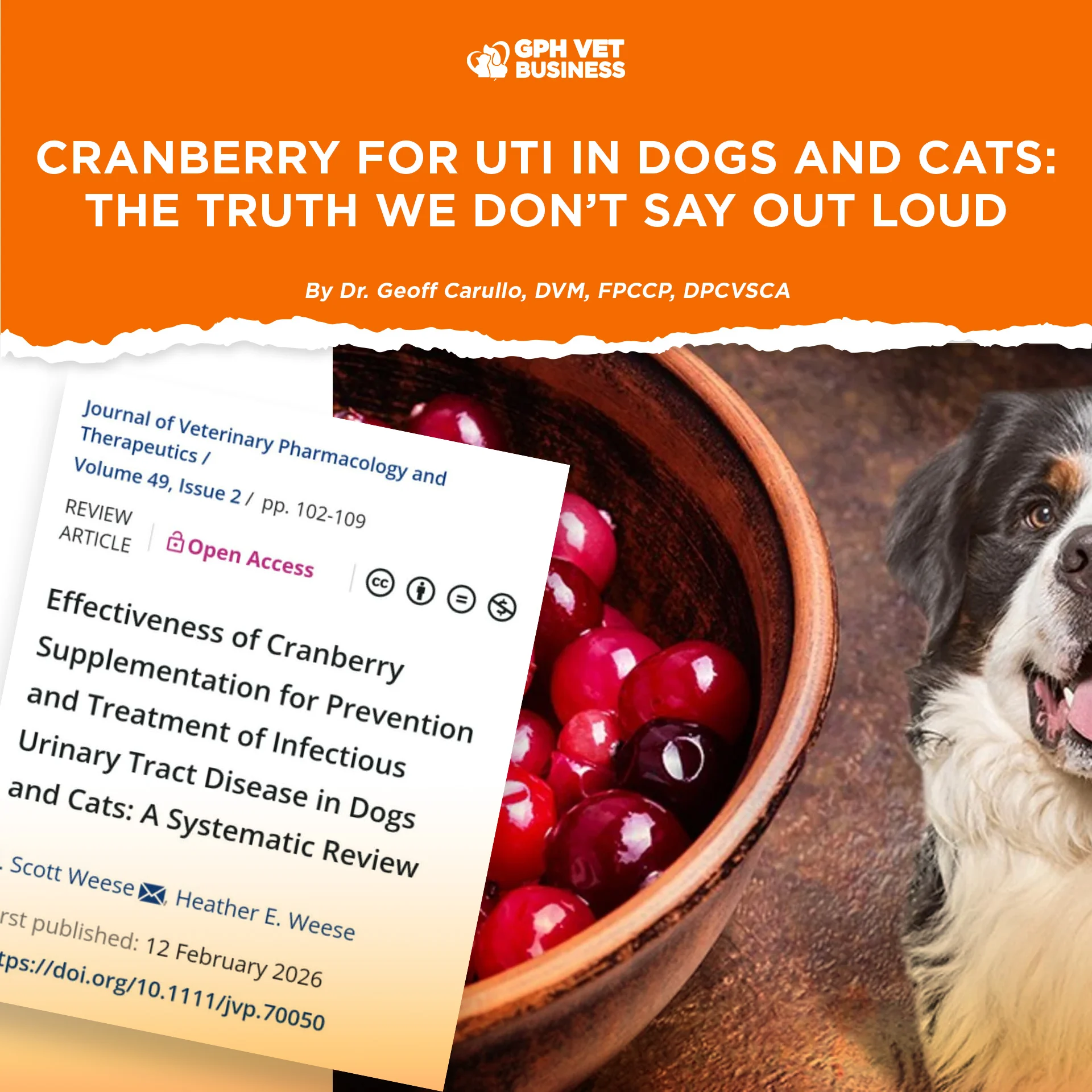
And when we look at actual veterinary evidence, including the recent review published in the Journal of Veterinary Pharmacology and Therapeutics, the picture becomes clear:
There is little to no convincing evidence that cranberry prevents or treats UTIs in dogs and cats.
Mechanism ≠ Medicine
This is where many clinicians and clients get misled.
Yes, cranberry has a proposed mechanism.
But in real-world veterinary patients:
- The concentration needed to affect bacterial adhesion is unclear
- Oral absorption and urinary excretion in dogs and cats are inconsistent
- The active compounds may not even reach effective levels in urine
So what are we left with?
A theoretical benefit… with no consistent clinical translation
And in medicine, that is not enough.
The Hard Clinical Reality
Let’s bring it down to what actually matters in practice.
A dog with a UTI presents with:
- Pollakiuria
- Dysuria
- Hematuria
- Bacterial infection confirmed on urinalysis or culture
Now ask yourself:
Will cranberry resolve this infection?
The answer is simple.
No.
Cranberry does not kill bacteria.
Cranberry does not eliminate infection.
Cranberry does not replace antibiotics.
At best, it does nothing.
At worst, it delays proper treatment.
So How Effective Is It, Really?
If we strip away marketing and theory, here is the honest grading:
- Treatment of active UTI: Ineffective
- Prevention of UTI: Weak, inconsistent, unproven
- Adjunct support: Minimal, uncertain benefit
That’s the reality.
Not zero science—but very low clinical impact.
Why This Matters More Than We Think
Because every time we allow cranberry to be perceived as a treatment, we risk:
- Delayed antibiotic therapy
- Worsening infection
- Chronic or recurrent UTI cases
- Loss of client trust when it fails
And the most dangerous part?
It feels harmless.
But ineffective medicine is not harmless when it replaces effective medicine.
The Real Role of Cranberry
If we are being fair and evidence-based:
Cranberry may have a place… but only as:
- A non-essential adjunct in selected chronic or recurrent cases
- A client-driven supplement, properly explained
- A supportive measure, not a therapeutic one
And even then, expectations must be clear.
The Take-Home Message
Cranberry is not a treatment.
It is not a solution.
It is not even reliably preventive.
It is a biologically interesting idea that has not translated into meaningful clinical outcomes in veterinary medicine.
And as veterinarians, our job is not to sell hope.
Our job is to deliver results.
Sources
Weese JS. Effectiveness of Cranberry Supplementation for Prevention of Urinary Tract Disease in Dogs and Cats. Journal of Veterinary Pharmacology and Therapeutics (2026).
Frontiers in Veterinary Science. Veterinary Pharmacology and Species Differences (2016).
Giorgi M. Veterinary Pharmacology: A World Almost Unexplored (2022).
Dr. Geoff Carullo is a Fellow and the current President of the Philippine College of Canine Practitioners.
Sharing this helps others understand what it really means to be a vet. Like and follow if you’re with us.