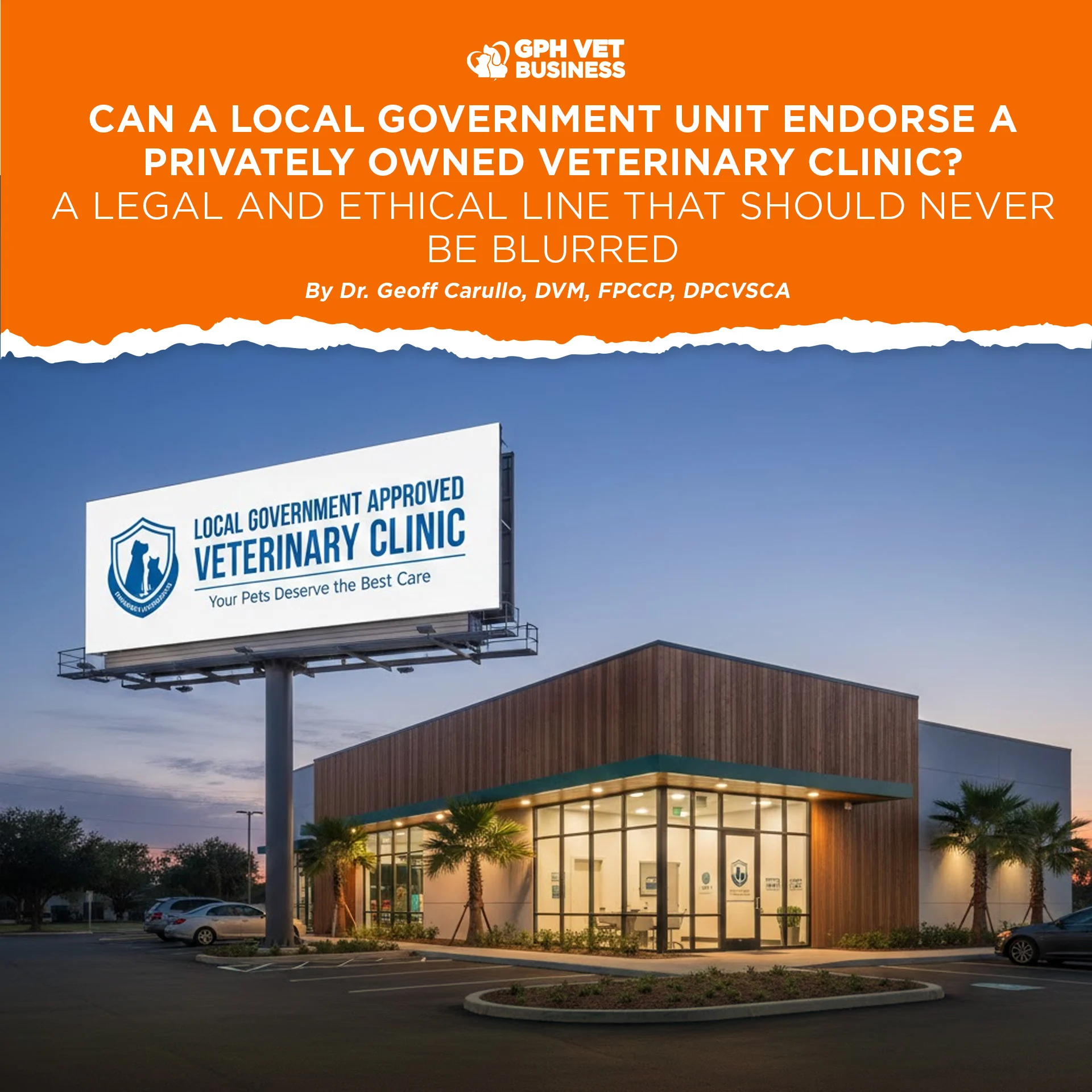
Local government units (LGUs) play an important role in delivering veterinary and animal welfare services to the public. In doing so, they are expected to uphold neutrality, fairness, and transparency, especially when interacting with privately owned veterinary practices.
This article is written not to accuse, but to clarify professional and ethical boundaries.
Because when government authority intersects with private enterprise, clear lines must exist to protect public trust and professional fairness.
The Core Question
Can an LGU legally endorse a privately owned veterinary clinic?
The short answer is:
An LGU must be extremely careful.
And in many situations, it should refrain from doing so altogether.
Why Clear Boundaries Are Necessary
1. Government Endorsement Is Never Neutral
When an LGU publicly promotes or names a specific private veterinary clinic, it carries implied authority.
To the public, this may appear as:
- Government-approved
- Government-backed
- Government-selected
Even without intent, this creates an uneven playing field for other veterinary clinics operating in the same locality.
Public institutions exist to serve the community as a whole, not to elevate or advantage a single private enterprise.
2. Location Matters in Public–Private Engagements
If a veterinary activity is presented as an LGU initiative, a reasonable question arises:
Why is the service:
- Conducted inside a privately owned clinic?
- Not held in a government facility or neutral public venue?
When public authority directs citizens into a specific private business location, the distinction between public service and private promotion becomes unclear.
Clarity of venue is part of transparency.
3. Impact on Other Veterinary Practices
Veterinary clinics within the same area:
- Operate under the same laws
- Pay the same taxes
- Serve the same population
When one clinic receives visibility through government channels, others are unintentionally placed at a disadvantage.
This is not about competition.
It is about professional fairness and institutional neutrality.
Best Practices for LGUs
To remain ethical, defensible, and inclusive, LGUs should:
- Conduct services in public facilities whenever feasible
- If private partnerships are necessary, apply open and transparent accreditation processes
- Avoid naming or promoting a single clinic
- Clearly separate government programs from private marketing
- Apply equal standards to all participating veterinary practices
Why This Conversation Matters
This is not about individuals or institutions.
It is about precedent.
When boundaries are unclear, confusion follows.
When authority appears selective, trust weakens.
Clear rules protect:
- The public
- The profession
- The credibility of government programs
Government authority should guide public service, not private preference.
Transparency protects everyone involved.
Sharing this helps others understand what it really means to be a vet. Like and follow if you’re with us.