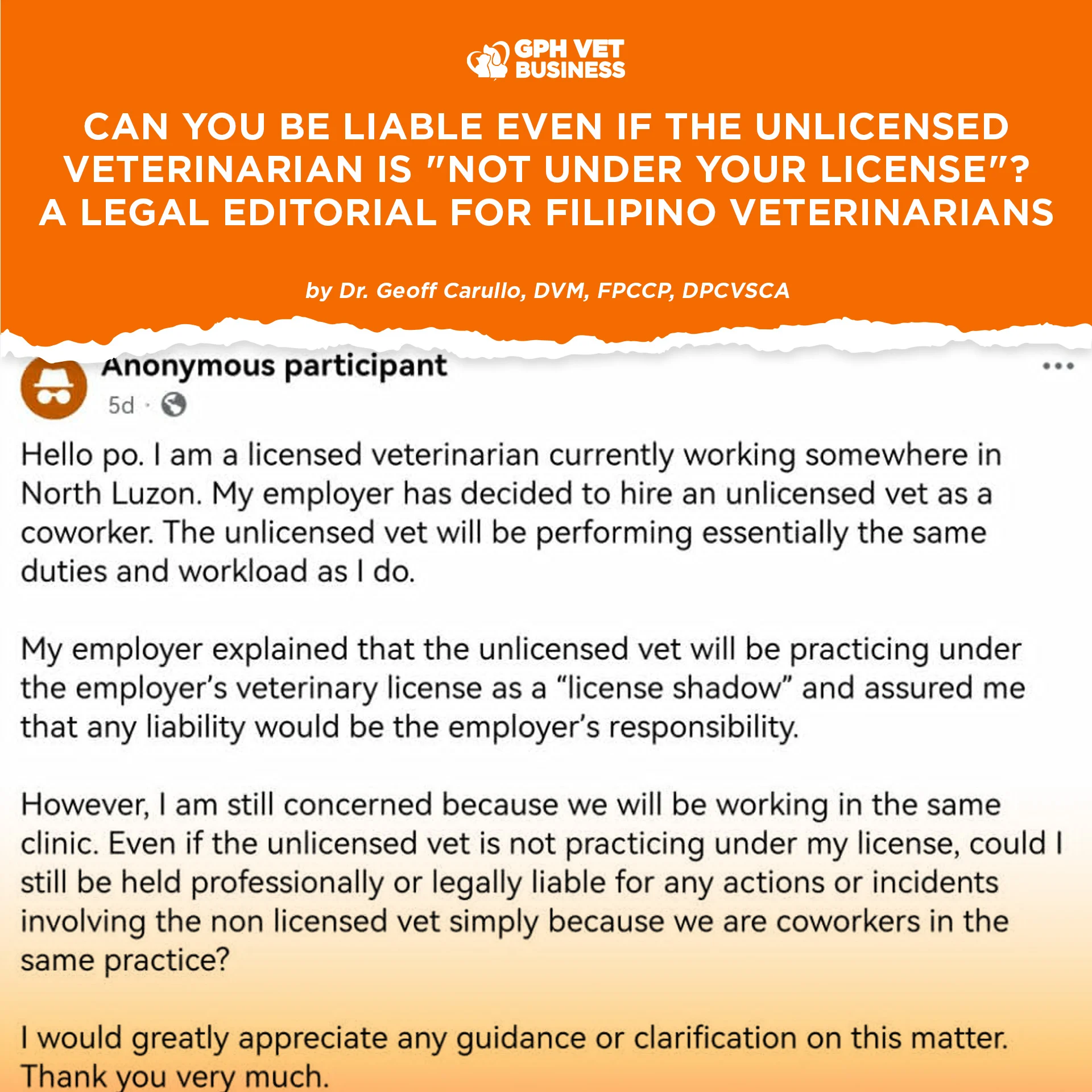
A question recently circulated in a veterinary forum:
“If my employer hires an unlicensed veterinarian who performs essentially the same duties as I do, but the employer says that person is practicing under the employer’s license, can I still be held liable because we work in the same clinic?”
It is an important question.
The first point is clear.
Under the Philippine Veterinary Medicine Act of 2004 (Republic Act No. 9268), it is unlawful for a person to practice veterinary medicine without a valid Certificate of Registration and Professional Identification Card issued by the Professional Regulatory Board of Veterinary Medicine and the PRC.


The second point is where many veterinarians become confused.
Some people believe that because the clinic owner assumes responsibility, the other licensed veterinarians in the clinic are automatically protected.
That is not necessarily true.
Professional liability is not determined solely by employment arrangements. It may also depend on what each veterinarian knew, participated in, approved, supervised, or failed to act upon.
If you knowingly allow unlicensed practice to continue, sign records that you did not personally supervise, permit your professional standing to create the appearance that illegal practice is acceptable, or become directly involved in the management of those cases, your own professional conduct may also come under scrutiny.
This is why the issue is not merely “Whose license is being used?”
The real question is:
“What was your role, and what did you know?”
Silence does not always equal liability.
However, knowledge combined with participation, supervision, endorsement, or other conduct can become highly relevant during an administrative, civil, or even criminal investigation, depending on the facts.
Every case is different.
Regulators and courts do not simply ask whether two veterinarians worked in the same clinic. They examine each person’s actual participation and professional responsibilities.

For that reason, veterinarians should never assume that “the owner will take all the liability.”
Professional licenses carry individual responsibilities.
If you believe an arrangement violates the Veterinary Medicine Act, document your concerns, seek clarification from management, and, when appropriate, obtain independent legal advice or guidance from the Professional Regulatory Board of Veterinary Medicine.
Protecting your license sometimes means asking difficult questions before a problem becomes a case.
Sources
- Republic Act No. 9268, The Philippine Veterinary Medicine Act of 2004, particularly provisions on unlawful practice of veterinary medicine.
- Philippine Veterinary Medical Association, Republic Acts compilation (RA 9268).
- Editorial note: This article is for educational discussion only and should not be taken as formal legal advice. Actual liability depends on the specific facts of each case and applicable laws and regulations.


Sharing this helps others understand what it really means to be a veterinarian. Like and follow if you’re with us.
Dr. Geoff Carullo is a Fellow and the current President of the Philippine College of Canine Practitioners.