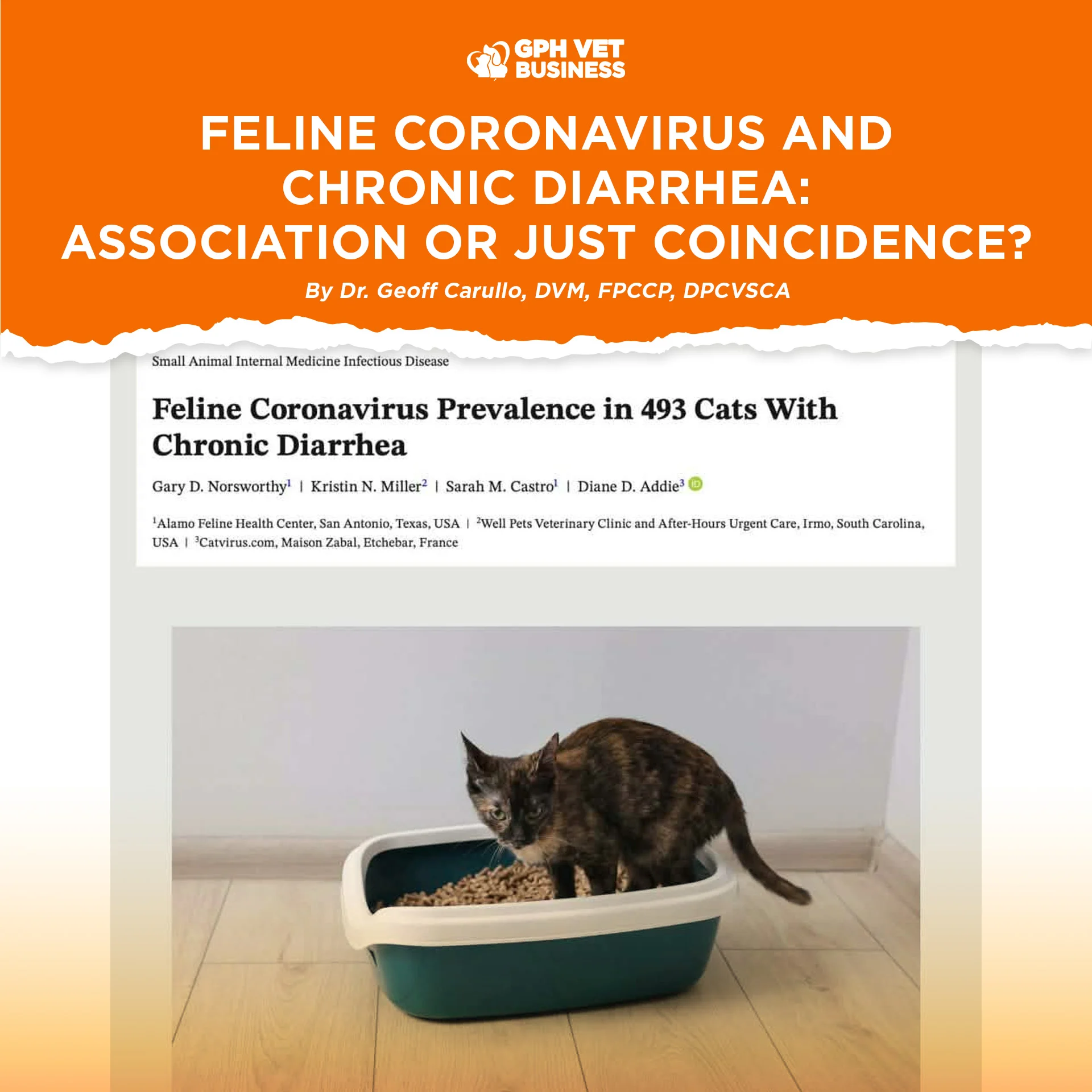
In everyday feline practice, chronic diarrhea is one of the most frustrating cases we face. It lingers, it relapses, and despite extensive testing, it often refuses to give clear answers. Then comes a result that almost every veterinarian has seen at some point: positive for feline coronavirus (FCoV).
But here’s the real question.
Does it actually mean something?
The Virus Everyone Finds… But Rarely Understands
A recent study published in the Journal of Veterinary Internal Medicine looked deeper into this dilemma. Out of 493 cats with chronic diarrhea, 321 tested positive for FCoV, representing a striking 65.1% prevalence. That alone is enough to make any clinician pause.
But let’s go beyond the numbers.
Feline coronavirus is not rare. In fact, in multi-cat environments, shelters, and even households, FCoV exposure and shedding are extremely common. Many cats carry it without any clinical signs. They eat well, play well, and look perfectly healthy.
So when we detect FCoV in a diarrheic cat, we must ask:
Are we finding the culprit… or just a bystander?
What the Study Really Showed
This study revealed three important insights:
First, FCoV was the most frequently detected organism among cats with chronic diarrhea. That alone suggests it may play a role, at least in some cases.
Second, coinfections were very common. Many cats were not just positive for FCoV but also had organisms like Clostridium perfringens. This complicates interpretation. Which one is the true cause? Or are they acting together?
Third, and perhaps most intriguing, FCoV was the only detected pathogen in nearly 24% of cases. This is where things become clinically interesting. When nothing else is found, and the cat is symptomatic, we can no longer easily dismiss FCoV.
Age Matters
Younger cats, particularly those under one year old, were significantly more likely to test positive.
This aligns with what we already observe in practice. Kittens and young cats are:
- More exposed in high-density environments
- More likely to shed virus
- More susceptible to gastrointestinal instability
This raises a possibility. In younger cats, FCoV may not just be present. It may be contributing to disease expression.
The Problem with PCR
PCR is powerful. But it has a limitation that every clinician must remember:
Detection does not equal causation.
A positive PCR only tells us that viral RNA is present in the feces. It does not tell us:
- Whether the virus is actively causing pathology
- Whether it is incidental shedding
- Whether another organism is the primary driver
This is the same dilemma we face with many enteric panels today. The more sensitive our tests become, the more complex our interpretation becomes.
So… Is There an Association?
Here’s the balanced clinical truth.
There is likely an association, especially in:
- Young cats
- High viral load shedders
- Cases with no other identified pathogens
But it is not definitive causation, especially in:
- Adult cats
- Multi-pathogen positive cases
- Clinically stable carriers
FCoV may act as:
- A primary contributor in some cases
- A co-factor that worsens intestinal inflammation
- Or simply a background finding in others
What This Means for Practice
As clinicians, we need to move beyond binary thinking.
A positive FCoV result should not automatically lead to:
- Panic
- Overdiagnosis
- Or premature conclusions
Instead, it should guide us to think deeper:
- Correlate with clinical signs
- Assess age and environment
- Evaluate for coinfections
- Consider response to therapy
Because in feline medicine, especially in chronic diarrhea, context is everything.
The Bigger Takeaway
This study reminds us of something important.
Not everything we detect is the disease.
And not everything we ignore is harmless.
Feline coronavirus sits in that gray zone.
Common, misunderstood, and occasionally significant.
And as veterinarians, our role is not just to detect.
It is to interpret.
References
Norsworthy, G. D., Miller, K. N., Castro, S. M., & Addie, D. D. (2025). Feline coronavirus prevalence in 493 cats with chronic diarrhea. Journal of Veterinary Internal Medicine.
Pedersen, N. C. (2009). A review of feline infectious peritonitis virus infection. Journal of Feline Medicine and Surgery.
Addie, D. D., et al. (2020). Feline infectious peritonitis: ABCD guidelines on prevention and management. Journal of Feline Medicine and Surgery.
Sparkes, A. H., et al. (2022). ISFM consensus guidelines on the diagnosis and management of feline enteropathies.
Dr. Geoff Carullo is a Fellow and the current President of the Philippine College of Canine Practitioners.
Sharing this helps others understand what it really means to be a vet. Like and follow if you’re with us.