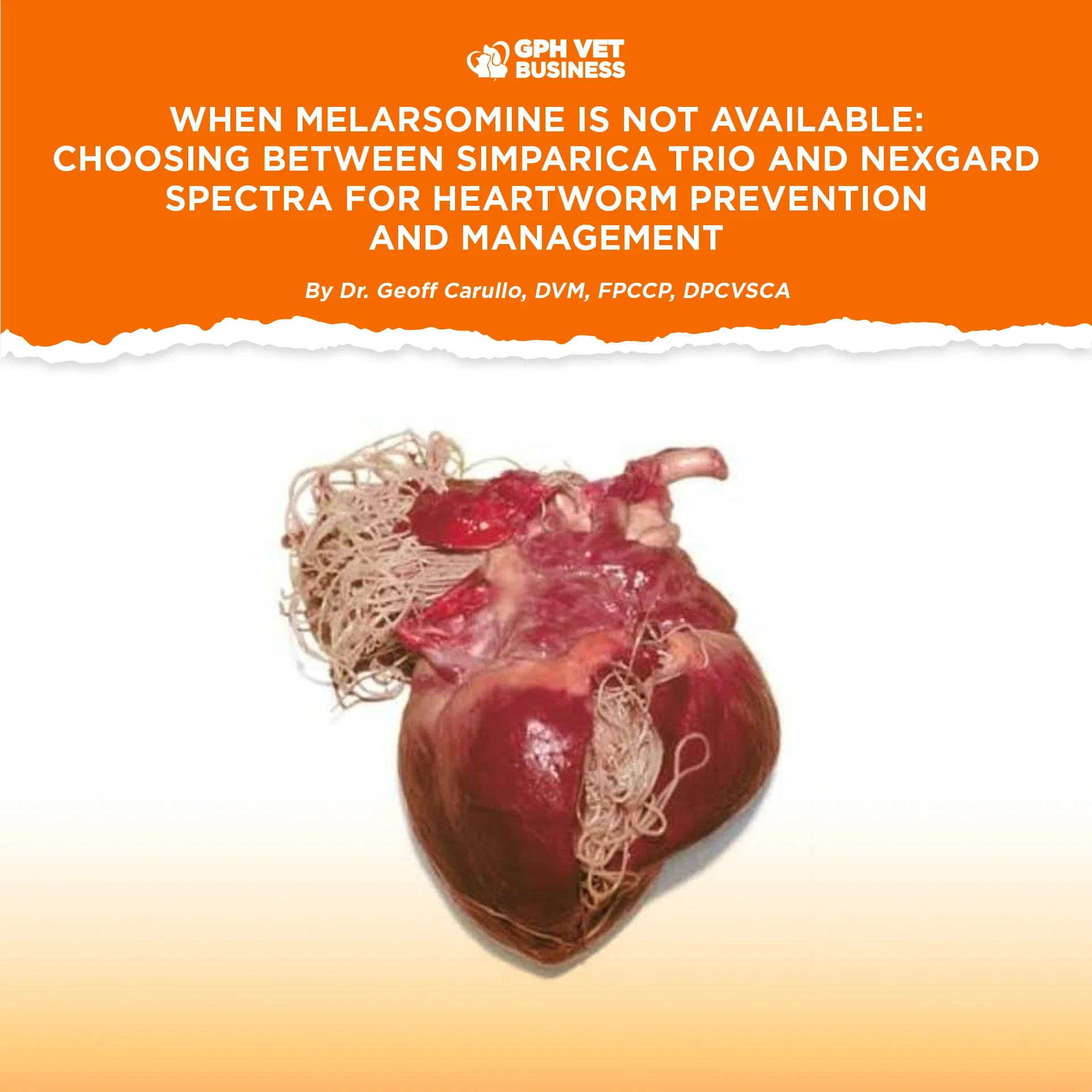
Heartworm disease remains one of the most serious parasitic threats to dogs in the Philippines. Transmitted by mosquitoes and caused by Dirofilaria immitis, this disease can silently progress for months before clinical signs appear. In many countries, the gold standard treatment for heartworm infection is melarsomine, an adulticide that kills mature worms in the pulmonary arteries.
However, in the Philippines, melarsomine is currently not available, leaving veterinarians with limited therapeutic options. This reality forces many practitioners to rely on preventives and slow-kill protocols when managing heartworm-positive patients.
One question that frequently arises in clinical practice is this:
Between Simparica Trio and NexGard Spectra, which is the better option for heartworm prevention and possible management in the absence of melarsomine?
To answer this, we must look closely at their pharmacology.
The Key Difference Lies in the Heartworm Molecule
Both products are broad-spectrum monthly preventives that control fleas, ticks, intestinal parasites, and heartworm. But the macrocyclic lactone component responsible for heartworm prevention is different.
Simparica Trio
- Sarolaner – flea and tick control
- Pyrantel – intestinal worms
- Moxidectin – heartworm prevention
NexGard Spectra
- Afoxolaner – flea and tick control
- Milbemycin oxime – heartworm prevention
While both molecules belong to the macrocyclic lactone class, moxidectin and milbemycin oxime behave differently in the body.
Why Moxidectin Matters
Moxidectin, the heartworm component in Simparica Trio, has several pharmacologic advantages:
- Longer half-life
- Higher lipid solubility
- Stronger potency against heartworm larvae
It remains in the body longer, allowing extended activity against developing larvae.
This allows deeper tissue distribution and more persistent activity.
Studies suggest that moxidectin may be more effective against certain resistant strains of Dirofilaria immitis.
Because of these characteristics, moxidectin is commonly used in slow-kill protocols in regions where melarsomine is unavailable.
The Reality of Slow-Kill Protocols
In an ideal world, adult heartworms should be eliminated using melarsomine. This approach kills adult worms more rapidly and reduces long-term pulmonary damage.
But when melarsomine cannot be obtained, veterinarians sometimes rely on “slow-kill” management, which typically involves:
- Monthly macrocyclic lactone preventive
- Doxycycline to target Wolbachia bacteria within heartworms
- Exercise restriction
- Periodic monitoring
This method gradually reduces worm burden over time as adult worms die naturally while new larvae are prevented from maturing.
Although slow-kill protocols are not the preferred gold standard, they are sometimes the only practical option in certain countries.
Where NexGard Spectra Fits
NexGard Spectra contains milbemycin oxime, which is an excellent heartworm preventive with a long history of safe use. When given monthly, it effectively eliminates L3 and early L4 larvae before they mature into adult worms.
For routine prevention in heartworm-negative dogs, NexGard Spectra performs very well.
However, milbemycin oxime has shorter persistence and slightly lower potency compared with moxidectin when it comes to long-term tissue activity. Because of this, it is generally regarded as more suitable for prevention rather than slow-kill management.
Practical Takeaway for Veterinarians in the Philippines
Given our local limitations, veterinarians must choose products strategically.
For pure prevention, both options are effective when administered monthly.
But when considering areas with high heartworm prevalence, or situations where slow-kill protocols may be necessary, Simparica Trio may offer a more strategic advantage because of its moxidectin component.
This does not mean NexGard Spectra is inferior. It simply reflects the pharmacologic strengths of moxidectin in situations where heartworm management becomes more complicated.
The Bigger Issue
The larger concern remains the lack of access to melarsomine in the Philippines. Without a true adulticide, veterinarians are forced to rely on workarounds rather than definitive treatment.
Until this gap is addressed, prevention remains our most powerful weapon.
Monthly heartworm prophylaxis, mosquito control, and routine screening are still the best strategies to protect dogs from a disease that is far easier to prevent than to treat.
Dr. Geoff Carullo is a Fellow and the current President of the Philippine College of Canine Practitioners.
Sharing this helps others understand what it really means to be a vet. Like and follow if you’re with us.