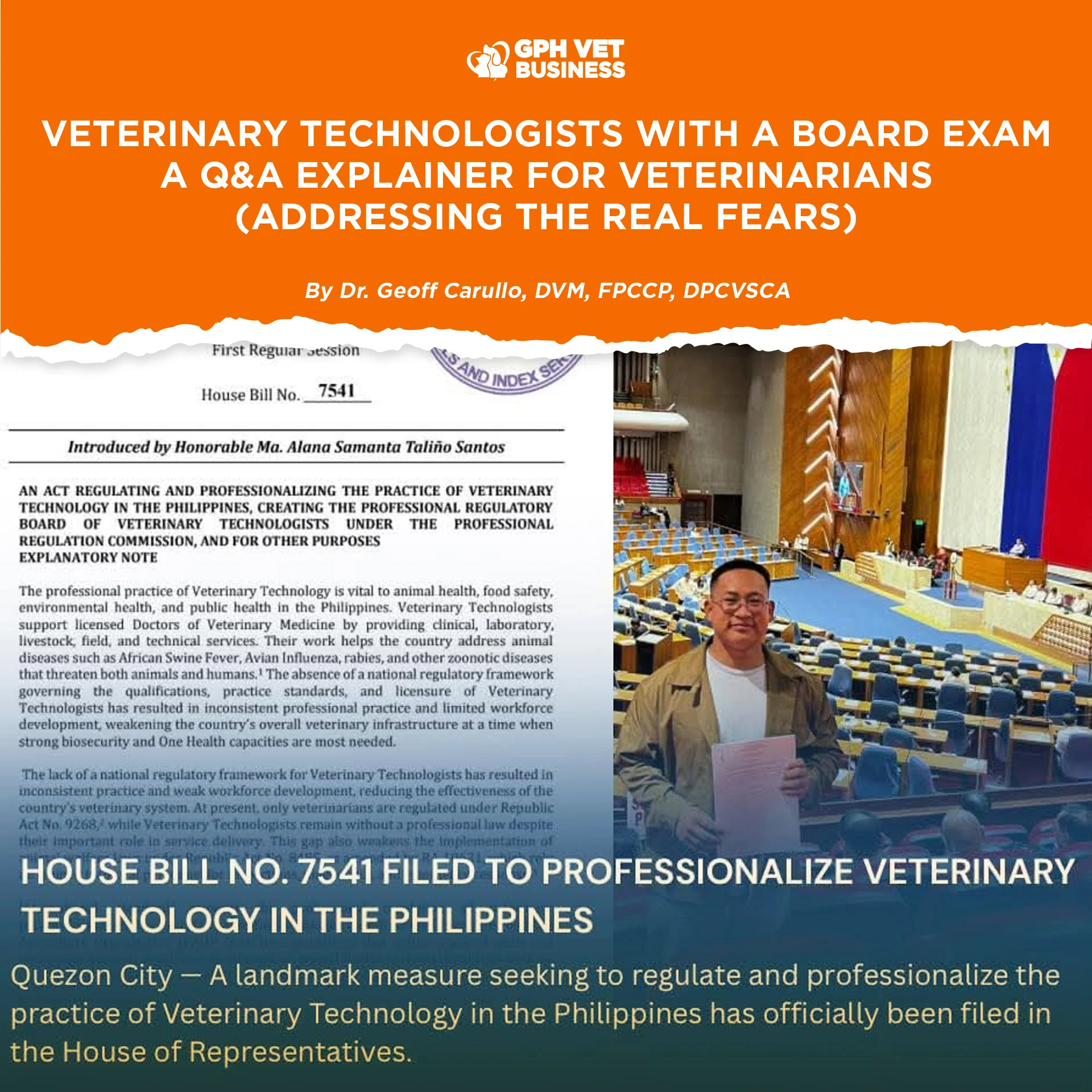
The filing of House Bill No. 7541 has sparked intense discussion within the veterinary community. Beyond the headlines, many veterinarians are asking the same hard questions — about authority, scope, liability, and the future of practice.
Read: HOUSE BILL NO. 7541 FILED TO PROFESSIONALIZE VETERINARY TECHNOLOGY IN THE PHILIPPINES
Let’s address them directly.
Q1: Will licensed Veterinary Technologists replace veterinarians?
No.
Licensure does not grant the authority to:
- Diagnose
- Prescribe
- Decide treatment plans
- Perform acts of veterinary medicine
Veterinarians remain the sole holders of medical authority. Regulation formalizes assistance — it does not create parallel doctors.
Q2: Won’t this blur the line between veterinarians and Veterinary Technologists?
No — the line is blurred now, precisely because there is no regulation.
Unregulated systems allow:
- Informal diagnosing
- Staff-led medical explanations
- Veterinarians absorbing blame for acts they didn’t perform
Regulation draws boundaries in law, not assumptions.
Q3: Can Veterinary Technologists give vaccinations?
Not independently.
Vaccination is a medical act, not a mechanical one. It requires:
- Clinical assessment
- Vaccine selection
- Risk evaluation
- Informed consent
What Veterinary Technologists may be allowed to do (subject to future IRRs):
- Prepare vaccines
- Administer injections only under direct veterinary supervision and explicit delegation
What they cannot do:
- Decide vaccination protocols
- Recommend vaccines
- Offer or advertise vaccination services independently
Medical responsibility always stays with the veterinarian.
Q4: Can Veterinary Technologists perform surgery?
Absolutely not.
Surgery is a core act of veterinary medicine.
Veterinary Technologists:
- Cannot perform surgical procedures
- Cannot decide surgical plans
- Cannot operate independently
They may assist through:
- Patient preparation
- Instrument handling
- Monitoring under veterinary direction
- Post-operative nursing care
Assistance is not authority.
Q5: What if they pass a board exam — doesn’t that change things?
No.
A board exam:
- Regulates competence
- Defines scope
- Creates accountability
It does not confer:
- Diagnostic authority
- Prescriptive authority
- Surgical authority
Licensure is not doctorhood.
Q6: Will this increase my legal risk as a veterinarian?
In practice, it reduces risk.
With regulation:
- Veterinary Technologists answer to their own board
- Scope violations are punishable
- Delegation becomes defensible
Today, veterinarians absorb nearly all liability. Regulation distributes accountability more fairly.
Q7: Will clinics become harder or more expensive to run?
Short-term adjustments are real:
- Protocol updates
- Documentation
- Structured supervision
Long-term benefits include:
- Better efficiency
- Reduced errors
- Less burnout
- Clearer team roles
Competent assistance frees veterinarians to practice medicine properly.
Q8: Are veterinarians losing authority?
No — we are shedding unrealistic expectations.
Authority comes from:
- Medical judgment
- Ethical leadership
- Final responsibility
Regulation allows veterinarians to lead, not micromanage.
Q9: What if Veterinary Technologists overstep their scope?
That fear exists because there is no board today.
With regulation:
- Overstepping becomes a violation
- Complaints no longer default to the veterinarian
- There are real consequences for abuse
Unregulated professions overreach.
Regulated ones are constrained by law.
Q10: Why does this feel threatening to some veterinarians?
Because for decades, veterinarians carried:
- All responsibility
- All risk
- All blame
Structure can feel like loss — until it becomes support.
Final Thought
This bill does not weaken veterinarians.
It strengthens the ecosystem around them.
A regulated Veterinary Technologist:
- Does not vaccinate independently
- Does not perform surgery
- Does not replace the veterinarian
What it creates is clarity, safety, and accountability — for everyone.
A Fellow and the current President of the Philippine College of Canine Practitioners, Dr. Geoff Carullo continues to contribute to the advancement of canine and feline practice through leadership, education, and professional dialogue.
Sharing this helps others understand what it really means to be a vet. Like and follow if you’re with us.