In practice, almost every fetal loss gets casually labeled as “stillbirth.”
Clinically, that is wrong — and sometimes dangerous.
Fetal death is not a single condition.
It is a spectrum, and each form has different implications for diagnosis, prognosis, timing, and intervention.
This article lays out all recognized forms of fetal death in veterinary medicine — clearly, correctly, and clinically.
1. Stillbirth
Definition
A stillbirth is a fully developed fetus that dies:
- Shortly before labor
- During parturition
- Or at the moment of birth
The fetus reaches term but is born lifeless.
Key Clinical & Imaging Features
- Normal fetal size for gestational age
- Normal skeletal posture
- No gas accumulation
- No skeletal collapse
- Appears “normal” on X-ray
📌 The problem is timing, not development.
Common Causes
- Periparturient hypoxia
- Prolonged dystocia
- Umbilical cord compression
- Placental insufficiency
2. Mummified Fetus
Definition
A mummified fetus results from intrauterine death earlier in pregnancy, where:
- The cervix remains closed
- The uterus stays sterile
- Fetal fluids are absorbed
- The fetus dehydrates and shrinks
Radiographic Hallmarks
- Collapsed, overlapping fetal skeleton
- Smaller than littermates
- Sharp, dry bone margins
- Minimal to absent soft tissue shadow
- No gas
📌 This is chronic fetal death, often retained for weeks.
Clinical Importance
- Often causes dystocia
- Frequently prevents normal labor progression
- Common reason for cesarean section
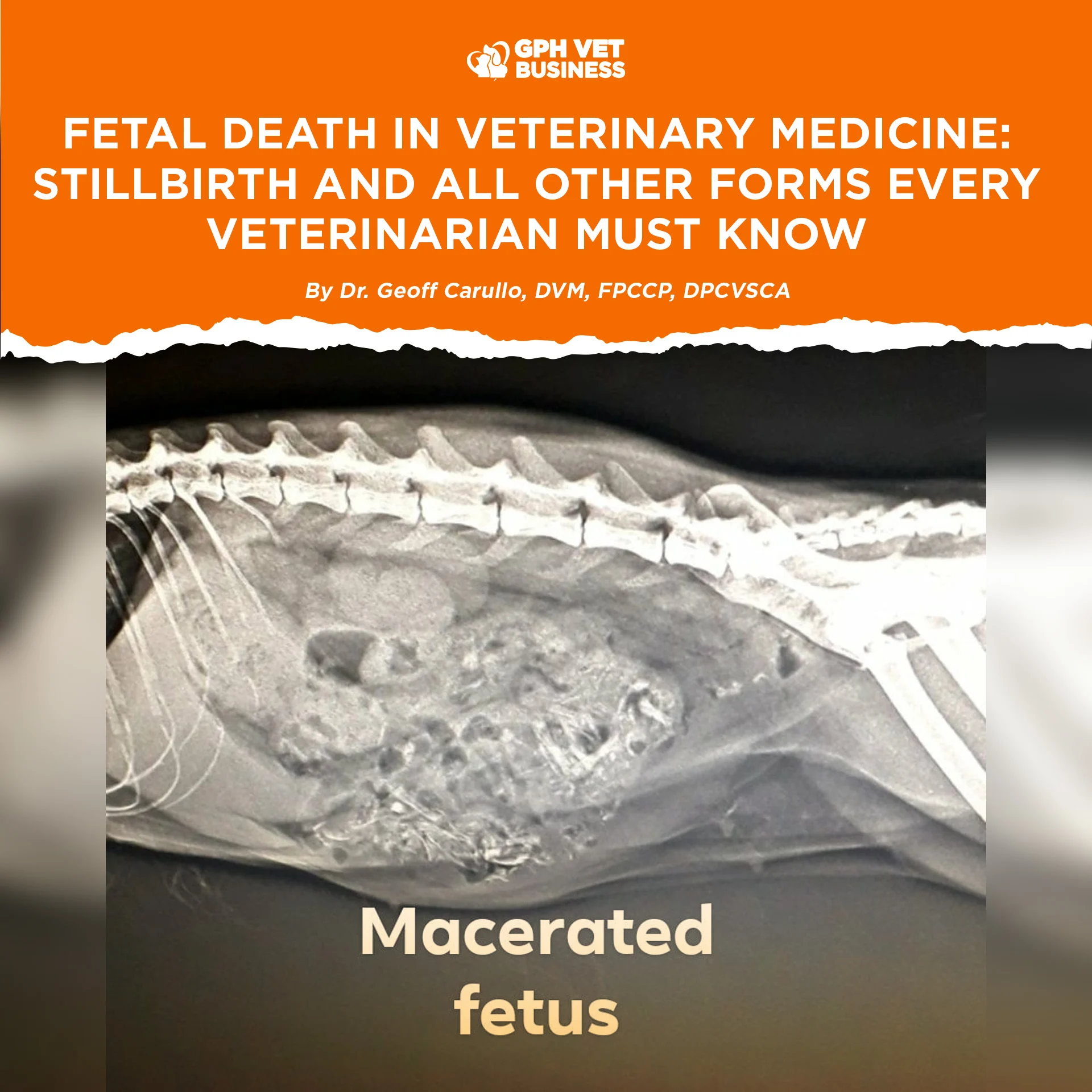
3. Macerated Fetus
Definition
A macerated fetus is a dead fetus that undergoes bacterial decomposition inside the uterus.
This occurs when:
- The cervix opens
- Bacteria enter
- Soft tissues liquefy
Diagnostic Features
- Gas within fetal tissues
- Fragmented or floating bones
- Foul-smelling vaginal discharge
- Systemic illness in the dam
📌 This is a true medical emergency.
4. Fetal Resorption
Definition
Fetal resorption occurs when embryonic death happens before skeletal mineralization.
- Embryo is reabsorbed by the dam
- No fetus visible on X-ray
- Pregnancy appears to “disappear”
When It Happens
- Very early gestation
- Often unnoticed by owners
- Diagnosed retrospectively
📌 Common but frequently overlooked.
5. Abortion
Definition
An abortion is the expulsion of a dead or nonviable fetus before term.
Clinical Presentation
- Vaginal discharge
- Partial or complete litter loss
- Possible systemic illness
Causes
- Infectious disease
- Hormonal insufficiency
- Trauma
- Toxins
📌 May involve multiple fetuses simultaneously.
6. Neonatal Death (NOT Stillbirth)
Definition
Occurs when:
- The neonate is born alive
- Dies within 24–48 hours post-partum
Common Causes
- Hypoxia
- Congenital defects
- Weak neonate syndrome
- Failure of passive transfer
📌 Birth occurred. Life occurred. This is not a stillbirth.
7. Partial Litter Loss
Definition
A condition where:
- One or more fetuses die
- Others remain viable
This can involve:
- Mummification
- Stillbirth
- Abortion within the same litter
📌 Extremely common and often confusing.
Why Terminology Matters in Practice
Mislabeling fetal death as “stillbirth” can:
- Delay surgical decision-making
- Lead to inappropriate medical management
- Increase maternal morbidity
- Create false reassurance for the client
Each condition demands a different response.
Clinical Summary (Mental Framework)
- Stillbirth – late death, intact fetus
- Mummification – early death, dehydration
- Maceration – death + infection + gas
- Resorption – very early death, disappears
- Abortion – expelled before term
- Neonatal death – born alive, dies later
- Partial litter loss – mixed outcomes
Final Clinical Reminder
Fetal death is not one diagnosis.
It is a timeline-dependent pathology.
Recognizing when the fetus died tells you:
- What you are dealing with
- How urgent the case is
- Whether waiting will cost lives
Precision in terminology is not academic.
It is clinical responsibility.
Sharing this helps others understand what it really means to be a vet. Like and follow if you’re with us.