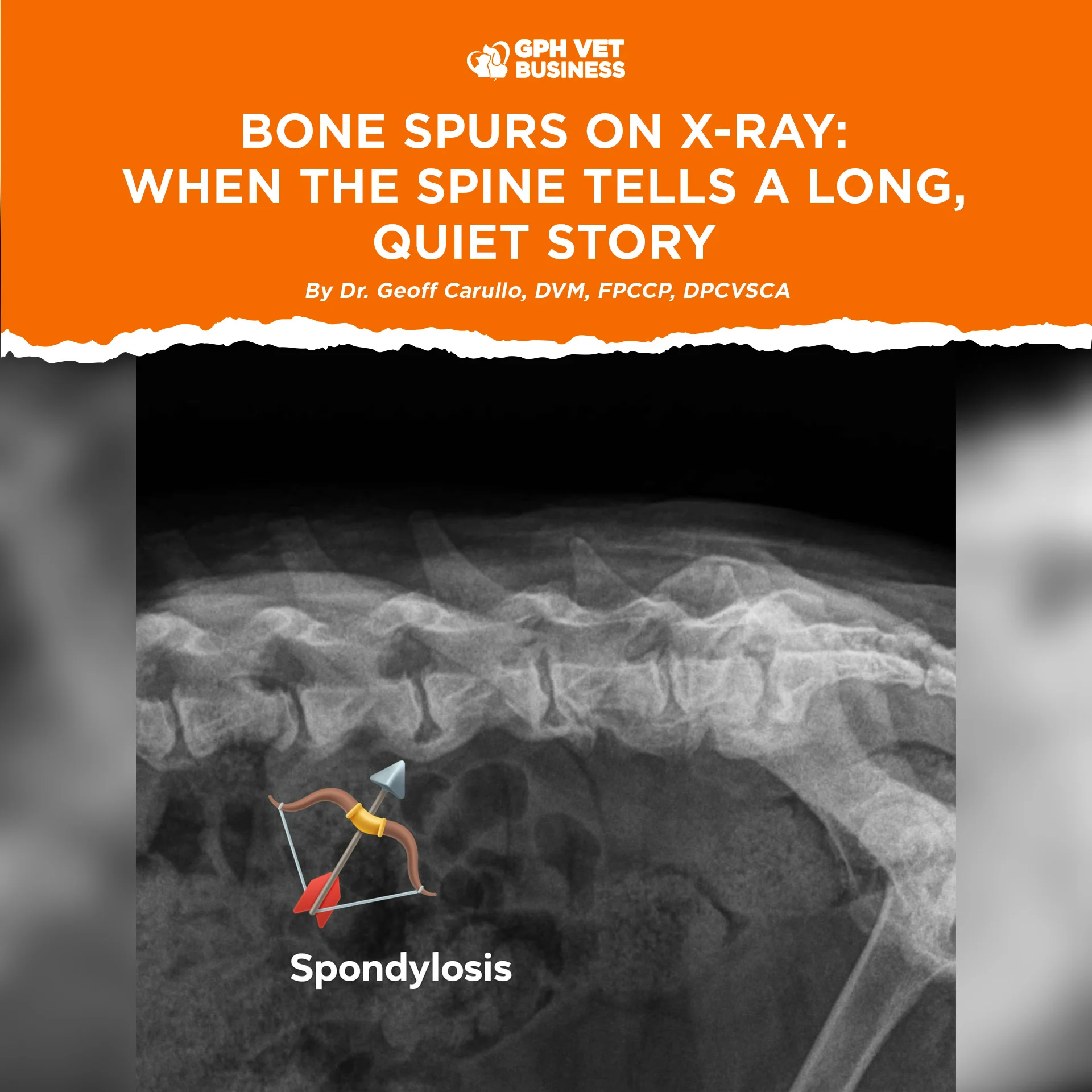
You take a lateral radiograph for a vague complaint. Maybe stiffness. Maybe reluctance to jump.
Then you see it.
Bony projections bridging vertebrae. Rough edges where smooth lines should be.
Clients often panic when they hear the words bone spurs.
Veterinarians should not.
Because in many dogs, these changes are not a sudden disease.
They are the spine’s long-term response to stress, motion, and time.
What Are Bone Spurs in Dogs, Really
In veterinary radiology, what we commonly call bone spurs along the spine are usually spondylosis deformans.
This is a degenerative, non-inflammatory process where new bone forms along the ventral or lateral aspects of vertebral bodies, often adjacent to the intervertebral disc space.
Think of it as the body trying to stabilize a segment that has been moving abnormally for years.
It is adaptation.
Not always pathology.
Why Do Bone Spurs Form
Bone spur formation is driven by chronic mechanical stress.
Common contributors include:
- Intervertebral disc degeneration
- Long-standing spinal instability
- Aging and repetitive microtrauma
- Previous injury or abnormal posture
- Breed and conformation
As discs lose height and elasticity, the spine compensates.
Bone forms to limit motion.
Stability is traded for flexibility.
What You Are Seeing on the Radiograph
Radiographically, bone spurs appear as:
- Smooth to irregular bony projections from vertebral endplates
- Ventral bridging between adjacent vertebrae in advanced cases
- Most common in the thoracolumbar and lumbosacral regions
Early changes may look subtle.
Advanced spondylosis can form complete bony bridges.
Important reminder.
Radiographic severity does not equal pain severity.
Some dogs with dramatic changes are clinically normal.
Others with minimal changes are painful.
Is Spondylosis Always a Problem
No.
And this is where experience matters.
Spondylosis deformans is often:
- An incidental finding
- Slowly progressive
- Clinically silent
It becomes clinically relevant when:
- Associated with spinal pain
- Concurrent with disc disease
- Causing nerve root irritation
- Limiting mobility and quality of life
The X-ray shows history.
The patient shows reality.
Common Clinical Signs When It Matters
When bone spurs are part of a painful syndrome, you may see:
- Stiffness after rest
- Difficulty rising or lying down
- Reluctance to jump or climb stairs
- Altered gait
- Behavioral changes related to chronic pain
This is not an emergency picture.
This is a chronic pain conversation.
What Bone Spurs Are NOT
They are not:
- A cancer diagnosis
- An infection
- Automatically a surgical condition
- A reason to alarm clients
Mislabeling degenerative change as disease erodes trust.
Management Is About the Patient, Not the X-ray
Treatment focuses on:
- Weight management
- Controlled exercise
- Pain modulation when needed
- Joint and spine support strategies
- Client education and expectation setting
There is no need to “treat” bone spurs that are not causing clinical signs.
Treat the dog.
Not the image.
The Bigger Lesson for Veterinarians
Bone spurs remind us of an important truth.
Radiographs show what has happened.
Patients tell us what is happening.
Our role is to connect those two stories with clarity, calm, and clinical judgment.
Not every finding needs fixing.
But every finding needs understanding.
Sharing this helps others understand what it really means to be a vet. Like and follow if you’re with us.