This question keeps resurfacing in the Philippine veterinary community, and it deserves a clear, local answer.
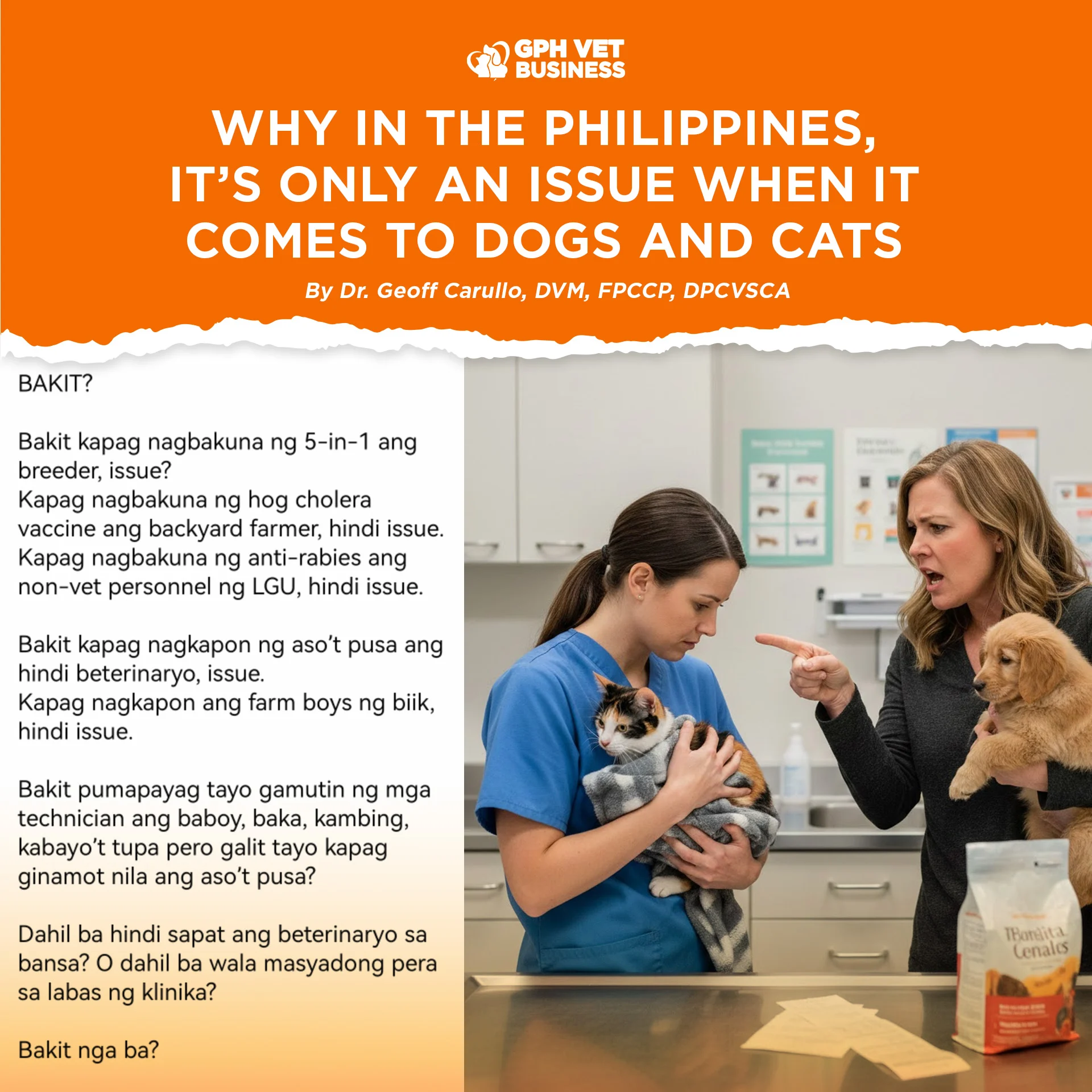
Why is it an issue when a breeder administers a 5-in-1 vaccine to puppies,
but not an issue when a backyard farmer vaccinates pigs against hog cholera?
Why is it acceptable when LGU personnel who are not veterinarians administer anti-rabies vaccines,
but controversial when non-veterinarians treat dogs and cats?
Why can technicians and farm workers inject and medicate pigs, cattle, goats, horses, and buffaloes,
yet doing the same for dogs and cats becomes a professional issue?
So what is really happening — in the Philippines?
THE DIRECT ANSWER
This is not about skill.
This is not about competence.
And this is not because the Philippines lacks veterinarians.
This is about PHILIPPINE LAW, RISK, AND ACCOUNTABILITY.
1. IN THE PHILIPPINES, FOOD ANIMALS AND PETS ARE REGULATED DIFFERENTLY
Under Philippine practice and regulation, livestock and poultry operate within animal production systems:
- Population-based treatment
- Standardized vaccination programs
- Delegated tasks allowed to trained technicians and farm personnel
- Institutional responsibility (farms, integrators, LGUs)
This is why in the Philippines:
- Backyard farmers vaccinate pigs
- Farm workers inject biologics
- Technicians handle routine treatments in production settings
These activities are accepted and regulated within the livestock framework.
2. DOGS AND CATS IN THE PHILIPPINES ARE NOT PRODUCTION ANIMALS
Dogs and cats in the Philippines are treated as individual patients, not production units.
Companion animal practice involves:
- Individual diagnosis
- Case-by-case medical decisions
- Emotional attachment of owners
- High likelihood of complaints, legal action, or public escalation
When something goes wrong in a pig:
It is considered an economic loss
When something goes wrong in a dog or cat:
- The owner demands accountability
- Complaints reach clinics, LGUs, PRC, or social media
And in the Philippines, the licensed veterinarian is the first person held responsible.
3. ANTI-RABIES VACCINATION IS A PHILIPPINE-SPECIFIC EXCEPTION (Rabisin by Boehringer Ingelheim)
Anti-rabies vaccination by non-veterinarians is allowed in the Philippines because:
- Rabies is a public health concern
- There is a national anti-rabies program
- LGUs are legally mandated to implement mass vaccination
- Implementers are given legal protection
This exception:
- Applies only to anti-rabies vaccination
- Does not extend to general treatment
- Does not authorize veterinary medical practice
In Philippine law and practice, anti-rabies is the exception, not the rule.
4. THE CORE ISSUE IN THE PHILIPPINES: MEDICAL DECISION-MAKING AND LIABILITY
Vaccination and treatment in dogs and cats are not merely injections.
They involve:
- Clinical assessment
- Identifying contraindications
- Differentiating diseases
- Managing adverse reactions
- Explaining outcomes to owners
- Defending decisions when complaints arise
When non-veterinarians perform these acts,
they carry no professional license to lose.
When problems occur,
the licensed veterinarian is still the one questioned.
5. THIS IS NOT ABOUT MONEY OR CLINIC PROFITS
This is not about:
- Protecting income
- Limiting access
- Professional gatekeeping
If it were, veterinarians would oppose non-vet involvement in all animal sectors.
They do not.
The line is drawn where risk, legal exposure, and personal accountability converge — and in the Philippines, that line is companion animal practice.
THE PHILIPPINE REALITY
- Livestock medicine operates under system-based accountability
- Companion animal medicine carries personal legal risk
- Complaints and investigations target licensed veterinarians
- Professional licenses are directly at stake
That is why, in the Philippines, it becomes an issue when it involves dogs and cats.
Not because of ego.
Not because of money.
Not because of insecurity.
But because when things go wrong, someone must be legally accountable — and that someone is the veterinarian.
Sharing this helps others understand what it really means to be a vet. Like and follow if you’re with us.