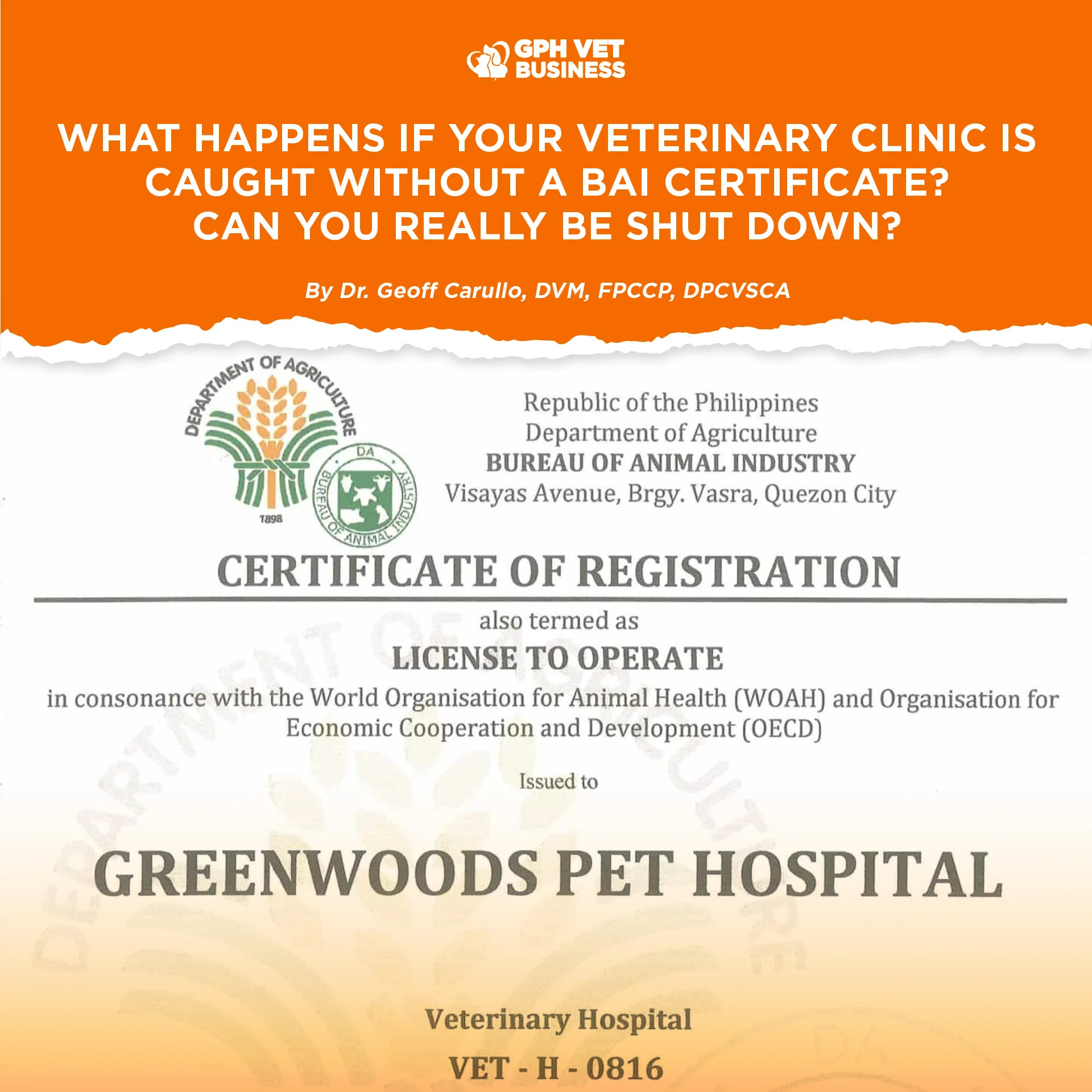
What Happens If Your Veterinary Clinic Is Caught Without a BAI Certificate?
Can You Really Be Shut Down?
By Dr. Geoff Carullo, DVM, FPCCP, DPCVSCA
For many veterinary clinics, the Bureau of Animal Industry (BAI) certificate is often misunderstood, delayed, or unfortunately ignored. Some think it is optional. Others assume it only matters during renewal season. The hard truth is this: operating without a valid BAI certificate carries real legal consequences, and yes, closure is a legitimate outcome.
What Is the BAI Certificate and Why It Matters
The BAI certificate (often referred to as the License to Operate or registration with BAI) is the national government’s confirmation that your veterinary clinic complies with animal health, biosecurity, and regulatory standards under Philippine law.
It is not just a piece of paper. It is proof that:
- Your clinic is legally recognized as an animal health facility
- Your operations comply with national veterinary and public health laws
- You are authorized to provide veterinary services to the public
Without it, your clinic is technically operating outside the regulatory framework.
What Happens If You Are Caught Without One?
If authorities discover that your clinic is operating without a valid BAI certificate, several things can happen, depending on the situation and the enforcing agency.
- Issuance of a Notice of Violation
Most cases start with a formal notice. You may be asked to explain why you are operating without registration and given a deadline to comply. - Fines and Administrative Penalties
BAI and local government units (LGUs) can impose fines or penalties, especially if the clinic has been operating for a long time without registration. - Suspension of Operations
If the violation is considered serious or prolonged, authorities may order a temporary suspension until compliance is achieved. - Closure of the Clinic
Yes, closure is legally possible.
If a clinic continues operating despite warnings, or if it refuses or fails to comply, LGUs, often in coordination with BAI, can issue a closure order.
Who Can Shut You Down?
This is important to understand.
- BAI has regulatory authority over animal health facilities
- LGUs (City or Municipal Government) enforce business permits and health regulations
- Joint enforcement is common
In many cases, BAI identifies the violation and the LGU enforces closure through the business permit system.
So even if your mayor’s permit is valid, operating without mandatory national requirements can still put you at risk.
Common Misconceptions Among Vets
Let’s address some dangerous assumptions:
- “Licensed vet naman ako.”
A PRC license allows you to practice as a veterinarian, not to operate a clinic. - “Wala pa naman humuhuli.”
Enforcement is often complaint-driven or inspection-based. Absence of inspection does not mean compliance. - “Matagal lang mag-process.”
Delays do not exempt you from the requirement. Operating while waiting for approval without proper documentation is still risky.
Why This Is Bigger Than Compliance
Operating without a BAI certificate does not only expose you to legal trouble. It also affects:
- Professional credibility
- Insurance coverage
- Legal defense in case of complaints
- Your clinic’s reputation in the community
In the worst cases, it can be used against you if a client files a complaint or lawsuit.
The Bottom Line
Yes, it is legitimate for a veterinary clinic to be closed if it operates without a BAI certificate.
This is not about harassment or targeting veterinarians. It is about regulation, public trust, and professional accountability. As veterinarians, we demand respect for our profession. That respect starts with compliance to the laws that govern it.
𝗦𝗵𝗮𝗿𝗶𝗻𝗴 𝘁𝗵𝗶𝘀 𝗵𝗲𝗹𝗽𝘀 𝗼𝘁𝗵𝗲𝗿𝘀 𝘂𝗻𝗱𝗲𝗿𝘀𝘁𝗮𝗻𝗱 𝘄𝗵𝗮𝘁 𝗶𝘁 𝗿𝗲𝗮𝗹𝗹𝘆 𝗺𝗲𝗮𝗻𝘀 𝘁𝗼 𝗯𝗲 𝗮 𝘃𝗲𝘁. 𝗟𝗶𝗸𝗲 𝗮𝗻𝗱 𝗳𝗼𝗹𝗹𝗼𝘄 𝗶𝗳 𝘆𝗼𝘂’𝗿𝗲 𝘄𝗶𝘁𝗵 𝘂𝘀.