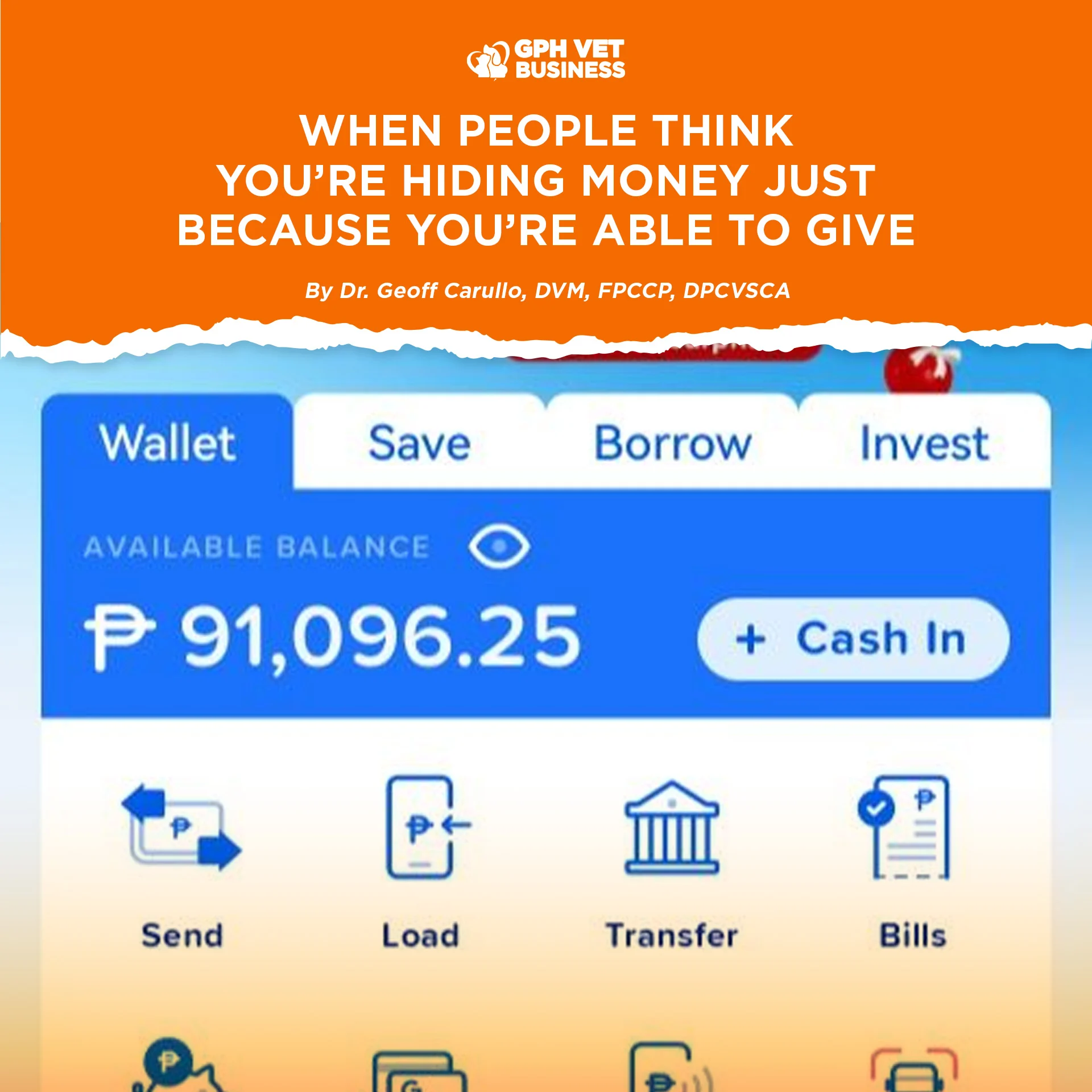
Sometimes you look at your phone and wonder:
Why did GCash have to exist?
Not because it is bad.
In many ways, it truly helped.
You can support faster, send help immediately, be there for people who genuinely need assistance.
But when sending money became easier…
access to you also became unlimited.
Anyone can message.
Anyone can ask.
Anyone can test how soft your heart really is.
And here’s the painful truth:
It’s not that you don’t have money.
You do.
But that money was built through sleepless nights,
risks that almost crushed you,
quiet breakdowns nobody ever saw,
and responsibilities that never seem to leave.
It came from years of choosing work over comfort,
service over rest,
others over yourself.
What hurts is not the asking.
What hurts is the assumption.
That because you can help,
you must always help.
That because you look “okay,”
you must have no limits.
That when you hesitate,
you must be hiding something.
Sometimes the unspoken judgment feels loud:
“Meron ka naman. Ayaw mo lang ibigay.”
They don’t see the bills lined up quietly.
They don’t see the people you already support.
They don’t see the moments you silently pray:
“Lord, sana kayanin pa.”
They only see the transfer.
They only see what leaves your account.
They never see what it costs your heart.
And then comes something even more painful…
There are times you feel forced to lie.
Not because you are selfish.
Not because you don’t care.
But because if you simply say:
“I can’t give right now,”
it will not be accepted.
So reasons get invented.
“May babayaran pa kasi.”
“Nauna na yung iba.”
“Short lang talaga ngayon.”
Even when the truth is simple:
You are just trying to protect your peace.
And it hurts.
It hurts to have to explain.
It hurts to justify every peso.
It hurts that saying “no” needs a story.
Because without explanation, suddenly you become:
“Madamot.”
“Nakaluwag luwag lang, nagbago.”
“Hindi na marunong tumulong.”
What people don’t realize is this:
It isn’t the wallet being protected.
It is the mind.
The boundaries.
The heart.
And every excuse leaves a bruise inside.
Not because of greed —
but because you’re tired of defending yourself
for refusing to be abused.
There is a quiet loneliness in being “the one who has.”
People come when they need.
They disappear when they’re okay.
And the moment you finally get tired, the verdict arrives:
“Nag-iba ka na.”
But slowly, painfully, there is something important to learn:
You are allowed to have boundaries
even if you can afford to give.
You are allowed to protect your peace
even if your account is not empty.
You are allowed to say:
“I love you,
but I cannot carry everyone.”
Generosity should be love,
not pressure.
Giving should be chosen,
not demanded.
No one should come to you
because they think you are their walking ATM.
People should come to you
because you still matter
even when you give nothing at all.
And if someone only sees your money
and never your heart…
they never truly saw you.
Protecting what you worked for is not greed.
Sometimes, it is survival.
And the pain of that truth runs deeper than most people will ever know.
If this spoke to you, don’t just scroll.
Share it in your own way — someone out there needs to understand this.