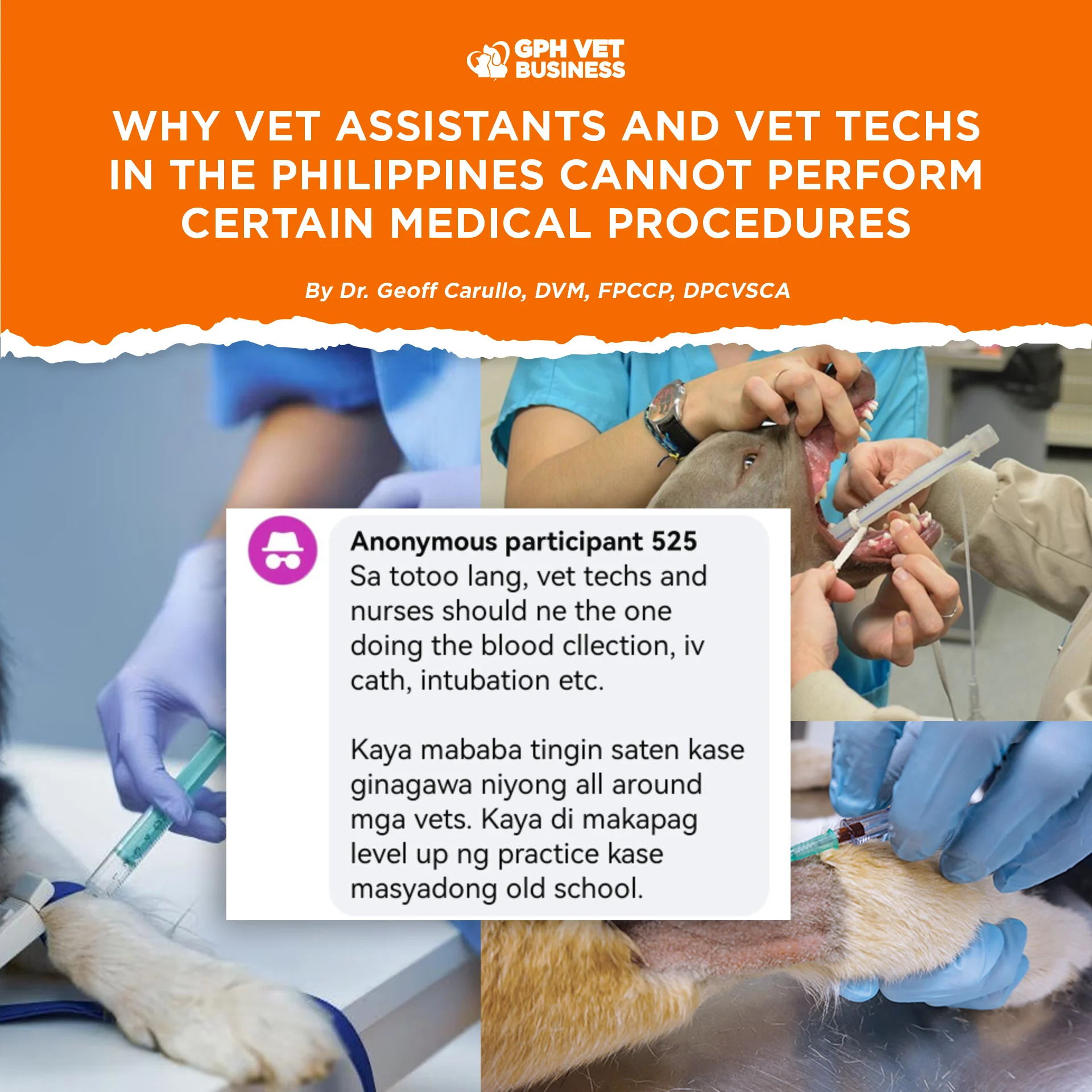
Let’s be honest.
May point ang sinasabi ng ibang tao about delegation.
In an ideal setup, trained veterinary nurses and vet techs should really be able to handle many technical procedures like:
- blood extraction
- IV catheters
- anesthesia monitoring
- intubation
so the veterinarian can focus more on diagnosis, medical decisions, surgery, and critical thinking.
That is how many advanced veterinary systems abroad are structured.
But it also isn’t fair to simply say:
“Old school ang mga vets sa Pilipinas.”
Because context matters.
There are clinics with:
- limited staff,
- no formally trained techs,
- emergencies happening every hour,
- or assistants who are still learning.
In those situations, it is actually safer that the veterinarian performs the procedure.
And here’s the bigger reality:
- In the Philippines, only a couple of schools currently offer vet tech courses.
- There is no national licensing system for veterinary technicians.
Which means training quality varies widely.
You cannot automatically assume every tech or assistant is ready to perform invasive, risky, or anesthesia-related procedures.
Delegation only works when the system is strong:
training, supervision, accountability, and law.
Not simply because, “dapat ganito.”
And that brings us to the heart of the issue.
-
In the Philippines, only licensed veterinarians are legally accountable
Procedures such as:
- blood collection
- IV catheter placement
- anesthesia administration and monitoring
- intubation
- interpreting diagnostics
- surgery
are classified as acts of veterinary medicine.
And acts of veterinary medicine are legally tied to:
- DVM graduates
- PRC board-passers
- licensed veterinarians
If complications happen, it is the veterinarian — not the assistant — who must answer to:
- the owner
- the PRC
- possibly the courts
You cannot assign legal responsibility to someone the State did not authorize.
-
Most vet assistants and “vet techs” here did not undergo standardized veterinary education
Abroad (US, UK, Canada, Australia):
Veterinary nurses/technicians:
- study in accredited universities
- follow structured medical curricula
- complete hospital training
- pass a licensure exam
- are regulated by councils
- must continue education regularly
They study subjects like:
- anesthesia and analgesia
- pharmacology
- physiology and pathology
- emergency medicine
- radiology safety
- sterile technique
- veterinary ethics and law
Meanwhile in the Philippines, most assistants:
- ✘ learn mainly on-the-job
- ✘ have no unified curriculum
- ✘ have no licensure exam
- ✘ are not professionally regulated
- ✘ have highly variable training quality
Some become very skilled through experience — and we respect that.
But experience is not the same as licensed, nationally recognized medical authority.
-
Abroad, vet techs have more responsibility — because they are licensed
Abroad (example: USA)
Veterinary technician = similar to a licensed nurse.
They may:
- place IV lines
- monitor anesthesia
- intubate (in some states, with supervision)
- collect samples
- triage patients
But they cannot:
- ✘ diagnose
- ✘ prescribe
- ✘ perform surgery
And if they make major mistakes, their license is at risk.
In the Philippines
“Vet tech” or assistant:
not recognized legally as an independent profession
no official scope of practice
no licensure body
no regulatory protection
So many tasks remain primarily with veterinarians.
Not because vets want to control everything —
but because our system is not yet built to delegate safely.
-
Patient safety always comes first
What looks simple can go wrong very fast.
Blood collection risks:
- vein collapse
- hematoma
- infection
- wrong labeling/handling
- Intubation risks:
- torn trachea
- aspiration
- lack of oxygen
- cardiac arrest
When something goes wrong, the question becomes:
“Sino ang mananagot?”
Legally.
Ethically.
Professionally.
The answer must always be the veterinarian.
-
We CAN move forward — but properly
If we want delegation to look like the systems abroad, then we must:
- develop accredited veterinary tech/nursing programs
- standardize curriculum across schools
- include anesthesia, emergency care, law, and ethics
- create a national licensure exam
- define legal scope of practice
- regulate the profession properly
- mandate supervision structures
We cannot skip steps.
You don’t copy the last chapter without building the foundation first.
Final thought
Vet assistants and future vet techs are important.
They carry huge responsibility and support the clinic in countless ways.
But being “progressive” is not measured by who inserts the catheter.
Progress is measured by:
- patient safety
- proper training
- clear roles
- legal accountability
- teamwork
Until the Philippine system is ready:
Delegating invasive procedures is not “old school.”
It is protecting the patient, the veterinarian, and the profession.
Sharing this helps others understand what it really means to be a vet. Like and follow if you’re with us.